
Bag Tech Pack Revisions: Control Sample Changes and Approvals
Control bag tech pack revisions with measured feedback, component impact reviews, a change log and one approved production specification.
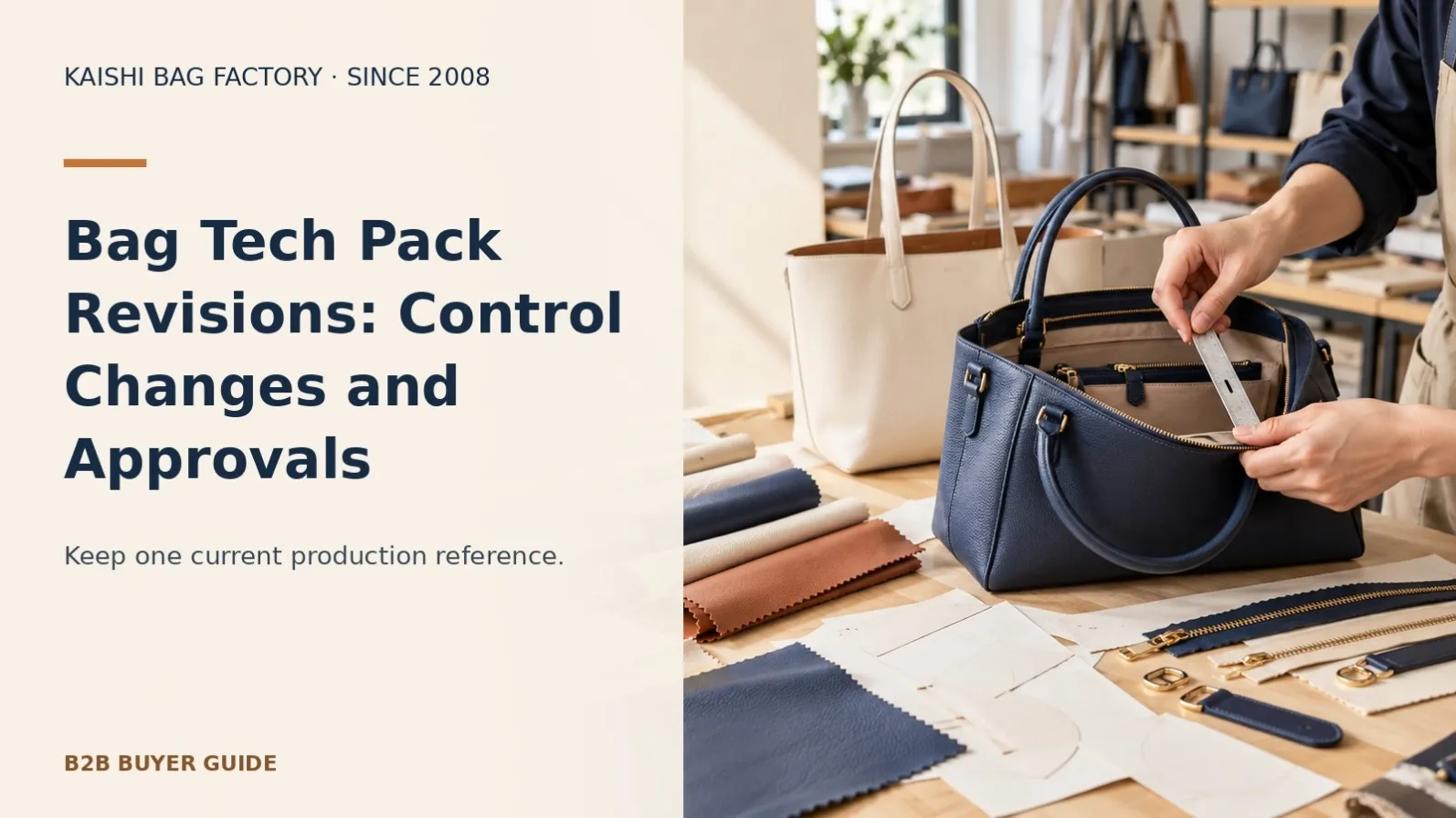
Control bag tech pack revisions by giving every sample and specification a version reference, recording each requested change, assessing its effects, and releasing one approved production package. A drawing, chat message and physical sample should not describe conflicting versions of the bag. Clear revision control helps the buyer and supplier agree what is actually authorized.
This checklist focuses on updating technical information during sampling and before production. It is distinct from an initial quotation brief: once development begins, the main task is to track decisions, resolve exceptions and make sure the next sample reflects the right instructions.
Establish a starting specification and sample reference
Identify the style, specification revision, date and owner. Link the drawings, component list, colour references, branding artwork and packing requirements to that version. Assign a separate reference to each physical sample and note which specification it was intended to follow.
Record anything that differs from the proposed final product. Temporary zipper tape, substitute lining or unfinished branding should appear in an exception list, not remain an unwritten assumption. A sample may be suitable for reviewing proportions while still being unsuitable for final material approval.
ISO's public overview of ISO 10007 describes configuration-management guidance across a product's life cycle. The workflow below applies that general idea to purchasing records; it is a practical checklist, not a claim that Kaishi or the buyer is certified to the standard.
Turn feedback into measurable change requests
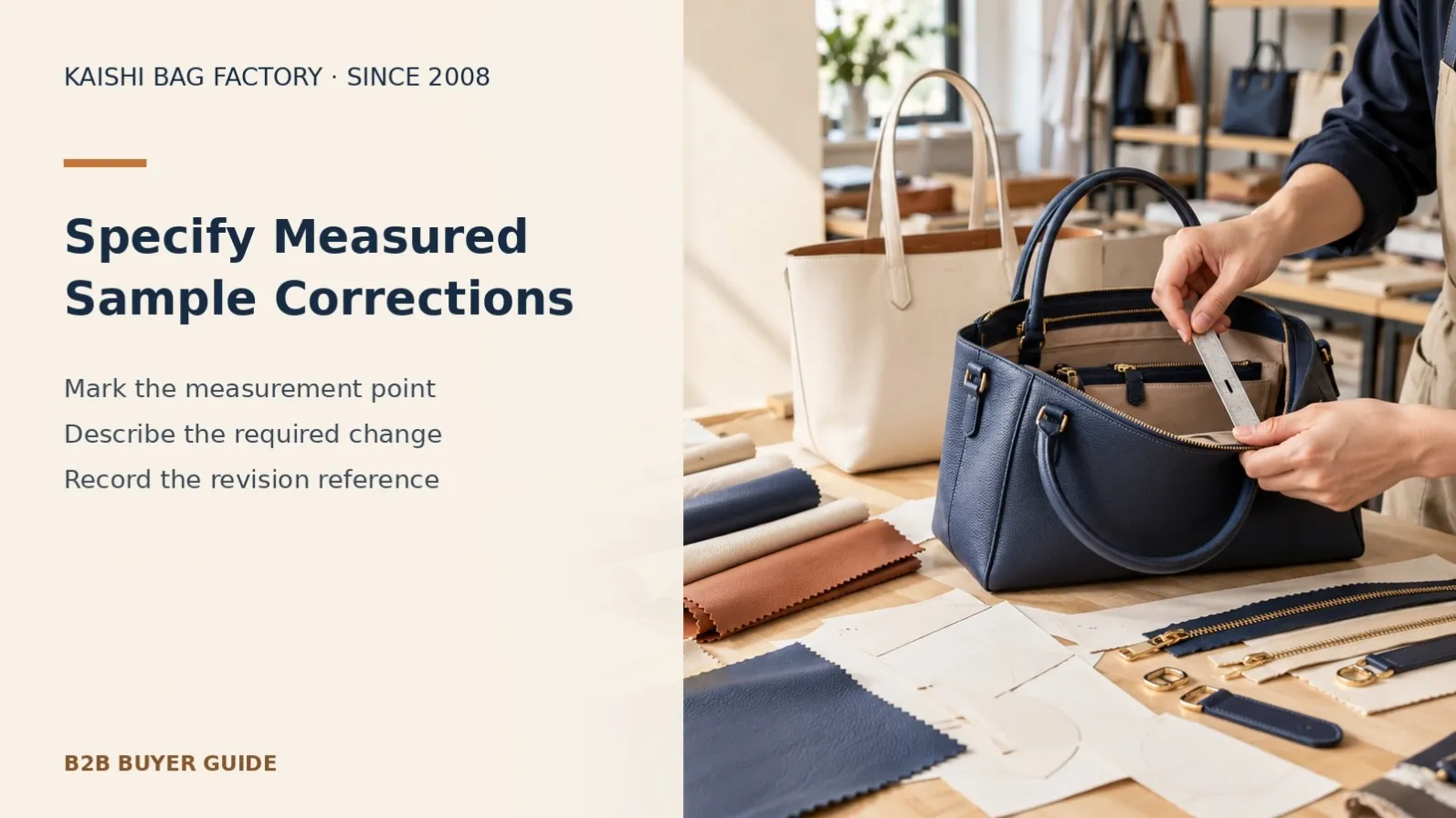
Replace comments such as make it more premium with a concrete observation and required decision. Describe the affected component, the current condition and the proposed change. Use annotated photographs or drawings with the relevant sample reference.
For measurements, define the point being measured, the bag's condition and the unit. A handle drop measured with the bag empty may differ from a loaded carrying condition. Agree the method and tolerance for the feature rather than imposing a generic tolerance on every soft or structured bag.
Separate a correction against the current specification from a new design request. Correcting a misplaced pocket and adding an extra pocket are different tasks. That distinction helps the supplier evaluate cost, materials and sample work without confusing quality corrections with scope expansion.
Use one change log for the project
Collect feedback from the designer, sourcing team and commercial reviewer into one agreed log. Resolve conflicting comments before sending it to the supplier. If two reviewers request different opening sizes, the factory should not have to choose which instruction is authoritative.
| Field | What to record | Why it matters |
|---|---|---|
| Change reference | Unique change ID and relevant style/sample version | Connects feedback to the correct product |
| Affected feature | Drawing location or component code | Avoids ambiguous implementation |
| Requested action | Current condition and intended revision | Separates correction from new scope |
| Impact review | Material, construction, cost and timing effects | Prevents an isolated change from creating another issue |
| Approval owner | Person authorized to decide | Resolves conflicting instructions |
| Verification | Next sample/check and final status | Shows whether the change was implemented and accepted |
Use clear statuses such as proposed, awaiting impact review, approved for next sample, verified or rejected. Approval for a sample revision is not automatically approval for bulk production. Make that distinction visible in the record.
Check the effects of component changes
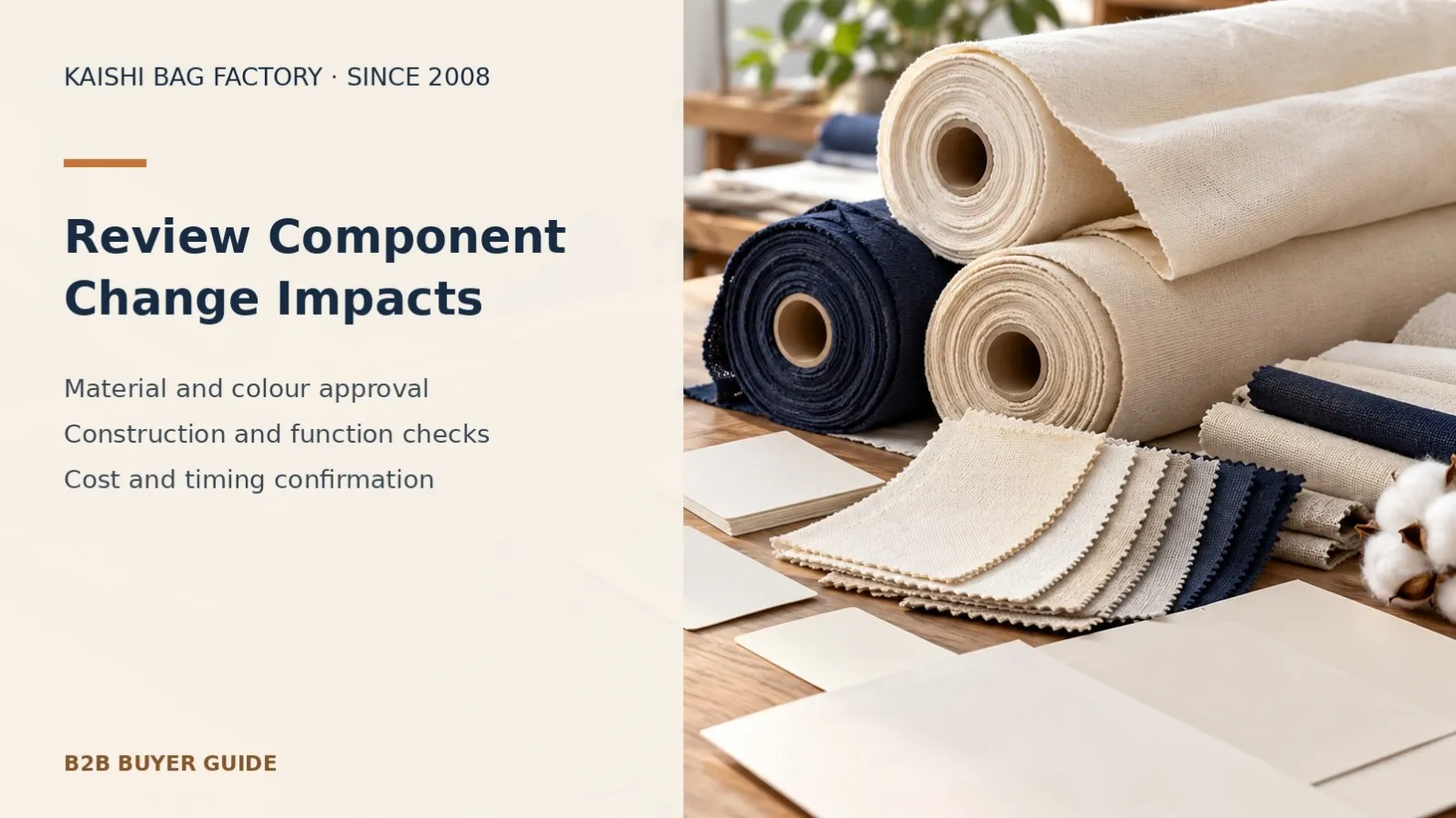
A material substitution can affect more than colour. Review hand feel, support, seam behaviour, folding, lining fit, branding and packing where relevant. A thinner-looking sample should not be accepted on appearance alone if structure or function depends on the material.
Record the actual material construction and approved reference. Do not assume a universal canvas weight range, PU thickness or lining code. Ask the supplier to propose and document the relevant specification, then evaluate it against the intended use.
Hardware changes can affect attachment dimensions, clearances and nearby material stress. Ask for updated component references and repeat affected checks. Record whether the change requires new tooling or sourcing, with charges and timing confirmed before authorization.
Update colour and artwork references carefully
Identify the colour system and physical reference, not just an isolated code or screen screenshot. Pantone's support guidance provides a way to obtain physical colour samples. For a bag project, pair any colour code with an agreed physical material approval and viewing method.
Outer material, lining, thread, zipper tape and packaging may use different substrates and processes. State which reference governs each item and how acceptable variation is reviewed. Do not require every component to use the same colour-system suffix without confirming its suitability.
For branding, update authorized artwork, size, placement, orientation and application method together. Identify superseded files clearly. A revised logo file should not quietly change production while the approved sample still carries an older version.
Verify implementation in the next sample
Compare the new sample with the change log, current specification and relevant earlier reference. Mark each requested item as implemented, partly resolved or still open. Photograph the evidence and record measurements or function checks using the agreed methods.
Review interactions between changes. Moving a pocket can affect lining access; changing a closure can affect the opening; revising reinforcement can alter shape or packing. A sample that fixes one comment may introduce another issue, so verification should cover the affected system.
A hypothetical revision might move an internal pocket to improve access while retaining the same outer appearance. The next review should check the new pocket position and the lining's behaviour, rather than approving the bag from an exterior photograph. This is an example, not a Kaishi customer case.
Release a complete approved production package
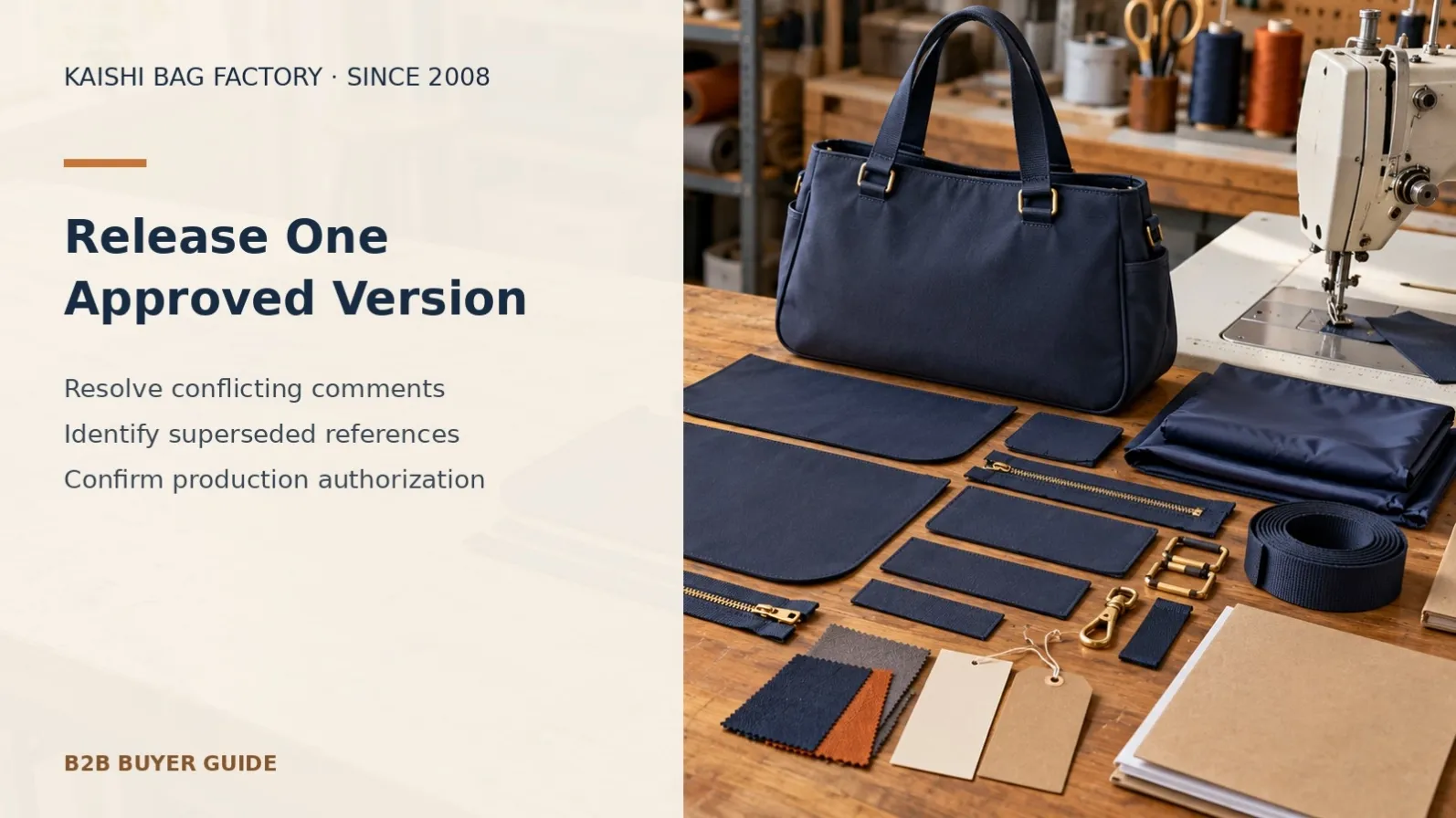
Before bulk authorization, reconcile drawings, component specifications, colour approvals, branding, packing and the final sample record. State which version controls and list any explicit exceptions. Do not leave one department working from an older file because the filename looked similar.
Archive superseded references for traceability and identify them as obsolete for production. Confirm how the supplier communicates the released specification to the relevant work areas. A signed sample supports the decision, but it does not replace written details or production checks.
For changes proposed after release, reopen the impact review. Confirm whether materials have been ordered, patterns changed or production started, and agree any consequences before implementation. There is no automatic promise that a late change can be absorbed without cost or delay.
Confirm the commercial effects before authorizing changes
Kaishi Bag Factory is based in Baigou, China, and has worked in OEM/ODM since 2008. Its usual standard MOQ is 300 pieces per style. A first order of 200 may be assessed individually but is not guaranteed; 100 is generally not feasible. Mixed-order acceptance and lower repeat minimums are not promised.
Samples are paid in advance, with non-refundable fees and no promised automatic bulk credit. Payment is T/T only, usually 50% deposit and 50% before shipment. Confirm revision charges and any changed quotation terms in writing.
Lead times depend on design, materials, sample approval and quantities. A complete revision record can support clearer decisions, but it does not guarantee a fixed number of sample rounds, a one-day construction review or a specific production window.
Frequently asked questions
What should a bag tech pack revision include?
Identify the sample and specification version, affected feature, requested action, impact review, approval owner and verification result.
Can I send changes only through chat?
Chat can support discussion, but consolidate final instructions in an agreed revision record so conflicting or superseded comments are identifiable.
Should corrections and new design requests be separate?
Yes. A correction against an approved requirement and an added feature can have different commercial and development implications.
Can a colour code replace a material swatch?
No. Confirm the actual material appearance and agreed physical reference. Different substrates can present colour differently.
Does approval of a revised sample authorize bulk?
Only if the approval explicitly has that scope and the production package is complete. Approval for the next sample is a separate decision.
What if the supplier proposes substitute hardware?
Document the alternative and review attachment, appearance, function and commercial effects before accepting it.
Can I change the bag after final approval?
Submit a controlled change request and confirm the effect on work already started, cost, timing and required re-approval.
Discuss your current bag revision
Send the latest specification, sample reference, consolidated change log and target quantities. Review our product categories, company information and payment guidance. Contact Kaishi Bag Factory to discuss the project. Email donna@Kaishibagfactory.com or use WhatsApp.
Sources and scope
Sources checked 3 October 2026. The revision workflow is practical purchasing guidance, not a certification or guaranteed reduction in sampling rounds. Images are illustrative generated scenes rather than confirmed Kaishi facility photographs.