Kaishi Bag Factory Frequently Asked Questions
Kaishi buyer FAQs: OEM/ODM, MOQ, paid samples, T/T payment, variable lead times, material documents, quality checks and project enquiries.
Quick answer: Kaishi's confirmed order policies
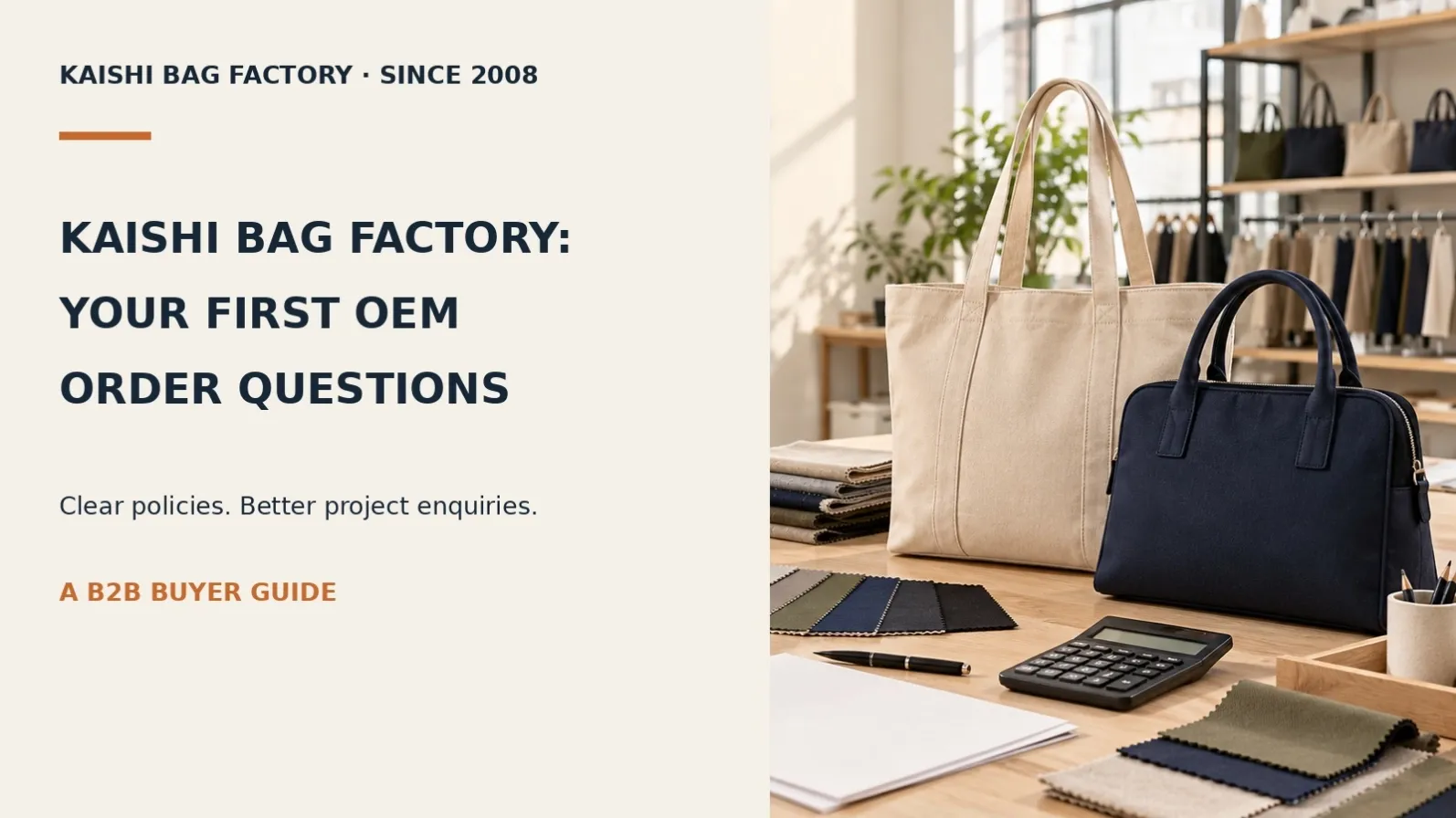
Kaishi Bag Factory is based in Baigou, China and has worked on OEM/ODM bags since 2008. Standard MOQ is usually 300 pieces per style. A 200-piece first order may be assessed individually without a guarantee; 100 pieces is generally not feasible. Payment is T/T only, normally 50% deposit and 50% before shipment. Sampling, production and delivery timing must be confirmed for the actual design, materials, approved sample, quantity and route.
This page gives brand owners, importers and wholesale buyers a clear starting point for an enquiry. It summarizes company policies rather than offering a universal bag-industry specification. Your confirmed quotation and written order should record the agreed product, scope and commercial details. If an older page or message conflicts with these policies, ask Donna to resolve the wording before proceeding.
What information should you prepare?
Start with a clear drawing or reference image, approximate dimensions, intended use, destination market and quantities by style and colour. State the material preference, pockets, closures, straps, logo method and packaging requirements. If a feature is optional, label it as optional so it can be discussed without changing the essential design.
A reference photo is a visual starting point, not a complete manufacturing specification. Identify which features you want to develop and provide artwork you have the right to use. Do not request a third party's logo or present a reference as authorization to reproduce protected branding. You can begin with a concise brief and refine it through the project assessment.
| Enquiry item | Useful detail | Why it matters |
|---|---|---|
| Design | Drawing, dimensions and intended use. | Defines what the sample should demonstrate. |
| Material | Preferred fabric or leather reference, colour and finish. | Allows availability and suitability assessment. |
| Quantity | Pieces for each style and colour. | Avoids an assumed mixed-order minimum. |
| Branding | Artwork, size, placement and label wording. | Sets a measurable approval reference. |
| Market and timing | Destination, intended buyer and target arrival window. | Supports compliance and schedule planning. |
Frequently asked questions for first-time buyers
1. What products and services can I discuss with Kaishi?
You can enquire about women's handbags, canvas tote bags, leather bags and related OEM/ODM projects. Share the intended construction and use so Donna can assess the fit. OEM usually starts from a buyer-defined specification; ODM can involve developing an agreed design direction with the supplier. Neither label removes the need for a clear sample and approval process.
For wholesale stock enquiries, ask for current styles, colour quantities and the applicable order terms. Availability changes; this FAQ does not guarantee stock of every pictured product or a fixed dispatch time. A custom development quotation and a stock enquiry should be treated as distinct requests.
2. What is the minimum order quantity?
The standard MOQ is usually 300 pieces per style. A 200-piece first order may be evaluated for the individual specification, but it is not guaranteed. A 100-piece custom order is generally not feasible. Different styles, materials or colour allocations should not be assumed to qualify as one combined minimum.
Send the complete quantity breakdown before planning your assortment. Using a simpler construction or accepting an alternative component can be discussed, but it does not automatically lower the MOQ. Repeat orders also require confirmation of the current specification and material conditions. See the order-planning guide for the information to prepare.
3. Can I request a sample, and what will it cost?
Sample development can be assessed from your brief. Confirm the design version, materials, branding, included work, revision scope and shipping charges before starting. Samples are paid upfront and the sample fee is non-refundable. Do not assume a free sample or automatic credit against a future bulk order.
Agree whether the sample is a development reference or the final production-intent sample. If temporary materials or components are used, record the substitutions and what remains to be approved. Send consolidated, measurable feedback rather than several conflicting messages from different team members.
4. How long will my order take, and how do I pay?
Timing depends on design, materials, sample confirmation and quantity. Ask for the sampling estimate, production-ready target and logistics estimate separately. A stated factory-ready date is not automatically a warehouse arrival date, and paying a deposit does not remove missing artwork or sample approvals.
Kaishi accepts T/T only. Bulk terms are normally 50% deposit and 50% balance before shipment. PayPal, Western Union and L/C are not accepted standard methods. Confirm the invoice, beneficiary and written milestones before transferring. For practical checks, see the payment guide.
5. Can Kaishi supply certified or special materials?
Tell Donna the precise material, claim or test requirement you need. Availability, sourcing and documentation must be evaluated for the project. This FAQ does not promise every recycled, organic or bio-based material, a universal fabric-weight range, or an unconfirmed factory certification.
Textile Exchange's RCS and GRS use third-party verification and chain-of-custody requirements for recycled materials. A general claim about a fabric does not automatically prove that the finished bag or complete supply chain qualifies for the intended label. Ask what evidence applies to the actual material and order before using a certification claim in your marketing.
6. How should quality issues, documents and shipping be handled?
Agree the specification, sample approval, inspection scope and acceptance criteria before bulk confirmation. There is no blanket “1% defects allowed” warranty in this FAQ. If an issue occurs, provide the order reference, affected quantity and clear photographs or other evidence; the response should follow the agreed order terms and the assessed issue.
Ask which shipment and product records are required for your destination, and which party prepares each one. Routes, freight services, document support and delivery terms must be confirmed for the actual order. Do not assume global door delivery or that the factory can provide every certificate. Your importer or broker should confirm destination requirements.
7. Can I visit the factory or discuss an NDA?
Contact Donna before arranging travel to confirm the visit date, location, access and available meeting arrangements. This page does not promise airport pickup or a particular transfer route. Send your agenda so the appropriate project discussion can be prepared.
For confidential designs, discuss a suitable NDA and information-handling expectations before sharing sensitive files. WIPO identifies confidentiality agreements as one of the reasonable measures businesses can use to protect trade secrets. An NDA's effect depends on its terms and applicable law; it is not an absolute guarantee against every possible disclosure. Share only the information needed for the current stage.
Five checkpoints before bulk confirmation
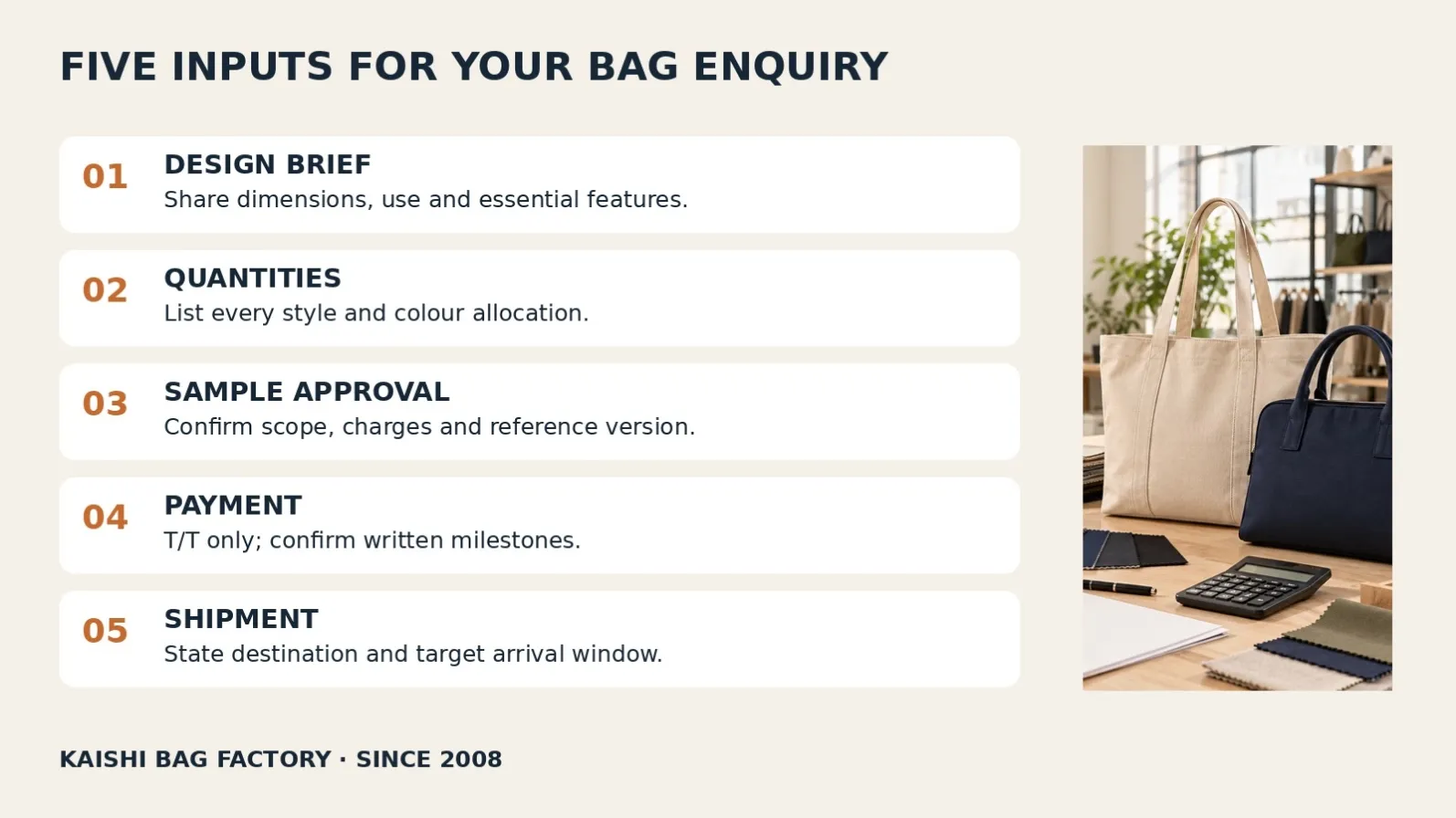
- Approve one specification and identify the sample it references.
- Confirm quantities by style and colour, including any individually assessed exception.
- Record branding, label wording and packing instructions.
- Confirm T/T milestones, invoice details and the project schedule assumptions.
- Agree inspection, shipment responsibilities and destination-document requirements.
Keep a versioned approval record that your design, buying and quality teams can all use. If you change a material, logo, pocket or carton arrangement after approval, ask how the change affects the sample, price and schedule. A new instruction should not silently coexist with an old approval.
What this FAQ does not guarantee
It does not guarantee mixed orders, reduced reorder MOQ, fixed sampling or bulk durations, sample-fee credit, unlimited capacity, a particular certification or zero defects. Performance requirements need a defined method and evidence relevant to the product. ISO explains that management-system certification and product certification are different; a certificate should be checked for its actual scope rather than treated as universal product approval.
For a proposed quote, distinguish an estimate from a confirmed order condition. Ask what information is still missing, what alternatives are being assessed and what needs your approval. This makes the next step clearer for both the buyer and the factory without relying on unsupported sales promises.
Sources and contact
Company policies on this page follow Kaishi's confirmed instructions. External references support the general guidance only: WIPO: Trade Secrets, Textile Exchange: RCS and GRS and ISO: Certification. They are not evidence that Kaishi holds a particular certificate or has approved your project.
Ready to discuss your bag project? Send your design, quantities, material preferences and destination through the Kaishi contact page. Email donna@Kaishibagfactory.com or use WhatsApp. Donna can assess the request and confirm the appropriate next step.