
Bio-Based PU for Bags: 7 Questions to Ask Before You Buy
A B2B buyer checklist for verifying bio-based PU: content basis, backing, performance tests, traceability, MOQ, availability and environmental claims.
Quick answer
Bio-based PU can be a useful bag material, but “bio-based” does not automatically mean biodegradable, compostable, recycled or lower-impact. For B2B sourcing, the safest approach is to verify the percentage of biobased carbon, the coating and backing construction, the exact test method, physical-performance data, traceability documents, MOQ and material availability before approving a sample.
At Kaishi Bag Factory, we evaluate alternative materials project by project. We do not promise that every bio-based, recycled or next-generation material is available. Standard MOQ is usually 300 pieces per style; a 200-piece first order may be reviewed case by case and is not guaranteed. Lead time depends on material sourcing, design complexity, sample approval and order quantity.
Key takeaways for buyers
- Ask for a measurable biobased-content claim, not only the word “eco.”
- Bio-based content and biodegradability are different properties.
- Verify both the PU coating and the textile backing.
- Match certificates and test reports to the exact material and supply chain.
- Confirm abrasion, flex, peel, colorfastness and hydrolysis performance for the intended bag.
- Approve the physical sample before using environmental claims in marketing.
What does bio-based PU mean?
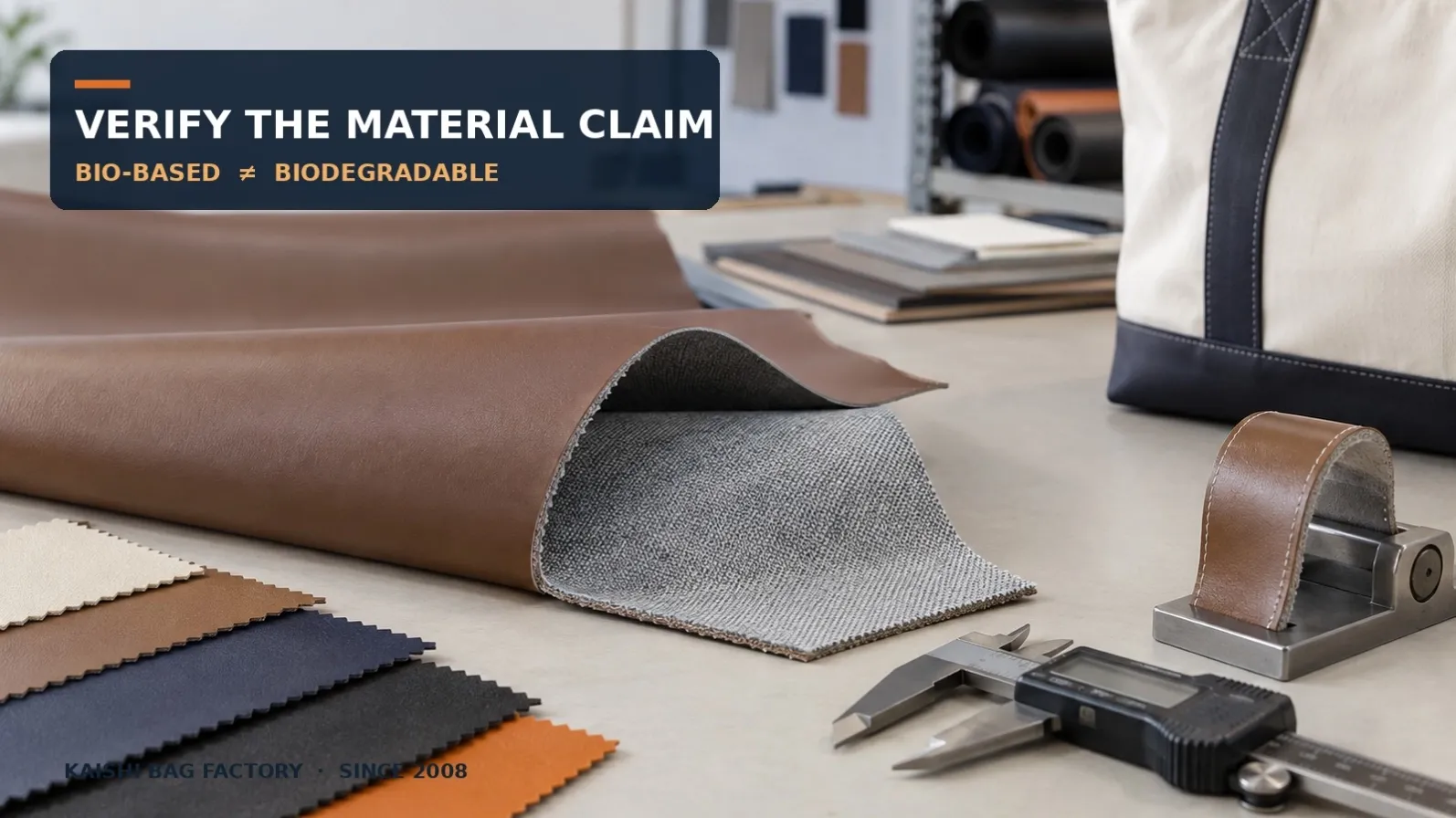
Conventional polyurethane is commonly made with fossil-derived chemical inputs. In a bio-based PU, part of the material’s carbon may come from renewable biological feedstocks. However, suppliers can use different formulations, percentages and calculation methods, so two materials sold under the same label may not be comparable.
The USDA BioPreferred Program defines biobased products as products composed wholly or significantly of biological products or renewable agricultural, marine or forestry materials. It uses ASTM D6866 radiocarbon analysis to quantify biobased content as a percentage of organic carbon. Buyers should therefore ask whether a quoted percentage refers to the coating, the finished coated fabric or another basis.
A bio-based claim also says nothing by itself about how quickly a finished bag will break down. A durable coated fabric may contain renewable carbon and still be designed for long service. Biodegradability or compostability requires a separate, relevant test and clearly stated conditions.
Seven questions to ask before buying bio-based PU
1. What exactly is included in the percentage?
Request the declared biobased percentage and its calculation basis. Ask whether it applies to the PU coating alone, the coated textile, or the complete material. If a supplier cites ASTM D6866, request a report that identifies the tested material and laboratory.
2. What is the complete material construction?
A bag material is a system, not only a surface. Confirm the coating type, backing fiber, backing construction, total thickness or mass, surface finish and any bonding layers. The backing affects tear strength, sewing behavior, shape retention and edge finishing.
3. Is the claim bio-based, recycled, biodegradable or compostable?
These terms answer different questions. Bio-based concerns the origin of some carbon; recycled content concerns recovered input; biodegradable and compostable claims concern breakdown under defined conditions. Avoid combining them in product copy unless each claim has its own evidence.
4. Which performance tests support the application?
For handbags and totes, useful tests may include abrasion, flex resistance, peel strength, tear strength, colorfastness, adhesion and hydrolysis resistance. The correct test method and acceptance level depend on the bag’s construction, market and expected use. A marketing brochure is not a substitute for an application-relevant report.
5. Can the documentation be traced to the exact material?
Check the supplier name, material code, color or finish, test date and scope. For recycled inputs, Textile Exchange explains that the Global Recycled Standard and Recycled Claim Standard support third-party verification and chain of custody. A certificate from an unrelated company or for a different material does not establish your product claim.
6. What are the MOQ, color minimum and current availability?
Alternative materials may carry upstream roll, color or finishing minimums. Ask for the minimum for the exact material and color, not a generic factory MOQ. Also confirm whether the quoted lot is current stock, a repeatable program or a one-time development lot.
7. What happens if the material changes before reorder?
Record the supplier, article number, construction, color standard and approved sample. For a repeat order, recheck availability and test data; previous approval does not guarantee that the same input remains available or unchanged.
Buyer verification table
| Claim or decision | Evidence to request | Why it matters |
|---|---|---|
| Biobased percentage | Material-specific declaration and, where relevant, ASTM D6866 report | Shows what was measured and on which basis |
| Recycled backing | Fiber composition, transaction documentation and relevant chain-of-custody evidence | Connects the claim to the supplied material |
| Durability | Application-relevant physical test results | Reduces the risk of cracking, peeling or color failure |
| Color and finish | Approved swatch, color standard and tolerance | Prevents approval based on a different sample |
| Commercial feasibility | Written MOQ, availability, sample terms and lead-time estimate | Shows whether the material fits the launch plan |
How Kaishi evaluates a material request
- Receive the brief: intended bag type, dimensions, target market, quantity, color, finish and required claims.
- Identify the construction: coating, backing, thickness or mass, texture and suitable reinforcement.
- Check evidence and availability: supplier documents, physical data, color options and upstream minimums.
- Make and review a paid sample: assess appearance, sewing behavior, edge finishing, structure and hardware compatibility.
- Confirm bulk terms: final specification, approved sample, MOQ, T/T payment terms and production plan.
Kaishi Bag Factory is based in Baigou, China and has worked in OEM/ODM bag development since 2008. Payment is by T/T, typically 50% deposit and 50% before shipment. Sample and production timing are confirmed only after the design, material, quantity and approval process are clear.
Environmental claims need product-specific proof
For brands selling in the EU, broad claims such as “green” or “eco-friendly” deserve particular care. The European Commission states that environmental claims should be reliable, comparable and verifiable, and Directive (EU) 2024/825 strengthens consumer-protection rules against greenwashing. This article is a sourcing checklist, not legal advice; buyers should review the final claim and evidence with their compliance adviser for the destination market.
Frequently asked questions
Is bio-based PU biodegradable?
Not automatically. Bio-based describes the origin of some carbon. Biodegradability is a separate property that requires an appropriate test under defined conditions.
Does a higher bio-based percentage guarantee better performance?
No. Percentage and physical performance must be evaluated separately. Approve the material only after reviewing relevant durability data and a finished bag sample.
Can GRS certify bio-based PU?
GRS verifies recycled content and chain of custody; it does not by itself verify biobased carbon. If the backing is recycled, GRS or RCS may be relevant to that component, subject to certification scope and transaction documentation.
What MOQ should a buyer expect?
Kaishi’s standard MOQ is usually 300 pieces per style. A 200-piece first order may be evaluated case by case and is not guaranteed. The material supplier’s roll or color minimum can be higher than the sewing MOQ.
Can different colors be combined to reach MOQ?
Do not assume so. Each color can create a separate material or finishing minimum. The quotation must state the quantity by style and color.
What should be included in a material approval?
Record the supplier, article code, color, finish, backing, thickness or mass, test references and approved physical swatch. Approve the finished bag sample as well as the raw material.
Can Kaishi source every bio-based material?
No blanket promise is made. Availability and feasibility are checked for each project, material, color and quantity before quotation and sampling.
Sources and further reading
- USDA BioPreferred Program: Biobased Products
- USDA BioPreferred Program: Certification Criteria and ASTM D6866
- Textile Exchange: RCS and GRS
- European Commission: Sustainable Consumption and Directive (EU) 2024/825
Discuss your bag material specification
Send your bag drawings, target market, quantity, material idea and required environmental claims to Kaishi Bag Factory. We will review what can be verified, sampled and quoted for your project.