
Canvas vs PU Leather Totes: A Buyer Specification Comparison
Compare canvas and PU tote specifications, construction, decoration, care, performance evidence and quoted cost before choosing a material for your bag order.
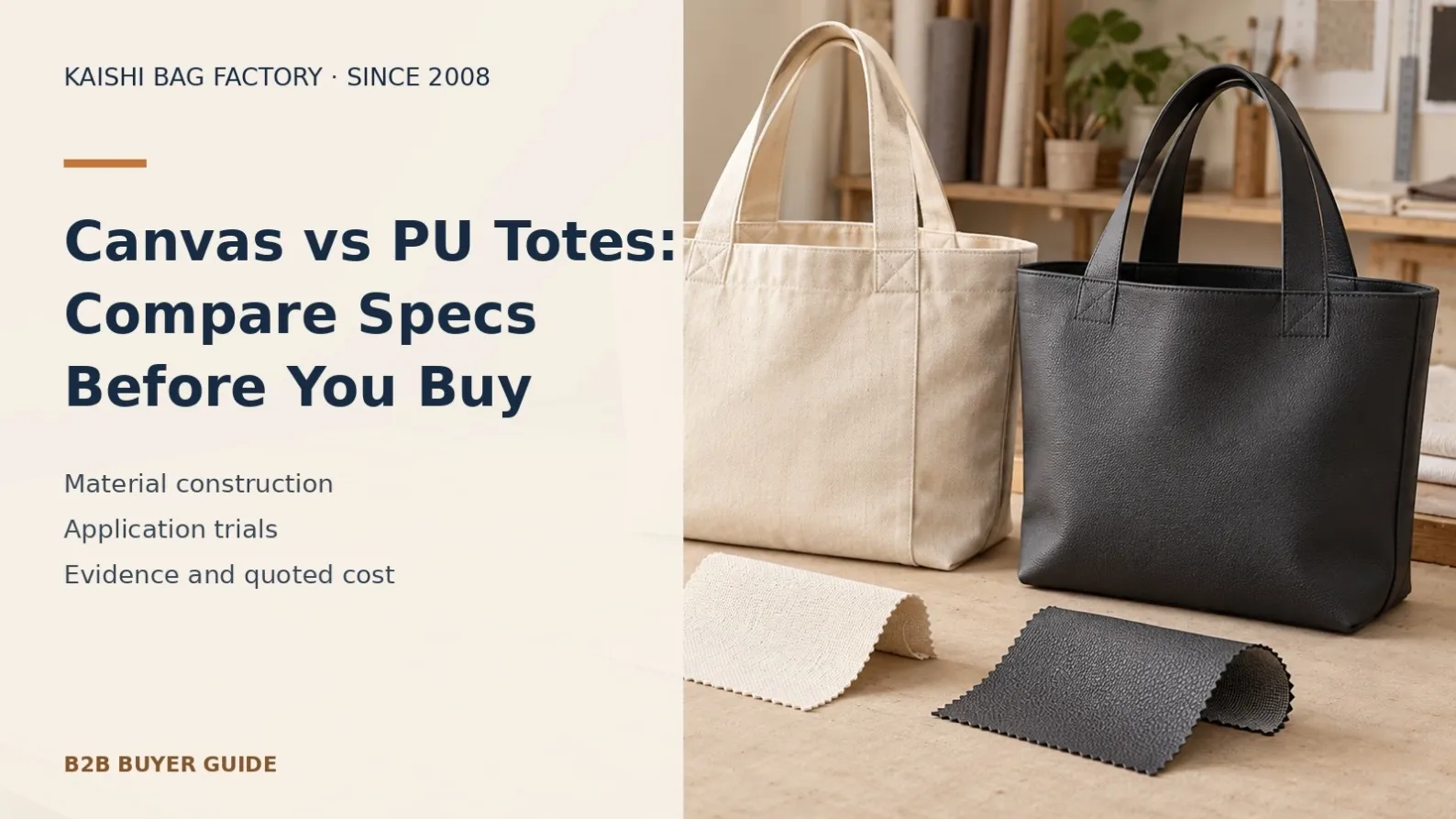
Choose between canvas and PU-coated textile totes by comparing the actual material construction, finished-bag structure, decoration, care requirements and quoted cost. Neither label alone establishes strength, lifespan, environmental performance or the right selling price. Review identified swatches and a finished sample before deciding which material suits your product brief.
For a brand or wholesale buyer, the useful question is not which material is universally better. It is which proposed specification supports the bag’s purpose and can be supplied and verified within the order constraints. This guide provides a side-by-side purchasing framework without assuming a standard canvas weight or PU thickness.
Specify what the material names mean
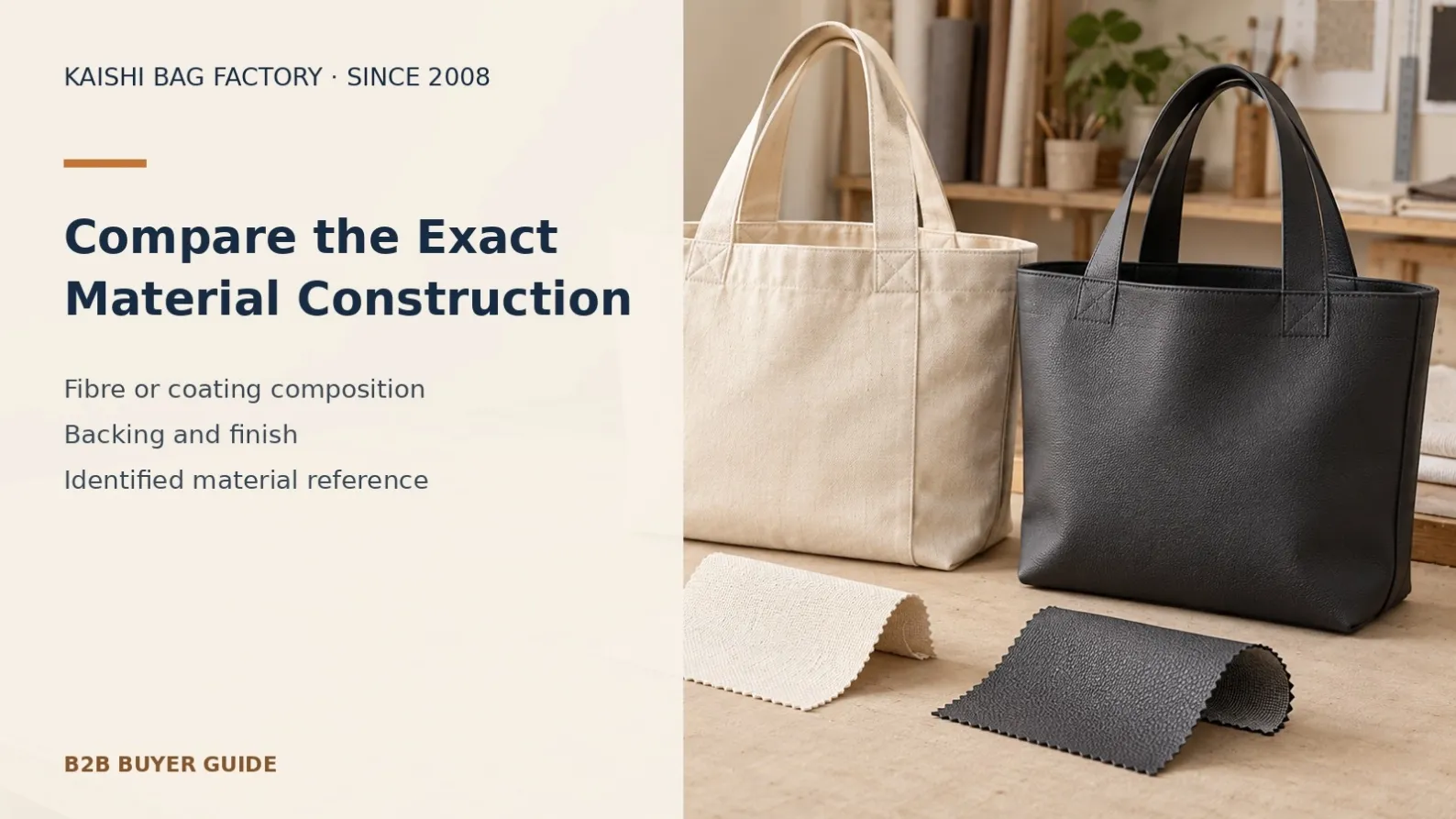
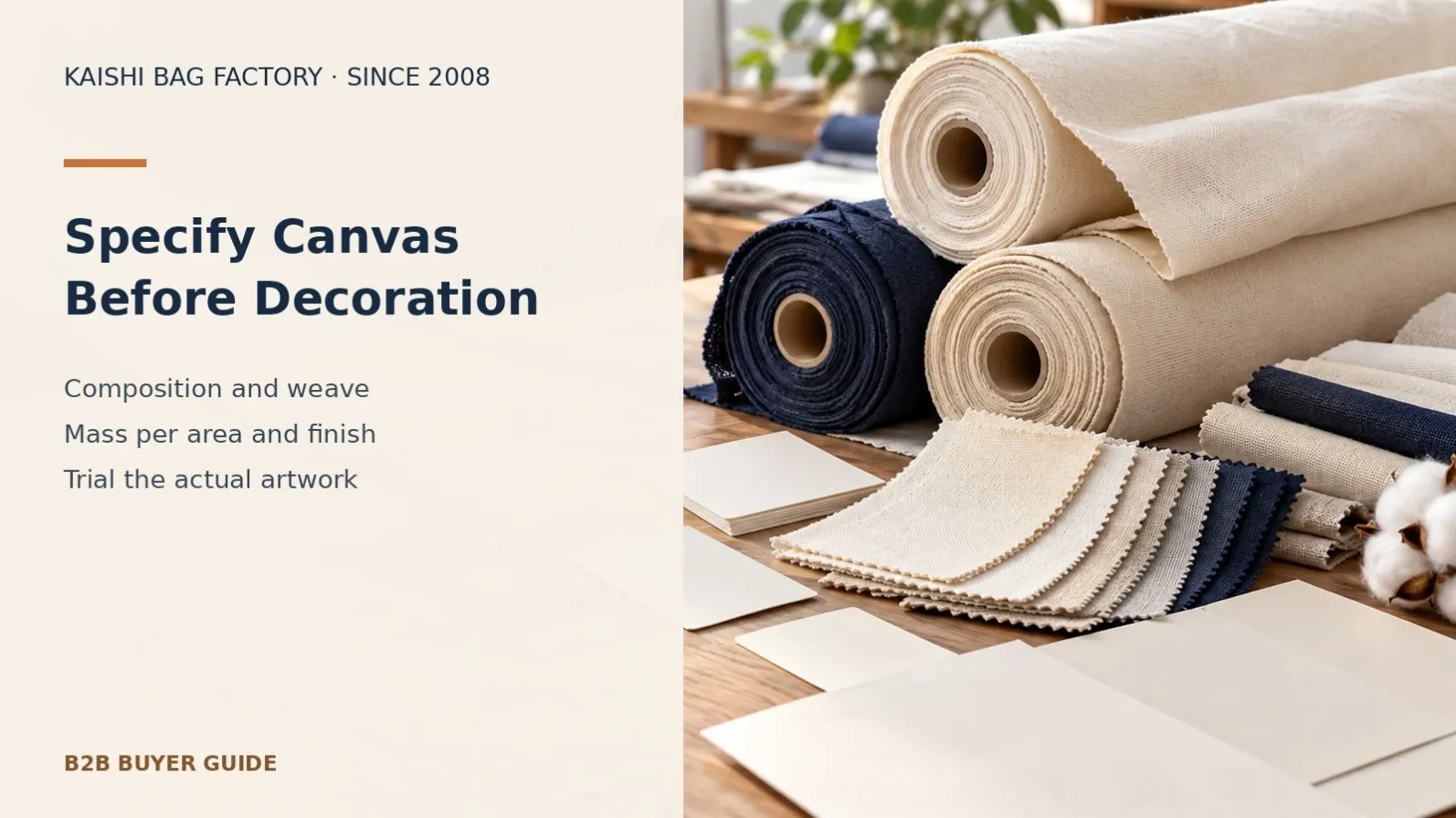
Canvas describes a fabric construction category rather than a complete purchasing specification. Record fibre composition, weave, mass per area, finish, colour and usable width as applicable. A cotton canvas and a blend should not be treated as identical merely because both are sold as canvas.
For PU-coated textile, identify the polyurethane surface, underlying textile backing, finish and total thickness. Request the supplier’s material reference and supporting information for the exact proposed grade. Total thickness alone does not describe coating chemistry, adhesion, backing strength or the finished bag’s performance.
Use consistent units and measurement methods in a comparison. Do not request canvas and PU at the “same gauge and weight” as though those values make them equivalent. Compare complete specifications against the same intended use instead.
Use a purchasing comparison table
| Decision | Canvas review | PU-coated textile review |
|---|---|---|
| Appearance and hand | Weave, fibre blend, finishing and drape | Surface grain, gloss, hand and backing |
| Shape | Panel design, lining, reinforcement and base | Material stiffness plus lining and reinforcement |
| Decoration | Trial the selected print or embroidery on the fabric | Trial the selected method on the exact coating |
| Durability | Seams, attachments, abrasion and colour transfer | Seams, attachments, coating adhesion and flexing |
| Care | Validate the complete bag’s cleaning instructions | Check coating and cleaner compatibility |
| Claims | Verify any organic, recycled or environmental wording | Verify composition and any animal-free or environmental wording |
| Cost | Quote the complete bag and order breakdown | Quote the complete bag and order breakdown |
The table identifies questions, not guaranteed results. Two grades in one category may behave differently, and a successful material trial does not automatically validate the handles, zipper or complete assembly.
Review shape as a construction decision
A woven tote can be made more structured through its panel design, reinforcement and base. A PU-coated material can also be soft and flexible. Avoid describing all canvas bags as collapsing or all PU bags as self-supporting. Ask for the proposed construction and assess the sample both empty and under the intended use conditions.
Check opening access, strap position, base support and the interaction between lining and outer panels. A design change that makes the bag stand upright may add weight, assembly steps or packing volume. Ask how these effects are reflected in the quotation rather than selecting the outer material in isolation.
For buyers selecting several styles, keep a separate construction record for each. A tote and a structured handbag should not share an acceptance specification just because they use the same outer material.
Trial branding on the selected substrate
Screen printing, transfer methods, embroidery, debossing and other processes require substrate-specific assessment. A method that works on one cotton fabric or coating is not automatically suitable for another. Review the artwork, placement, colour coverage, surface texture and desired touch with the supplier.
Ask for an application trial and agree what will be assessed: appearance, position, adhesion or resistance under relevant use and care conditions. Heat or pressure can affect some coated surfaces; embroidery can change panel behaviour. These are reasons to test the proposed combination, not blanket rules excluding a process.
Ask for relevant performance evidence
CottonWorks describes how cotton-fabric durability can be affected by engineering and finishing. This reinforces the need to specify and evaluate the proposed fabric. It does not show that every canvas tote has enhanced abrasion resistance or that Kaishi supplies a particular proprietary finish.
For PU-coated textiles, the Association for Contract Textiles explains that heat and humidity can contribute to hydrolysis and that resistance varies with composition and manufacture. It also cautions against converting laboratory exposure weeks directly into years of service. Its guidance concerns upholstery; its minimum recommendations should not be copied into a bag contract without reviewing the bag application.
Discuss an appropriate laboratory and test scope for your intended use. Ask which material reference was tested, the method and conditions, the report date and whether the result applies to the proposed component. A report for a different grade or an unfinished substrate may leave important questions open.
Validate care and customer-facing claims
Do not label a complete canvas bag machine-washable just because its outer cloth can be washed. Lining, stiffeners, decoration, metal parts and colour transfer can affect the result. Similarly, a wipe-clean coating does not validate every cleaner. Establish care instructions from the selected material guidance and complete-bag assessment.
The FTC Green Guides address environmental marketing claims in the US. Avoid vague claims such as eco-friendly, automatically recyclable or low-impact without suitable substantiation. Natural fibre, recycled content, organic status and animal-free positioning describe different attributes; none should be used as a shortcut for an overall environmental conclusion.
Ask what the proposed claim covers: the outer material, one component or the whole bag. Availability of certified material and permission to use a certification claim must be confirmed for the actual supply chain. No such availability is promised by this comparison.
Compare the full quotation
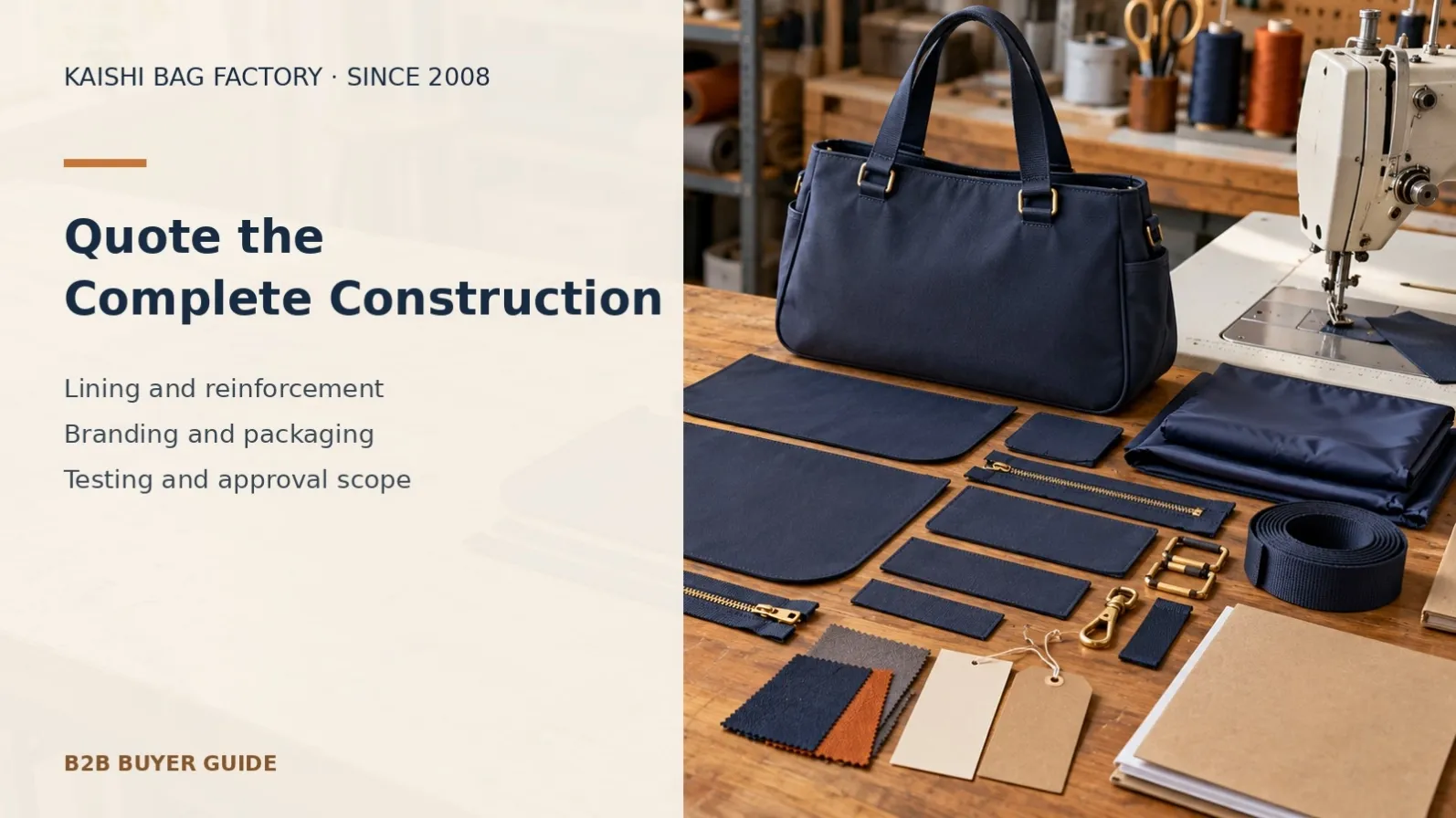
Canvas is not guaranteed to be cheaper in every design. Compare dimensions, lining, reinforcement, decoration, handles, hardware, packaging and order quantities. A complex canvas assembly may cost more than a simpler PU-coated tote, and a premium coating may change the comparison again.
Keep provisional components visible in the quotation. Ask which choices require a new sample, tooling or additional approval. Include any required testing, inspection and freight scope as separately identified items rather than assume that the unit price includes them.
Prepare a decision brief for Kaishi
Send the use case, design reference, dimensions, desired hand and shape, branding, care expectations, destination and quantity by style and colour. If you are undecided, request an assessment of material alternatives against those criteria. Do not assume a fixed stock selection or identical lead time for both materials.
Kaishi Bag Factory is based in Baigou, China, and has worked in OEM/ODM since 2008. Standard MOQ is usually 300 pieces per style. A first order of 200 pieces may be evaluated individually, without guarantee; 100 pieces is generally not feasible. Mixed styles and lower repeat-order MOQs are not automatic.
Samples are paid upfront, non-refundable and not automatically credited. Payment is T/T only, usually 50% deposit and 50% before shipment. Timing depends on design, materials, approval and quantity; no fixed sampling or production duration applies here.
Frequently asked questions
Is canvas always cheaper than PU?
No. Compare the complete bag specification, finish, decoration, construction and quantities rather than assuming a category-wide price ranking.
Which material lasts longer?
There is no universal answer. Review the selected grade, construction, use conditions and appropriate evidence. Thickness alone is not a lifespan guarantee.
Can canvas hold a structured shape?
It can be developed with suitable construction and reinforcement. Evaluate the actual sample and the effects on weight, appearance and cost.
Can a logo be applied to PU-coated textile?
Potential methods depend on the coating and artwork. Confirm suitability through an application trial on the proposed material.
Does cotton canvas make an environmental claim safe?
No. Claims need evidence and a defined scope. Natural fibre does not automatically establish recyclability, organic status or overall low impact.
Do hydrolysis test weeks equal years of bag use?
No direct conversion should be promised. Review the test method, application and exact material; the result is not a universal product warranty.
What should we send for a comparison quotation?
Send the same design, dimensions, construction expectations, branding, packaging and quantity breakdown for both proposed options.
Discuss your tote specification
Review product examples, Kaishi’s background and the payment terms guide. Submit your comparison brief through the contact page, email donna@Kaishibagfactory.com or WhatsApp Donna.
Sources and scope
- CottonWorks: cotton-fabric durability.
- ACT: hydrolysis guidance—upholstery context, not a universal bag requirement.
- FTC: Green Guides—US environmental marketing guidance.
Reviewed 3 October 2026. Images are generated material and workshop illustrations, not documentary Kaishi photographs.