
Sep 29, 2026Materials & Customization
Canvas vs PU vs Nylon: Choosing Materials for Your Bag Collection
Compare canvas, PU-coated fabric, nylon and polyester by construction, test plan, branding and use case—not fibre rankings. A B2B material approval checklist.
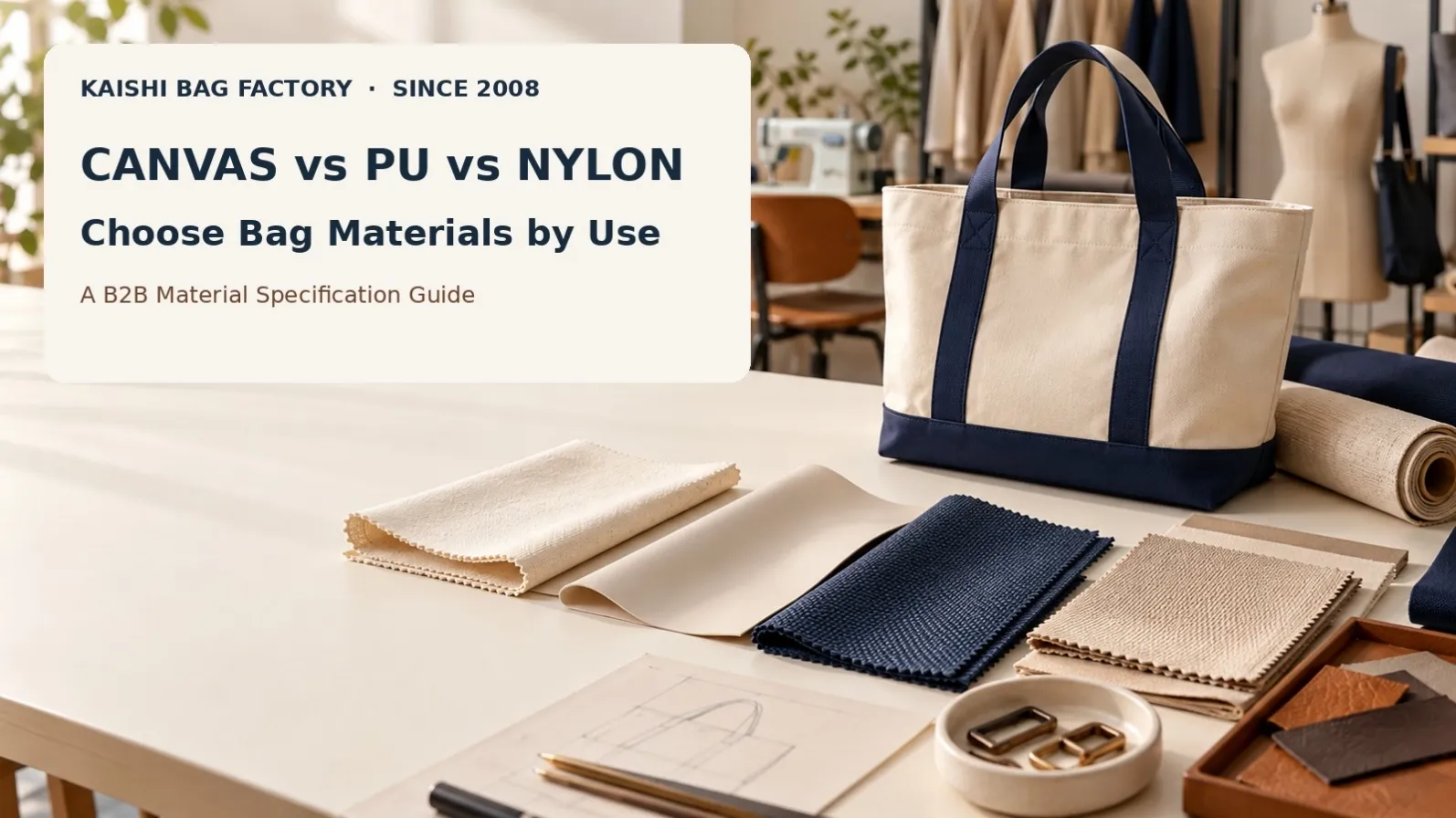
Quick answer: choose the specification, not the fibre name
Canvas, PU-coated fabric, nylon and polyester can all make successful bags, but none is inherently the most durable, sustainable or economical choice. Compare a finished material against the bag's intended load, feel, branding method, care needs, test requirements and target price. Then approve a production-intent sample. A fibre name or denier alone cannot prove performance.
This buyer guide helps brands and importers compare material options for a collection. Kaishi Bag Factory is based in Baigou, China and has worked on OEM/ODM bags since 2008. Its standard MOQ is usually 300 pieces per style. A 200-piece first order may be evaluated case by case, without a guarantee; 100 pieces is usually not workable.
Material comparison for a custom bag brief
| Candidate | Ask the supplier to define | Useful application to evaluate | Risk to check
| Cotton canvas | Yarn, weave, fabric mass, finish, shrinkage and colour | Printed totes, casual shoppers and structured canvas panels | Handle seams, colourfastness, dimensional change and moisture exposure
| PU-coated textile | Backing, coating formulation, thickness, finish and flexibility | Structured fashion bags and trims | Flex cracking, adhesion, hydrolysis, abrasion and transfer
| Nylon fabric | Weave, yarn, coating, fabric mass and finish | Lightweight backpacks and travel bags | Seam strength, abrasion and intended water resistance
| Polyester fabric | Weave, yarn, coating, fabric mass and finish | Sports bags, backpacks and printed panels | Print compatibility, seam performance and colourfastness
The applications are starting points for a design discussion, not performance rankings. Two fabrics in the same fibre family may behave very differently.
What changes the finished bag more than its material name?
Construction and load paths
Handles, shoulder straps and attachment seams carry the load. Specify the intended contents and loaded weight, then inspect reinforcement and seam placement on a sample. A high-performing shell cannot rescue a weak strap attachment.
Coatings and finishes
“Water-resistant” should describe a defined material or finished-bag test and its conditions. A coated fabric does not make every zipper, seam or opening waterproof. On coated PU textiles, request evidence relevant to flexing, abrasion and the expected storage or use conditions rather than assuming the coating will not age.
Branding and print compatibility
Screen printing, transfer, embroidery, debossing and labels have different limits on different constructions. Approve a strike-off or branded sample on the actual material and colour. Test rub or wash durability as appropriate to the product; confirm artwork rights and placement dimensions.
Total landed and usable cost
Compare the finished specification, yield, reinforcement, trim, sampling, packaging, inspection and freight assumptions. A lower-priced shell may require a different lining or additional reinforcement. Avoid a simple “cheap versus premium” label without comparable quotations.
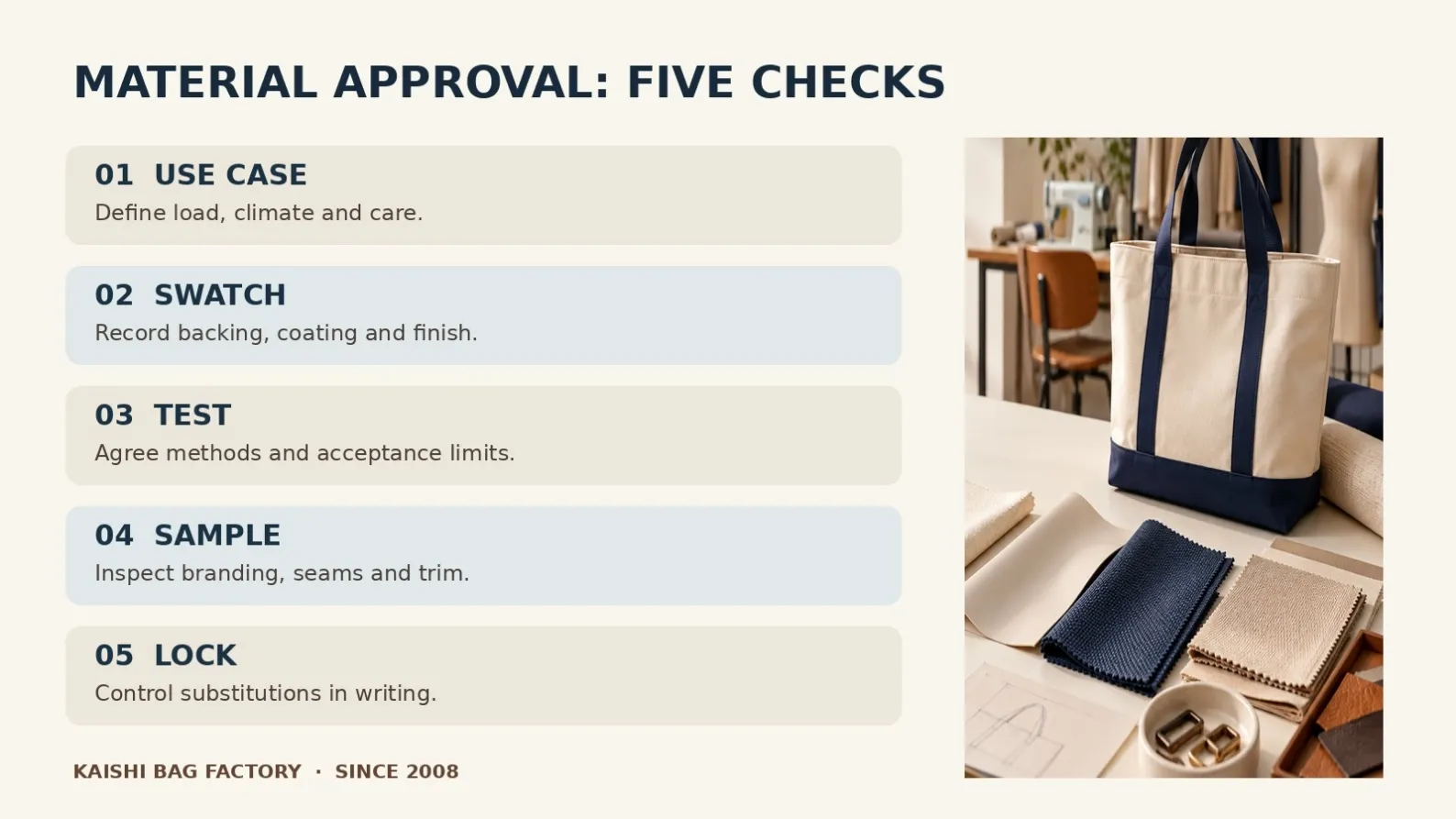
A five-step material approval checklist
Define the bag's user, contents, carrying method, climate and care instructions.
Request identifiable swatches with backing, coating, finish, mass and supplier reference recorded.
Agree the relevant test methods and acceptance criteria before ordering reports.
Build and inspect a production-intent sample with the final lining, hardware and branding.
Lock approved materials and substitutions in a written specification and change-control process.
Agree what will be tested and approved before bulk production.
For woven textiles, ISO 12947-2 describes a Martindale abrasion specimen-breakdown method, while ISO 13937-1 describes a tear-force method. A method citation is not a universal pass threshold. Select limits for the actual product and market.
Environmental claims need separate evidence
Do not call a bag “eco-friendly” merely because its face material is cotton, recycled polymer or described as vegan. Check the scope of the claim, the specific input, chain-of-custody documents where relevant, durability and end-of-life context. The US FTC Green Guides summary explains why broad environmental claims need qualification and substantiation. Request documentation for a particular material and order before making a marketing claim; Kaishi does not promise that every requested certified material is available.
How to brief a factory for a useful comparison
Send the intended bag shape, dimensions, target market, planned quantity per style, target retail position, reference photos, carrying load, branding artwork and desired delivery window. Ask for two or three defined material routes with the same construction, trim and packing assumptions. Compare samples side by side under the same checks.
Kaishi quotes after the design, materials, sample approval and quantity are understood. Sampling costs and timing are confirmed for each project. Payment is by T/T, typically 50% deposit and 50% before shipment. Lead time depends on the design, material availability, sample approval and quantity; no fixed duration applies to every order.
Frequently asked questions
Is canvas always more sustainable than PU or nylon?
No. Fibre identity alone does not establish a comparative environmental result. Define the exact claim and seek suitable evidence for the finished product and intended market.
Is nylon always stronger than polyester?
No universal ranking applies to finished bags. Compare specified constructions and relevant tear, abrasion, seam and loaded-bag checks under the same methods.
Does a high denier number guarantee durability?
No. Denier describes yarn linear density. Weave, coating, yarn quality, fabric mass, seams and product construction also matter.
Can PU-coated fabric be used for a structured handbag?
Yes, subject to the chosen backing, coating, reinforcement, finish and sample checks. Request evidence relevant to the intended use and storage conditions.
Can a coated fabric make a bag waterproof?
Not by itself. Seams, openings, zippers and design determine finished-bag water ingress. Agree exactly what resistance is claimed and how it is tested.
Can a collection combine different materials?
Potentially. Record the specification and quote each style and trim combination. Mixed orders and low quantities are evaluated case by case, not promised as a standing policy.
What is Kaishi's MOQ and payment policy?
Standard MOQ is usually 300 pieces per style. A 200-piece first order may be assessed individually, without a guarantee; 100 pieces is usually impractical. Payment is T/T, typically 50% deposit and 50% before shipment.
Request a material-based quotation
Send your bag brief, target market, reference photos, quantity and any test or claim requirements to Kaishi Bag Factory's contact page. We can discuss material options against your actual design and sample approval plan.