Custom Canvas Bags: Material, Printing and MOQ Guide
A B2B buyer guide to specifying canvas fabric, printing, handle construction, claim documents, MOQ and sample approval for custom bags.
Custom Canvas Bags: Material, Printing and MOQ Guide
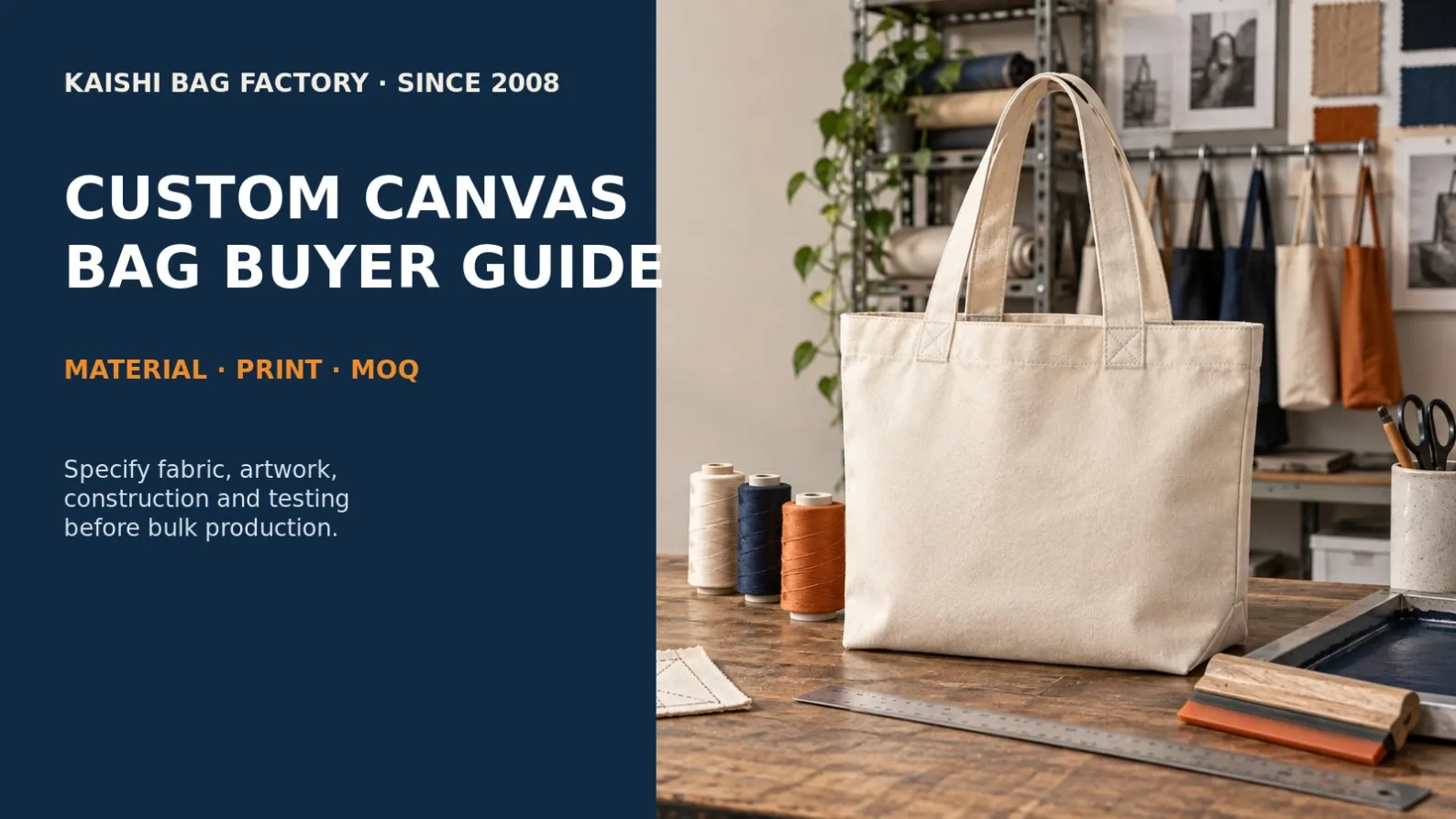
Direct answer: A reliable custom canvas bag order starts with measurable specifications—not a generic request for “heavy canvas.” Buyers should define fabric composition and weight, weave and finish, bag dimensions, handle construction, print method, tolerances, packaging and claim documentation before sampling. At Kaishi Bag Factory, the MOQ is 300 pieces per style. A first order is also 300 pieces per style, with no exceptions; 100 pieces is not workable.
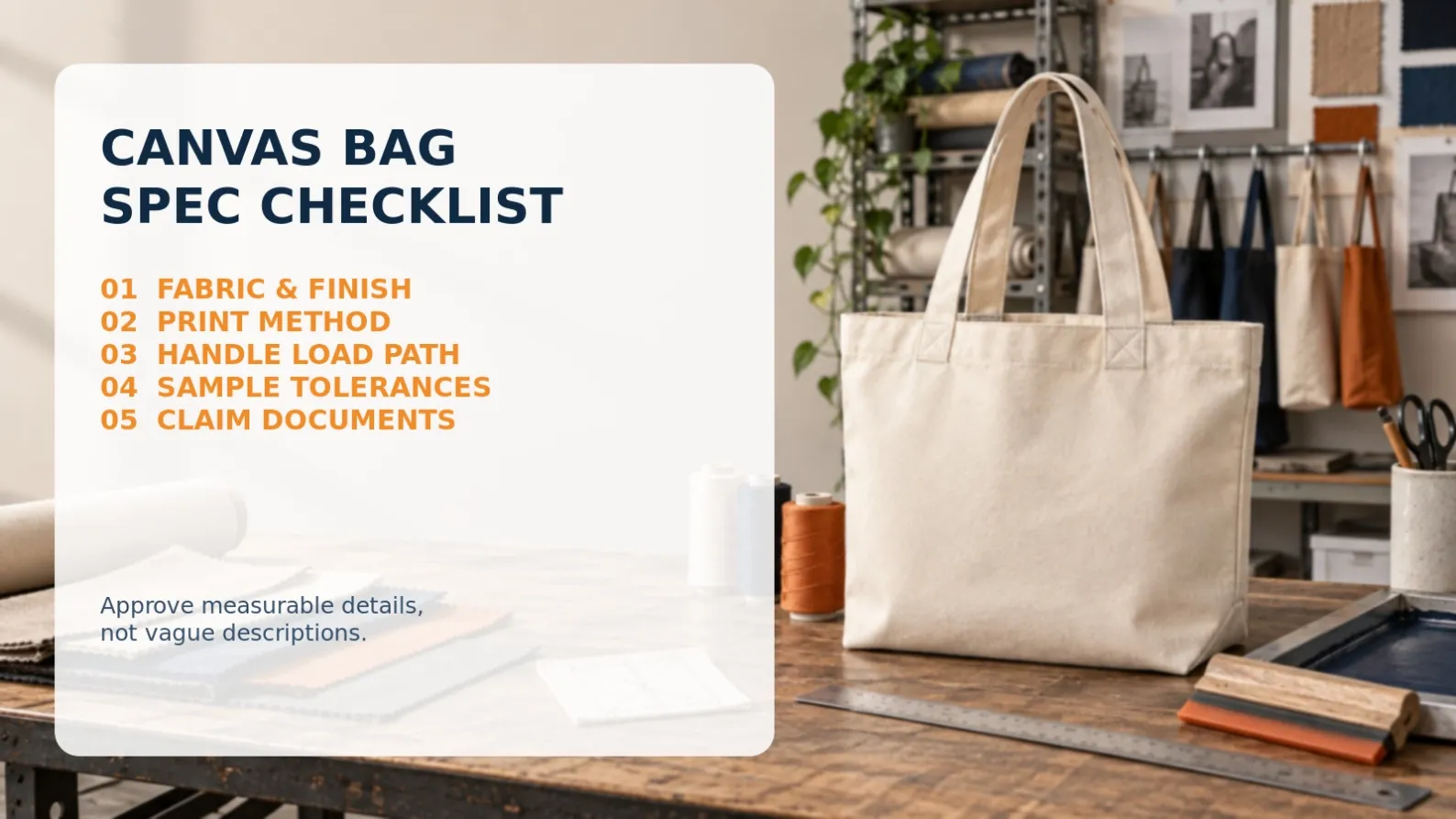
Quick buyer checklist
- State fibre composition, fabric weight and whether the measurement is oz/yd² or g/m².
- Approve a physical swatch because equal weights can feel different after weaving, dyeing or finishing.
- Match screen print, digital print, heat transfer, embroidery or labels to the artwork and fabric surface.
- Specify handle length, width, material, attachment and expected load.
- Record dimensions, print position and acceptable tolerances on the approved sample.
- Request transaction-specific evidence before making organic, recycled or environmental claims.
Canvas weight is only one part of the specification
Canvas is commonly described by mass per unit area, using ounces per square yard or grams per square metre. That number helps compare fabrics, but it does not by itself define quality. Yarn size, weave density, fibre blend, washing, coating and finishing can change stiffness, drape, shrinkage and print behaviour.
There is no universal weight that automatically makes a promotional tote, retail shopper or work bag “correct.” A lighter fabric may suit a foldable giveaway, while a denser fabric may help a structured retail bag. The right choice depends on the finished product, target cost, print method and intended load. Ask the supplier to identify the unit of measurement and submit the actual production-grade swatch for approval.
What to put on the fabric line of your tech pack
- Fibre composition and permitted blend tolerance
- Nominal fabric mass and measurement unit
- Weave, colour, surface finish and pre-wash requirement
- Coating or lamination, if any
- Required tests, such as colourfastness, shrinkage or abrasion
- Approved swatch reference and date
If colour transfer matters, a buyer can specify an appropriate rubbing-fastness method such as ISO 105-X12. Test methods do not create a pass level by themselves; the buyer and supplier still need to agree the acceptance requirement for the product and market.
How to evaluate cotton, recycled and certified claims
Terms such as “natural,” “organic,” “recycled” and “eco-friendly” are not interchangeable. They describe different attributes and should not be used without evidence. Organic or recycled content should be tied to the scope of a recognized standard, the certified organizations in the supply chain and the documents that apply to the specific material or shipment.
The Organic Content Standard verifies the presence and amount of organic material through the supply chain. Textile Exchange’s Recycled Claim Standard and Global Recycled Standard address recycled input and chain of custody, with the GRS adding further processing requirements. Availability must be checked for each project; Kaishi does not promise that every certified material is always available.
For the US market, the FTC Green Guides warn against broad, unqualified environmental benefit claims. Use precise wording supported by records—for example, a verified percentage of recycled content—rather than saying a bag is simply “green” or “sustainable.” Buyers selling elsewhere should confirm the rules that apply in their target market.
Choose the print method from the artwork and use case
Screen printing
Screen printing is often efficient for solid colours and repeat volume. Each colour normally requires preparation, so artwork with many colours or gradients can add setup and alignment work. Approve ink colour, opacity, edge definition and curing on the selected canvas.
Digital printing or heat transfer
These processes can reproduce gradients and detailed artwork, but results depend on the fabric surface, pretreatment, transfer system and wash or rub requirement. Do not approve from a screen mock-up alone. Review a decorated sample and agree the relevant durability check.
Embroidery, woven labels and patches
Embroidery can create a premium, tactile result, but dense stitching may distort lighter fabrics and very small text can lose clarity. Woven labels and patches are useful where fine branding must stay consistent across fabric colours. Specify dimensions, edge finish, stitch colour and placement.
Send production-ready artwork instructions
A print quotation is more dependable when the buyer provides vector artwork where possible, named colour references, finished decoration dimensions, the number of print positions and a measured placement. “Logo on the front” is not a production specification. A useful instruction reads: “Artwork centred on front panel, 180 mm wide, top edge 70 mm below the finished bag opening.”
Also identify whether artwork can be adjusted for manufacturing. Thin lines, small reversed text and colours close to the canvas shade may need modification. Approve the final artwork file and sample version in writing.
Handle construction and load paths
Handle complaints are rarely caused by one stitch alone. Performance depends on the handle material, overlap length, seam design, reinforcement, thread, fabric strength and how the load travels through the bag. Box-and-cross stitching or bartacks may be appropriate in some designs, but neither is an automatic guarantee.
Specify handle length, width and drop according to how the customer will carry the bag. Then define an agreed load or use test that reflects the product. Inspect seam security, symmetry, skipped stitches, puckering and damage around attachment points during sample approval and bulk quality control.
MOQ, pricing and sampling at Kaishi
Kaishi Bag Factory is based in Baigou, China and has worked in OEM/ODM bag manufacturing since 2008. Our MOQ is 300 pieces per style. A first order is also 300 pieces per style, with no exceptions. An order of 100 pieces is not workable.
Kaishi's MOQ is a fixed 300 pieces per style. It does not vary by design, material, colour or customization. Material purchasing, dyeing, print setup, accessories, packaging and production efficiency affect cost and timing, not the MOQ.. Combining different styles or colours cannot be assumed to satisfy one MOQ because each variation may require separate materials and setup.
Sample and production timing is confirmed after the specification, materials, artwork, quantity and sample approval process are understood. We do not promise a fixed lead time for every canvas bag. Payment is by T/T, normally 50% deposit and 50% before shipment.
Sample approval checklist
- Measure finished width, height, depth and handle drop.
- Match the fabric to the approved swatch and recorded mass.
- Check decoration size, colour, position, opacity and edge quality.
- Inspect handle alignment, overlap, reinforcement and seams.
- Review inside seams, labels, closures and packaging.
- Record all corrections on a numbered sample report.
- Keep one approved reference sample for bulk inspection.
Frequently asked questions
What canvas weight is best for a custom tote bag?
There is no single best weight. Select it from the bag structure, expected load, hand feel, printing process and target price, then approve the actual swatch.
Can Kaishi produce 100 custom canvas bags?
No. The MOQ is 300 pieces per style, including for a first order. Send the actual specification and quantity breakdown to Donna.
Can different colours be combined to reach the MOQ?
Do not assume they can. Colour changes can create separate material and setup requirements. The MOQ is 300 pieces per style. Confirm quantities by style and colour.
Which print method is most durable?
Durability depends on the complete system: fabric surface, ink or transfer, curing, artwork coverage and use conditions. Approve a decorated sample and specify an appropriate test rather than relying on the process name alone.
Can you supply certified organic or recycled canvas?
Availability and documentation must be checked for each order. A marketing claim should be based on valid, transaction-specific evidence, not an assumption about a material name.
How long does sampling and production take?
Timing depends on design complexity, material sourcing, decoration, sample revisions and quantity. It is confirmed project by project after the specification is reviewed.
What should I send for a quotation?
Send the bag dimensions, reference images or tech pack, material preference, quantity, destination market, artwork, decoration size, packaging requirements and target delivery window.
Request a project review
Send your canvas bag specification and artwork through our contact page, email donna@Kaishibagfactory.com, or contact us on WhatsApp. We will review the construction, material, decoration and quantity before confirming feasibility, and timing.