
Importing Custom Bags from China: Shipping, Documents and Incoterms
A B2B shipping checklist for custom bag imports: CIF risk, FCA versus FOB, packing, documents and landed-cost scope before order confirmation.
Quick answer: plan the shipment before confirming the order
To import custom bags from China, agree the product specification, destination requirements, shipment term and named location, packing details, document responsibilities and freight budget before production. Compare the total route to your warehouse, not just the factory price. Under CIF, the seller pays freight and insurance to the named destination port, but risk normally transfers when the goods are on board at the shipment port. Cost and risk do not move together.
This guide is for brand owners, importers and wholesale buyers planning OEM/ODM bag shipments. It focuses on transport decisions and document checks rather than providing a universal tariff rate. Rates and requirements depend on the product, origin, destination and entry date; your customs broker should confirm the treatment of the actual shipment.
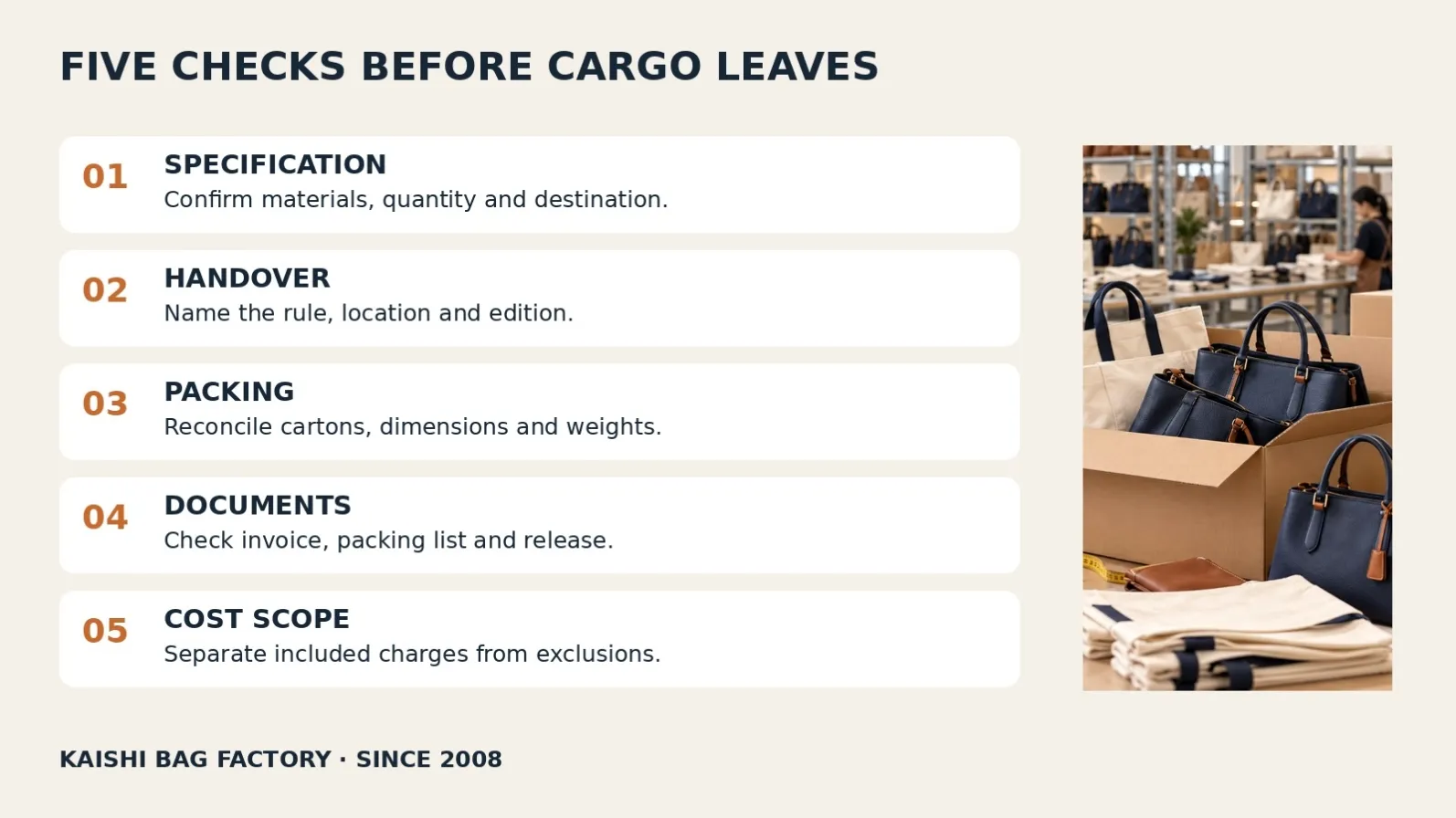
Separate five decisions in your shipping brief
- Product: material composition, construction, use, quantity and approved sample.
- Route: collection location, export handover point, destination and final warehouse.
- Responsibilities: the agreed Incoterms rule, named place or port and edition.
- Documents: who prepares, checks and submits each required record.
- Budget: included charges, excluded charges, validity and assumptions.
A request for “shipping included” leaves important questions unanswered. Is the price to a port, airport or warehouse? Are destination handling, customs clearance, duties, taxes and unloading included? Ask for a written scope so your purchasing and logistics teams compare the same service.
Choose an Incoterms rule that fits the handover
ICC publishes Incoterms rules to allocate specified delivery obligations, costs and risk between seller and buyer. They do not replace the sales contract or define every payment, ownership or product-compliance question. Record the agreed rule, precise named location and “Incoterms 2020” rather than using a three-letter abbreviation alone.
| Rule | Key delivery distinction | Question for the buyer |
|---|---|---|
| EXW | Goods made available at the named place; seller need not load or clear export under the rule. | Can your appointed parties manage collection and export formalities? |
| FCA | Delivery to the nominated carrier at the agreed place; export clearance is a seller obligation. | Is the exact carrier handover point documented? |
| FOB | Sea or inland waterway only; delivery and risk transfer on board at the named shipment port. | Does this match the actual handover, especially for container cargo? |
| CIF | Sea or inland waterway only; seller pays destination-port freight and required insurance, while risk transfers on board at origin. | What insurance, destination charges and claim procedures apply? |
| DAP / DDP | Destination-delivery rules; import clearance and duty obligations differ. | Who can legally perform import formalities, and what is included? |
For containerized bags handed to a carrier before vessel loading, ICC guidance points buyers toward FCA rather than automatically choosing FOB. The appropriate term depends on the transaction. Do not assume a factory offers every rule in this table: confirm the available arrangement with Donna and your forwarder.
CIF freight payment does not mean destination risk transfer
CIF can be misunderstood because it names a destination port. The seller contracts and pays for the specified carriage, but risk transfers at the shipment-port onboard delivery point. ICC also explains that CIF has a default minimum insurance level unless the parties agree otherwise. Review the policy scope, exclusions and claim process; “insured” is not equivalent to coverage for every possible loss.
Ask how cargo damage or shortage will be documented at receipt and which party should notify the carrier or insurer. Keep packing records and relevant shipment evidence. Neither a delivery term nor an insurance policy guarantees that a claim will be accepted.
Compare sea, air and courier using the same packed dimensions
Request quotations based on carton count, external dimensions, gross weight, collection point and final delivery address. Bags can occupy substantial space relative to weight, so a per-kilogram comparison alone may be misleading. Ask each provider to explain its chargeable-weight or volume basis and confirm whether the quote includes destination services.
Sea freight may suit a planned bulk shipment; air freight or courier may suit samples or urgent quantities. These are options to compare, not universal rankings. Actual price, availability and timing vary with route, cargo, service and date. Avoid assuming that an airport arrival estimate is the date your warehouse can receive saleable goods.
Build your schedule around sample approval, goods-ready date, collection, export processing, main transport, import processing and final delivery. Add an explicit contingency appropriate to the project. Confirm who updates the schedule if the approved design, quantity or packing changes.
Check the document set before cargo leaves
| Record | Buyer check |
|---|---|
| Commercial invoice | Correct parties, description, quantity, value, currency and agreed commercial basis. |
| Packing list | Carton count, contents, weights and dimensions reconcile with the shipment. |
| Transport document | Consignee, routing and release arrangements match the instructions. |
| Origin or preferential-origin evidence | Required format and eligibility confirmed; origin alone does not guarantee a lower duty. |
| Product or inspection records | Applicable market requirements and any commissioned inspection scope are documented. |
The US International Trade Administration distinguishes non-negotiable air waybills and straight bills of lading from negotiable order bills. Do not describe every ocean transport document as a document of title. Ask the forwarder which document and release method the shipment will use.
The ITA document overview is written for US exporters; its explanation of common records is useful, but US export filing rules should not be copied into a China-export checklist. Confirm the actual origin and destination formalities with the appointed logistics professionals. For US imports, CBP invoice guidance provides a starting point for the required commercial information.
Build a landed-cost worksheet without double counting
List the goods price, any separately charged development or tooling, origin services, freight, insurance, destination handling, clearance, duties, taxes and inland delivery. Mark each line as included, separately quoted or still unconfirmed. If freight is already included in the commercial price, do not add it twice.
Distinguish accounting landed cost from the customs-value basis used in the destination market. Ask your broker to confirm classification, valuation, applicable additional duties and required information. There is no single duty rate for all women's bags, canvas totes or leather bags. Avoid changing the invoice description or value merely to seek a lower charge.
Request quote validity, free-time assumptions and potential storage or delay charges. These are budget risks, not certain expenses. Record the exchange-rate assumption if the purchase and operating currencies differ. Use a dated estimate and refresh it before booking when the scope or market has changed.
Kaishi order planning and shipment confirmation
Kaishi Bag Factory is based in Baigou, China and has worked on OEM/ODM bags since 2008. Standard MOQ is usually 300 pieces per style; a 200-piece first order may be evaluated individually without a guarantee, while 100 pieces is generally not feasible. Do not assume mixed styles or colours meet a shared minimum.
Payment is T/T only, normally 50% deposit and 50% before shipment. Sampling and bulk timing depend on the design, materials, sample confirmation and quantity. Agree sample charges before development; no free sample or automatic fee credit is promised. Confirm the actual export arrangement, document support and route for your order rather than assuming a fixed port or universal door-delivery service.
Frequently asked questions
Is CIF risk transferred at the destination port?
No. Under CIF, risk normally transfers when goods are delivered on board at the shipment port, even though the seller pays the specified carriage and insurance to the destination port.
Should containerized bags always use FOB?
No. FCA can better match a pre-loading carrier handover. Agree the rule with the supplier and forwarder based on the actual delivery point.
Which documents should I request?
Start with the commercial invoice, packing list and transport document, then confirm destination-specific origin, product and other records with your broker.
Does a certificate of origin guarantee preferential duty?
No. Preference depends on an applicable arrangement, origin rules and acceptable evidence, not the document title alone.
Is air freight always too expensive for bulk bags?
No universal conclusion is appropriate. Compare current quotations for the actual packed cargo and arrival requirement.
Can Kaishi quote a fixed transit time?
Request a project-specific estimate and its assumptions. Production readiness, booking, clearance and delivery affect arrival; this guide promises no fixed duration.
Who confirms import duties and compliance?
The importer should work with qualified local professionals to confirm the actual shipment requirements. A supplier quotation or shipment term is not a substitute for that check.
Sources and next step
- ICC: Incoterms 2020
- ICC Academy: CIF and CIP differences
- ICC Academy: FCA and FOB differences
- ITA: Common Export Documents
- CBP: Commercial invoice requirements
For order-payment planning, see the custom bag payment checklist. Send your design, quantity, destination and target arrival window through the Kaishi contact page, email donna@Kaishibagfactory.com or WhatsApp. Donna can confirm the project scope and available shipment arrangement.