Original Bag Development: Design References, Artwork Permissions and Rights Review
Build an original bag brief with documented design references, artwork permissions and territory-specific rights review. An NDA does not authorize copying.
Build an original bag brief with documented design references, artwork permissions and territory-specific rights review. An NDA does not authorize copying.
This guide is for OEM/ODM brand teams, importers and wholesale buyers developing an original bag specification. It addresses original bag design references permissions through decisions that can be documented, sampled and reviewed. A photograph or generic material name is not an approval standard. Define the intended use, compare the actual proposed construction and keep a controlled physical reference before authorizing production.
1. Separate inspiration from an instruction to copy
Explain which general design qualities interest the buyer: carry role, proportion, colour relationship, texture or opening concept. Convert those observations into an original brief rather than asking the factory to reproduce a branded item. Remove customer logos and other protected identifiers from illustrative proposals unless their authorized use is established.
This article is a development and documentation checklist, not a legal clearance opinion for a particular bag. WIPO’s fashion resources explain that several intellectual-property routes can be relevant to fashion. The buyer should obtain qualified advice for the target markets and actual proposal before relying on a general article to resolve rights questions.
2. Document the origin of the design inputs
Keep the source and date of reference images, drawings, artwork and supplied component designs. Identify who created each item and what permission or ownership information is available. A file received in a group message is not automatically authorized for commercial production.
Distinguish buyer-created work from licensed artwork, public promotional images and supplier proposals. If permission is uncertain, keep the input out of the production instruction until reviewed. Do not state that changing a fixed percentage of a design makes it legally safe; no such universal rule is established by this guide.
3. Review logos, patterns and artwork separately
Ask the buyer to provide the correct authorized artwork and intended placement. Confirm file versions, colours and dimensions, while keeping permission review separate from technical print preparation. A production-ready vector file can still lack the necessary commercial authorization.
Review recurring patterns, distinctive decoration and component shapes as well as names and logos. WIPO distinguishes design rights concerning appearance from other intellectual-property categories. The practical lesson is to route the actual elements for the appropriate review. Do not assume removing a visible brand name resolves every question about the proposed product.
4. Consider the intended territories and timing
List where the buyer plans to sell, offer or promote the product. Ask qualified advisers which rights, searches and filing considerations are relevant. WIPO notes that industrial-design protection differs between registered and, in some systems, limited unregistered protection. Avoid saying a design is unprotected simply because a visible registration was not found.
Keep commercial deadlines separate from legal decisions. This December draft was prepared using sources checked in October 2026; recheck current official guidance before publication or a specific launch. Do not infer permission from the age of a photograph, a marketplace listing or the absence of an immediate objection.
5. Use a design-input review record
List the input, origin, intended use, available permission and unresolved question. Identify who can approve its inclusion in the original brief. The worksheet below is an internal planning tool, not a legal certificate or an assurance that a search has cleared the design.
Keep any qualified review with the correct drawing revision. If the design changes, identify which elements need another review. A prior opinion on a different proposal should not automatically cover new hardware, decoration or artwork. Record the decision without exposing confidential client information in public article examples.
| Input | Record | Required decision |
|---|---|---|
| Reference image | Source and intended observation | Translate into original brief |
| Artwork or logo | Creator and permission scope | Authorized project use |
| Component design | Origin and visual proposal | Relevant rights review |
| Territory | Planned sales destinations | Qualified market-specific advice |
| Final version | Accepted drawings and restrictions | Controlled production release |
6. Separate confidentiality from ownership and use
An NDA may address disclosure conditions, but it does not by itself establish who owns a design or who may manufacture, sell or license it. Discuss the relevant project terms explicitly with the appropriate advisers and parties. Do not promise that Kaishi can guarantee worldwide exclusivity or permanent protection through an informal confidentiality message.
Sample, drawing and tooling arrangements also need clear project-specific terms where relevant. This article does not create those terms or claim an existing agreement. Keep discussions conditional until accepted by the parties. A general promise to protect a brand is not a substitute for defined authorization and rights responsibilities.
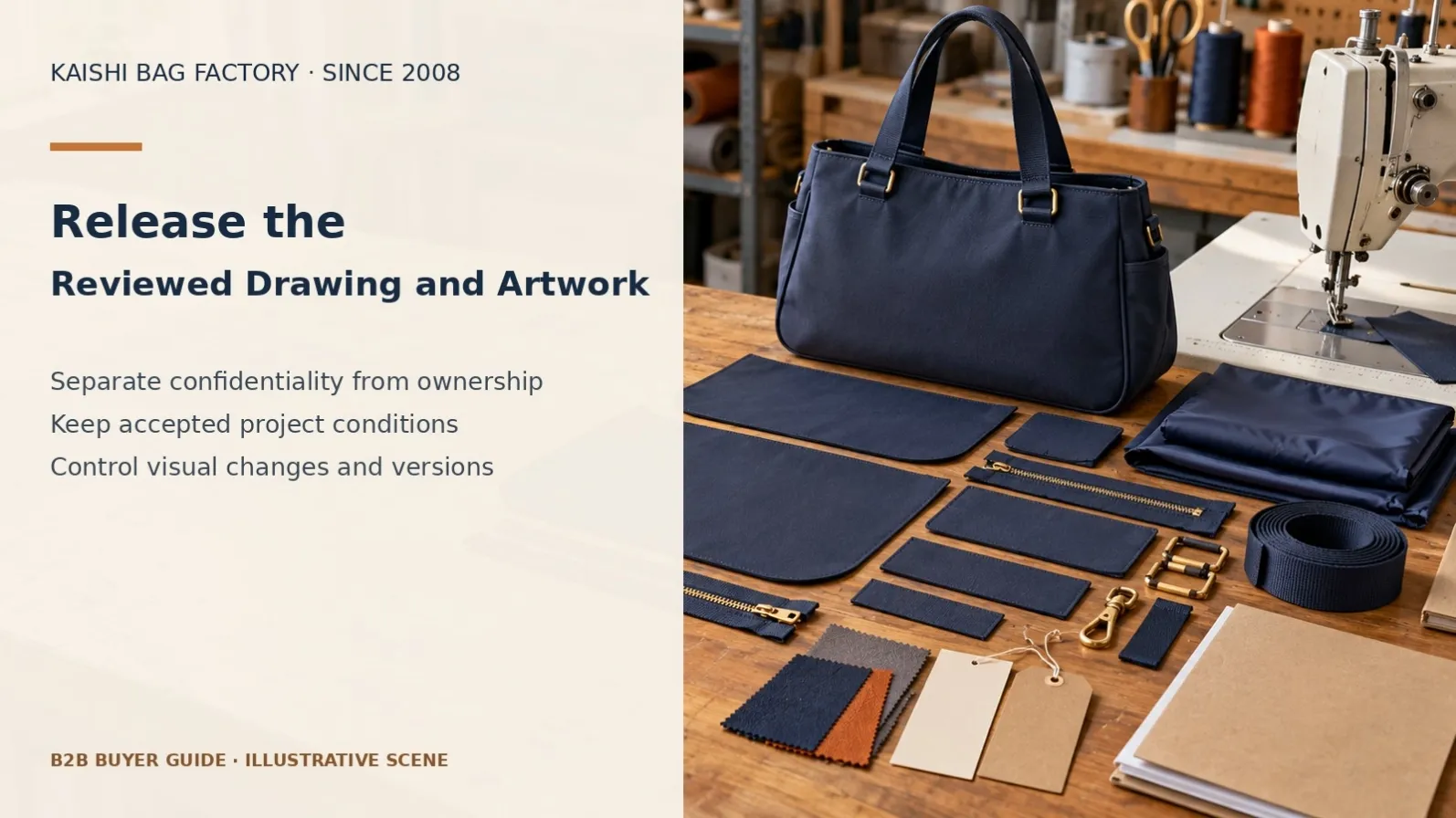
7. Release only the reviewed original brief
The production instruction should identify the accepted drawings, artwork and component references, with any authorized restrictions. Keep the technical and commercial approvals aligned with the reviewed design. If a proposed substitute introduces a different visual element, route it through the same relevant review rather than treat it as merely a factory detail.
For marketing, use approved original product images and supported descriptions. Do not publish a customer case, testimonial or logo without authorization and evidence. This guide complements the existing development and confidentiality articles by focusing on input permissions. It does not claim that any particular product is legally cleared for every market.
Prepare a project-specific enquiry
Send the current drawing or tech pack, measured dimensions, intended carry contents, material references, component list, colour breakdown and proposed order quantities. Identify the sales destination and any buyer-required testing or packaging documentation. Separate mandatory requirements from design preferences, and explain which decisions remain open. This lets the factory review a real development scope rather than make assumptions from a reference photograph.
Ask the quotation to identify the selected construction, sample scope, material exceptions, packaging, delivery basis and validity conditions. Confirm who approves the physical sample and which revision becomes the production baseline. If a component changes, request an impact review before accepting the replacement. Keep commercial approval separate from technical approval: an attractive unit price does not establish that the revised bag meets the agreed use or inspection requirements.
Related buyer guides
Continue with original bag development guide, artwork preparation guide.
Frequently asked questions
Does removing a logo make copying safe?
Not automatically. Review the actual design and relevant rights with a qualified adviser for the target markets.
Is changing a percentage of a design enough?
This guide establishes no universal percentage rule. Focus on original development and qualified review of the specific proposal.
Does an NDA prove ownership?
No. Confidentiality, ownership and authorization are different issues and need appropriate project terms.
Can a marketplace photo be used as artwork?
Do not assume so. Identify the origin, intended use and applicable permissions before placing it in a production brief.
Does a search guarantee clearance?
A general search is not a legal guarantee. Obtain qualified advice on relevant rights, territories and the actual design.
Is this legal advice for my collection?
No. It is a documentation workflow. Specific rights and agreements require review by an appropriately qualified professional.
What are Kaishi’s order, sample and payment terms?
Kaishi Bag Factory is based in Baigou, China and has worked in OEM/ODM since 2008. Standard MOQ is usually 300 pieces per style. A 200-piece first order may be evaluated individually without a guarantee; 100 pieces is usually not feasible. Mixed styles and reorders do not automatically qualify for lower minimums. Samples are prepaid and non-refundable, without automatic bulk-order credit. Payment is T/T only, usually 50% deposit and 50% before shipment. Timing depends on design, materials, sample approval and quantity. Any NDA and project-specific conditions require agreement.
Sources and next step
Sources checked on 7 October 2026: WIPO intellectual property in fashion and WIPO industrial-design FAQ. Supplier examples explain general principles, not Kaishi equipment ownership, certification or guaranteed availability. The purchasing worksheets are suggested buyer practices rather than quoted standard requirements.
Contact Kaishi Bag Factory with your specification and quantities for a project review. Email donna@Kaishibagfactory.com or message Donna on WhatsApp.