Private Label vs Full Custom Bags: How to Choose
Compare private-label, ODM adaptation and full-custom bags by scope, cost, materials, sample approvals and rights before choosing a development route.
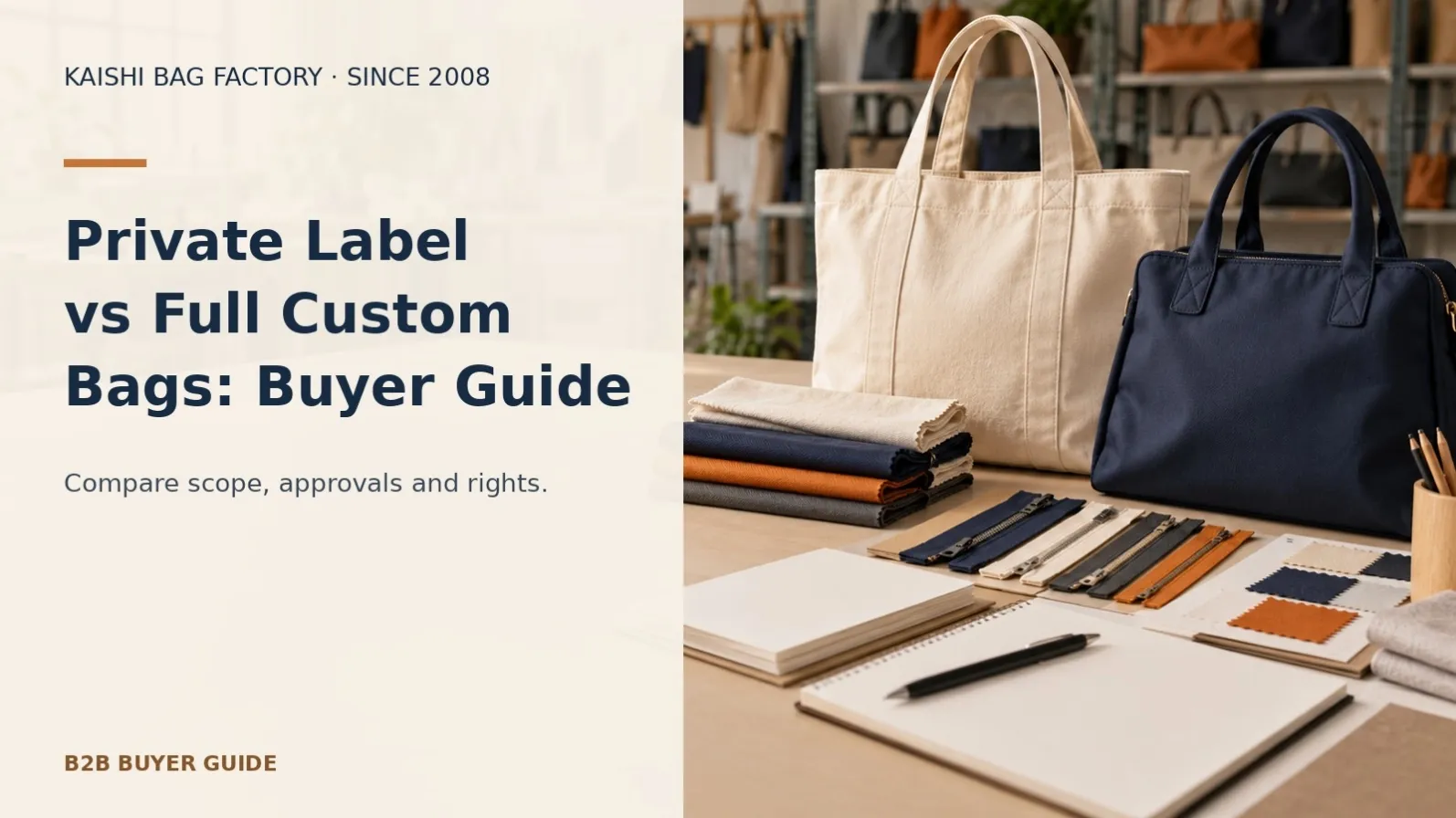
Choose private label bags when an available supplier design meets your needs with limited, confirmed changes. Choose full custom development when your required dimensions, structure or features need a new specification and sample process. Compare the actual scope, quotation, approvals and rights rather than assuming either route is always cheaper, faster or exclusive.
For OEM brands and wholesale buyers, the practical question is what must change to serve the intended customer. Private label, white label, ODM and OEM are used differently by suppliers. Define the work in writing before comparing offers. This guide focuses on selecting a development route, rather than explaining every step of launching a handbag business.
Define the routes in your project brief
In a private-label arrangement, a buyer commonly applies authorized branding to an existing design. Available colours, materials, trim and branding methods still require confirmation. An existing pattern does not guarantee finished inventory or immediate production capacity.
An ODM adaptation starts from a supplier reference but changes agreed features. Those changes might be cosmetic, or they might require new patterns and a substantial sample review. Do not assume that every adaptation is a small task.
Full custom development uses a project-specific specification for the proposed bag. The brief may include new proportions, pockets, reinforcement or hardware. OEM terminology alone does not establish the design's originality, ownership or legal protection. Ask the supplier to identify existing elements and newly developed work.
Separate essential features from preferences
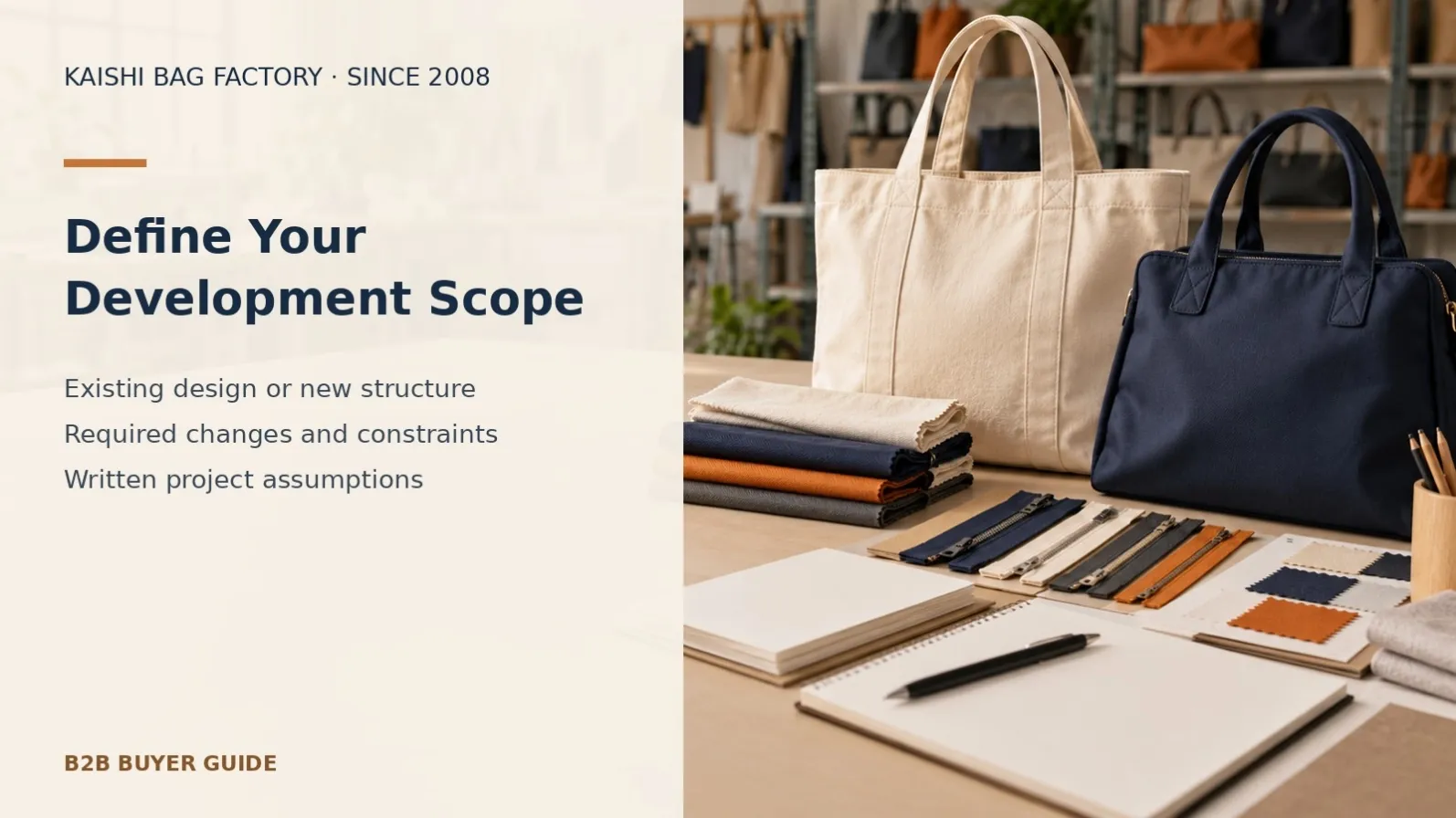
List the customer problem the bag must solve: carrying particular contents, retaining a structured shape, allowing easy pocket access, or fitting a display and packing arrangement. Record which requirements are essential and which can be adjusted after reviewing samples.
If an existing model satisfies the essential needs, limited adaptation may be worth evaluating. If its size, opening or load-bearing construction conflicts with your requirements, a new development brief may be more appropriate. Neither conclusion depends solely on whether the brand is new or established.
A hypothetical wholesale buyer may prioritize a repeatable shape and a coordinated colour range, while a brand developing a signature pocket system may need new pattern work. These examples illustrate decisions; they are not Kaishi customer cases or predictions of market demand.
Compare scope and cost on the same basis
Request an itemized quotation showing included work and assumptions. A stock-looking bag may still require sample charges, branding setup, material sourcing or revised packaging. A custom project using standard components may avoid some tooling. Compare actual proposals, not the label attached to them.
| Decision | Existing-design route | Full-custom route |
|---|---|---|
| Structure | Confirm which dimensions and construction remain unchanged | Define drawings, measurements and functional requirements |
| Materials | Verify proposed options and availability | Review sourcing, alternatives and approval needs |
| Branding | Approve method, placement and application sample | Approve branding alongside the developed structure |
| Setup costs | Identify any adaptation or branding charges | Identify pattern, sample and applicable tooling charges |
| Schedule | Confirm remaining approvals and production constraints | Allow for development, sourcing and revision decisions |
| Rights | Clarify permitted use and any agreed exclusivity | Clarify supplied IP, developed work and tooling terms |
Ask what happens if a material is unavailable, a sample needs revision or quantities change. Confirm whether quoted fees are one-time or recurring and what deliverables they cover. Paying a fee should not be treated as an unstated promise of ownership or unlimited future use.
Evaluate materials and branding with physical references
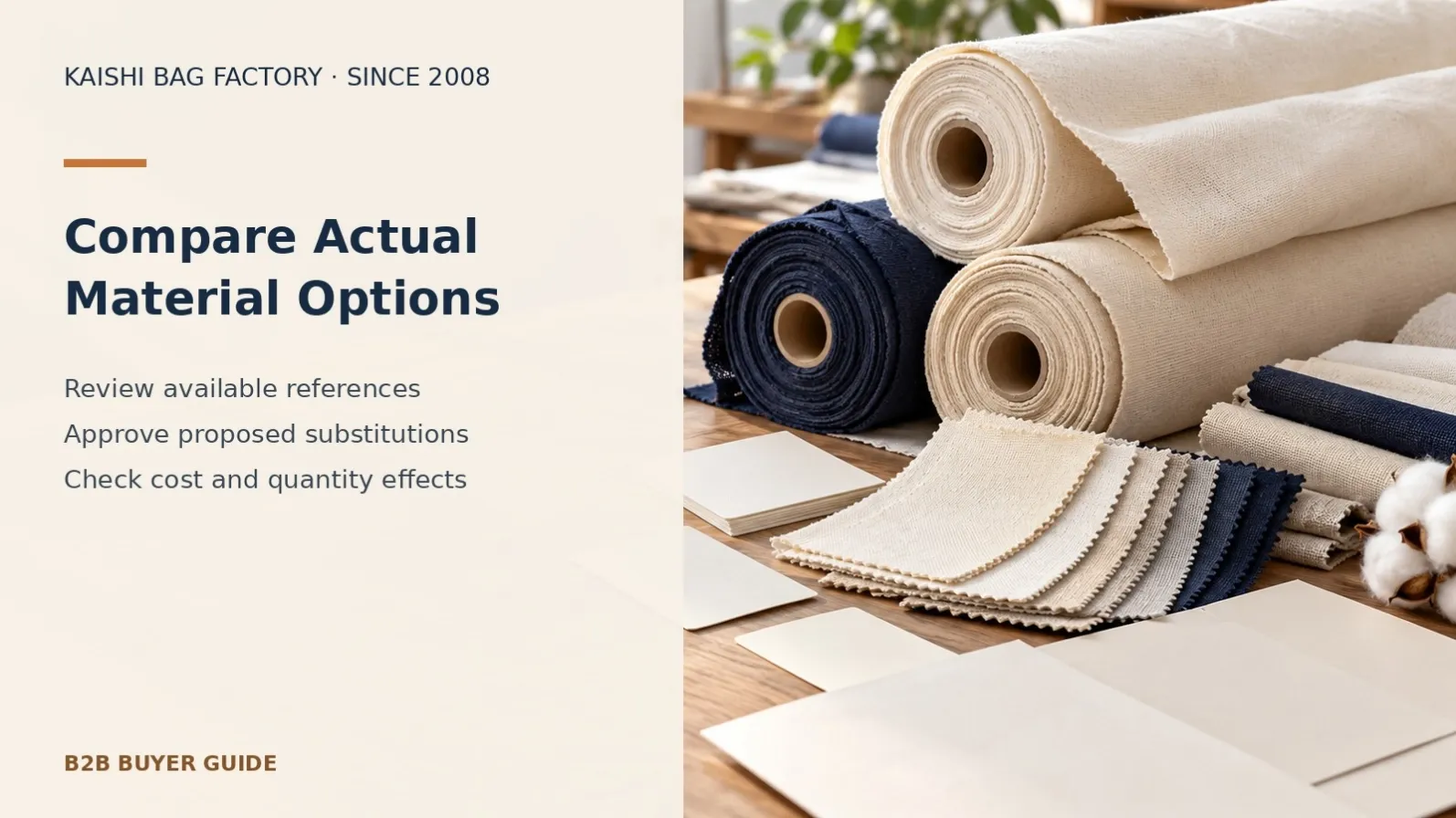
Review actual material swatches and assembled samples. A catalogue image cannot confirm hand feel, backing, lining construction or the finish of hardware. Specify proposed alternatives and whether buyer approval is required before substitution.
For branding, provide artwork you are authorized to use, with dimensions and placement. Ask for a sample of the chosen application method on the proposed material. A logo file does not demonstrate that a particular print, embossing or metal application will work satisfactorily on every surface.
Coordinate thread, lining, edge finish and visible hardware. If a change affects construction, treat it as development work and recheck the relevant function. Do not describe a materially revised product as a simple logo change in the purchase record.
Clarify intellectual property and exclusivity
WIPO explains that trademarks distinguish one enterprise's goods or services, while industrial design rights concern a product's appearance. These are different protections. Applying your brand name to an existing bag does not, by itself, establish exclusive rights to the underlying shape.
WIPO also notes that industrial design protection is territorial and that disclosure timing can matter. For a design you intend to protect, obtain qualified advice for the relevant markets before public disclosure. This article does not determine whether a particular handbag is protectable or whether it infringes another party's rights.
Agree who may use supplied artwork, patterns, samples and newly developed details. If exclusivity is important, define its scope, territory, duration and any conditions in the agreement. Confirm tooling ownership, storage, access and transfer separately. Full custom is not an automatic promise that no other supplier can make something similar.
Plan sample decisions, not a fixed number of rounds
Ask which sample checks remain necessary for the proposed route. Existing-design projects still need confirmation of changed materials, branding, colour and packing. Custom development needs decisions on the structure as well as those details.
Use an approved specification and a clear revision record. Consolidate comments, identify the affected feature and state what should be checked in the next sample. Do not assume that private label needs no sample or that every custom project will finish after a predetermined number of rounds.
Before production, identify the final approved reference and any unresolved items. Review function, measurements, appearance and packing against that reference. Keep written change approval separate from an informal discussion or a promotional product photo.
Confirm Kaishi's project-specific commercial terms
Kaishi Bag Factory is based in Baigou, China, and has worked in OEM/ODM since 2008. The standard MOQ is usually 300 pieces per style. A first order of 200 pieces may be evaluated individually but is not guaranteed; 100 pieces are generally not feasible. Mixed styles and lower repeat-order minimums are not promised.
Sample fees are paid in advance and are non-refundable; automatic credit against production is not promised. Payment is T/T only, usually 50% deposit and 50% before shipment. Confirm development charges, packing, delivery terms and any tooling arrangements in the project quotation.
Timing depends on design, materials, sample approval and quantity. An existing reference does not guarantee a fixed delivery window. Confidentiality or NDA terms can be discussed and agreed for the project; do not assume unlimited confidentiality or exclusivity without an agreement.
Frequently asked questions
Is private label the same as white label?
The terms overlap and supplier usage varies. Specify the actual changes, branding rights and exclusivity rather than relying on either term.
Is private label always cheaper?
No. It may reduce some development work, but materials, quantities, branding and packing still affect cost. Compare itemized quotations.
Does full custom mean I own everything?
No automatic conclusion follows from that label. Confirm supplied IP, newly developed work, tooling and permitted use in writing, with legal advice where needed.
Can an existing design be adapted?
Ask the supplier to assess the requested changes. Some adaptations affect patterns, material sourcing or function and require new approvals.
Do private-label orders need samples?
They still need an agreed approval process for the proposed product and changes. Do not assume catalogue photographs are sufficient.
Can I start with 200 pieces?
Kaishi may assess a first order individually, but acceptance is not guaranteed. The usual standard is 300 pieces per style.
Which route should a new brand choose?
Choose according to essential features, available references, budget, evidence of demand and development readiness. Brand age alone does not decide the route.
Request a comparison for your bag project
Send reference images, required changes, intended use, dimensions, authorized artwork, quantities and destination. Review our product categories, company background and payment guidance. Contact Kaishi Bag Factory for a project-specific assessment. Email donna@Kaishibagfactory.com or use WhatsApp.
Sources and scope
Sources checked 3 October 2026. The route comparison is practical purchasing guidance, not a legal opinion. Images are illustrative generated scenes, not confirmed Kaishi products or facility photographs.