
Sep 21, 2026Materials & Customization
Vegan Leather Bags: PU Material Specification Guide for Buyers
A practical B2B guide to specifying PU and other vegan leather bag materials—backing, coating, finish, testing, MOQ and sample approval.
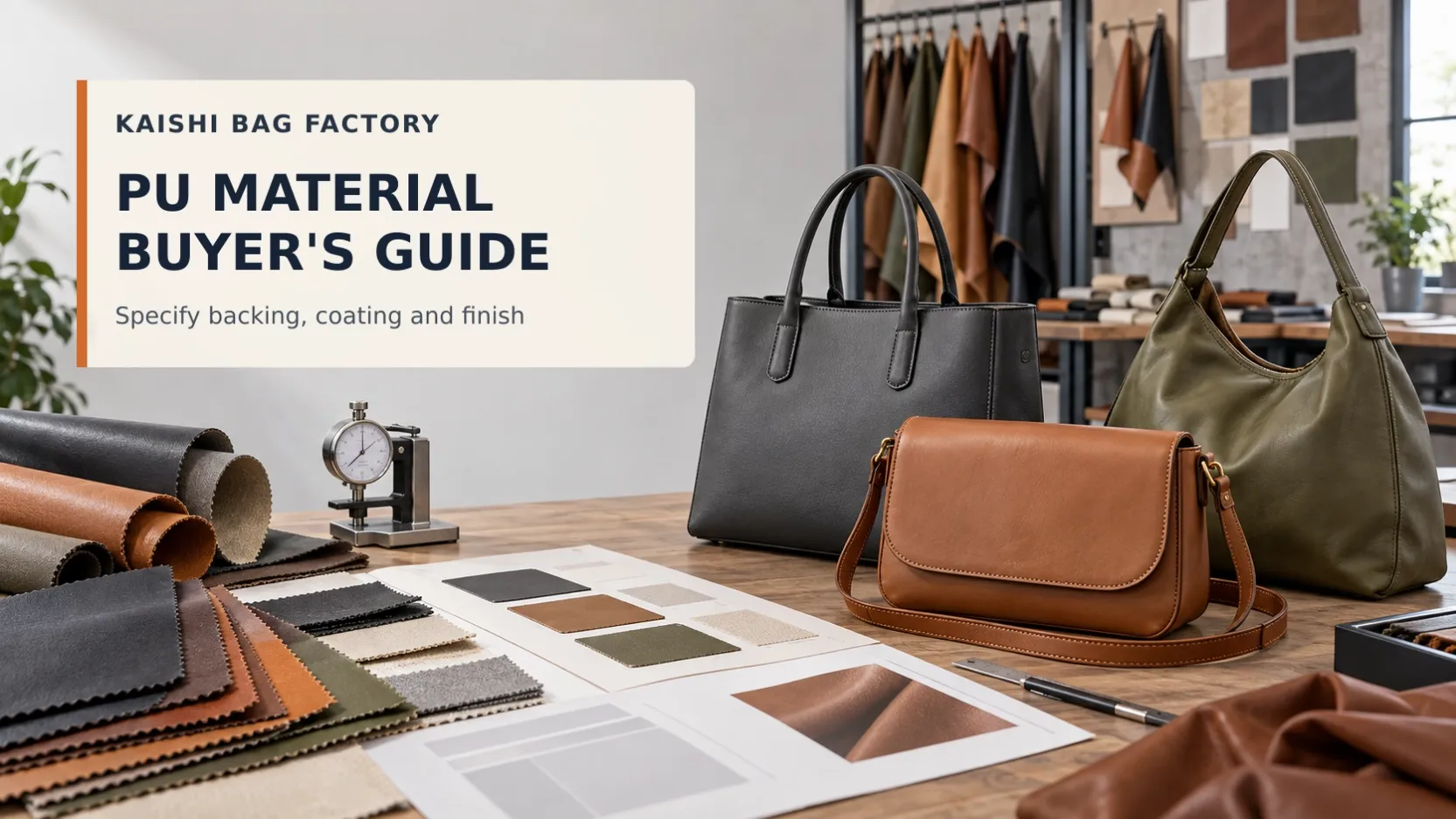
Quick answer: “Vegan leather” is not a complete bag-material specification. For an OEM or private-label bag, buyers should confirm the material family, total thickness, coating and backing construction, surface finish, colour standard, test requirements and approved reference sample. These details make supplier quotations comparable and reduce the risk of bulk material differing from the sample.
This guide is for brand owners, importers and wholesalers developing PU or other non-animal-material bags. It focuses on the purchasing decisions that can be documented before sampling and bulk production.
What does “vegan leather” mean on a bag quotation?
The phrase is commonly used for materials that imitate the appearance or hand feel of leather without using animal hide. It may refer to polyurethane-coated fabric, PVC-coated fabric, microfiber materials or newer formulations containing some plant-derived inputs. These materials do not automatically have the same structure, performance or environmental profile.
For US marketing, the Federal Trade Commission’s Leather Guides address misleading claims about imitation leather and say that non-leather content should be disclosed when a material looks like leather but is not leather. That is a useful purchasing principle even before a product label is prepared: name the actual material construction instead of relying only on “vegan leather.”
The PU specification a bag factory needs
A useful request for quotation should separate the visible finish from the material underneath it. Ask the supplier to record the following items against the approved swatch.
Specification itemWhat to confirmWhy it matters
Material familyPU-coated, PVC-coated, microfiber or another confirmed constructionPrevents unlike materials being compared under one marketing term
Total thicknessMeasured range and permitted toleranceAffects hand feel, folding, skiving and sewing
Coating and backingAvailable construction details, including backing typeInfluences stretch, recovery, edge behaviour and surface stability
Surface finishGrain, embossing, gloss level and top finishControls appearance and compatibility with branding methods
Colour referencePhysical swatch plus the agreed colour standardReduces disputes caused by screens and lighting
End useBag type, stress points and expected useAllows the material and construction to be reviewed together
Test planNamed method, conditioning, acceptance limit and testing partyTurns “durable” into a measurable requirement
Thickness alone does not predict bag performance
Two materials with the same total thickness can behave differently because the coating, backing, surface finish and formulation are different. A specification such as “1.2 mm vegan leather” is therefore incomplete unless that exact thickness and construction have been approved for the design.
Different bag areas also create different demands. A large body panel needs visual consistency. A shoulder-strap fold and handle attachment experience repeated movement. Edges may be folded, turned, skived or painted. The factory should review the selected material at these construction points during sampling rather than assume that one sheet is equally suitable everywhere.
Choose tests according to the product and claim
Testing should be tied to the intended use, target market and claim being made. ASTM lists D3389 as a test method for abrasion resistance of coated fabrics. ISO 17694 specifies a flex-resistance method for footwear uppers and linings regardless of material; it illustrates why a buyer should name the method rather than request a generic “flex test.” Leather-specific standards should not automatically be presented as proof for a synthetic material unless the laboratory confirms that the method is appropriate.
Depending on the product, a buyer may discuss abrasion, flexing, coating adhesion or peel behaviour, colour fastness, hydrolysis resistance, seam strength and restricted-substance requirements with a qualified laboratory. The correct method, sample conditioning, number of cycles and acceptance limit must be agreed. A test report for one material lot does not prove that every material sold under the same name performs identically.
How to approve material before bulk production
• Start with physical swatches. Review colour, grain, hand feel, backing and thickness in person.
• Record the approved construction. Attach the material reference and agreed specification to the tech pack or approval sheet.
• Make the sample in the intended material. Check folds, seams, edge finishing, logo application and high-stress areas.
• Define required testing. State the method and acceptance criteria before ordering bulk material.
• Keep control samples. The buyer and factory should retain signed or sealed references for comparison.
• Reconfirm before cutting. Compare the received bulk material with the approved reference and document any accepted variation.
Common sourcing mistakes
Comparing quotations that use different material assumptions
A lower quotation may reflect a different coating, backing, finish or colour process. Require each supplier to price the same written specification before comparing unit prices.
Using a screen image as the colour standard
Photography, monitors and lighting change colour. Use a physical approved swatch and record the agreed colour reference. Custom colour development may create its own material minimum and schedule.
Making broad sustainability claims
“Vegan” describes the absence of animal-derived leather; it does not by itself establish recycled content, bio-based content, biodegradability or lower environmental impact. Request evidence for each specific claim and confirm that the document applies to the supplied material and production lot.
Approving only the flat material
A swatch cannot show how the material behaves around a zipper, corner, strap fold or reinforced handle. Use the development sample to review the material together with the pattern and construction.
Labelling and compliance considerations
Product claims should be accurate for the destination market. The FTC Leather Guides cover composition and performance representations for leather and imitation-leather products in the United States. The European Commission also maintains rules for fibre names and composition labelling for textile products. Applicability depends on the finished product and its components, so importers should confirm requirements with a qualified compliance adviser instead of treating a supplier declaration as complete legal advice.
Ordering PU bags from Kaishi Bag Factory
Kaishi Bag Factory is an OEM/ODM bag manufacturer in Baigou, China, working with custom bag projects since 2008. Our standard MOQ is normally 300 pieces per style. A first order of 200 pieces may be evaluated case by case, depending on material, colour, hardware, construction and the production plan; it is not guaranteed. Quantities around 100 pieces are usually not workable for custom production.
Samples are paid in advance and are non-refundable. The sample route and production lead time depend on the design, material availability, approval rounds, quantity and current schedule. Payment is accepted by T/T, typically 50% deposit and 50% balance before shipment.
For a useful assessment, send the bag type, dimensions, reference images or drawings, target material, quantity, colours, branding, packaging and destination. We can then review which information is still needed before sampling.
Frequently asked questions
Is vegan leather the same as PU leather?
No. PU-coated materials are commonly marketed as vegan leather, but the broader term may also be used for PVC, microfiber and other non-animal alternatives. Ask for the actual material construction.
What thickness is best for a vegan leather bag?
There is no universal thickness. The appropriate range depends on the bag structure, pattern, reinforcement, folded edges, sewing method and desired hand feel. Approve the material in a finished sample.
How can buyers compare PU quotations?
Give every supplier the same specification: material family, thickness tolerance, backing, surface finish, colour reference, intended use, branding method and test requirements. Compare any exclusions separately.
What is the MOQ for custom PU bags?
At Kaishi Bag Factory, the standard MOQ is normally 300 pieces per style. A 200-piece first order may sometimes be evaluated case by case. Material and hardware minimums can require a higher quantity.
Can a supplier guarantee how many years PU will last?
A universal lifespan should not be promised without a defined material, construction, use environment and test plan. Performance can vary with formulation, coating, backing, heat, humidity, abrasion, storage and care.
Does “vegan” mean recycled or bio-based?
No. These are separate claims. Ask for product-specific documentation and verify that it covers the material and claim used in your market.
Sources
• US Federal Trade Commission — Leather Guides, 16 CFR Part 24
• ASTM International — coated-fabric abrasion test listings, including D3389
• ISO 17694:2016 — flex resistance of footwear uppers and linings
• European Commission — textiles, leather and fur industries and labelling framework
Request a material and sampling review
Preparing an OEM or private-label PU bag? Send your design, dimensions, expected quantity, target finish and destination market through the Kaishi Bag Factory contact page. We will review the specification and explain the next information needed for quotation and sampling.