
Bag Dimension Tolerances: Agree Measurement Points Before Sample Approval
Agree bag measurement points, sample condition and location-specific tolerances before approval. Overall dimensions alone do not define usable fit or inspection.
Agree bag measurement points, sample condition and location-specific tolerances before approval. Overall dimensions alone do not define usable fit or inspection.
This guide is for OEM/ODM brand teams, importers and wholesale buyers developing an original bag specification. It addresses bag dimension tolerances through decisions that can be documented, sampled and reviewed. A photograph or generic material name is not an approval standard. Define the intended use, compare the actual proposed construction and keep a controlled physical reference before authorizing production.
Define exactly what each dimension measures
Width, height and depth need marked endpoints. State whether the bag is empty, lightly supported or filled with agreed reference contents. A soft body measured flat can differ from the same body in its intended shape. Keep external dimensions separate from usable interior clearance, opening width, handle drop and strap adjustment. Draw the measurement lines on front, side and interior views. Identify whether piping, seam thickness, feet or handles are included. Do not assume a product listing and an inspector use the same definition. This measurement convention is a buyer proposal, not a universal official bag standard. Ask the factory to confirm that the proposed method is practical and repeatable on the actual construction before requesting a tolerance.
Prioritize fit-critical and appearance-critical points
A closure alignment, laptop compartment or strap attachment may need a different review from a relaxed side panel. Explain the purpose of each dimension rather than applying one allowance everywhere. Fit-critical points should connect to actual contents or mating components. Appearance-critical points should connect to the desired proportions and accepted sample. Avoid inventing a standard plus-or-minus figure for every bag. The appropriate agreement depends on material, construction and intended use. Ask what is feasible and what affects cost or sample development. Record agreed limits with the relevant method and units. If a field remains undecided, keep it visibly open instead of allowing a provisional drawing value to become a production acceptance rule.
Build a buyer approval worksheet
Use the following worksheet to connect the requirement to its actual reference and review owner. For every field, identify what is confirmed, what is provisional and which evidence is still missing. Include a photograph or annotated drawing where text alone could be interpreted differently. State whether an item is a mandatory functional requirement or a negotiable appearance preference. The table is an operational suggestion, not a quoted standard or a promise of performance. Keep the final version with the accepted sample and quotation so the factory, buyer and inspector can refer to the same baseline. If an exception is accepted, identify its exact scope instead of approving a vague statement that everything is fine.
Make the measurement process reproducible
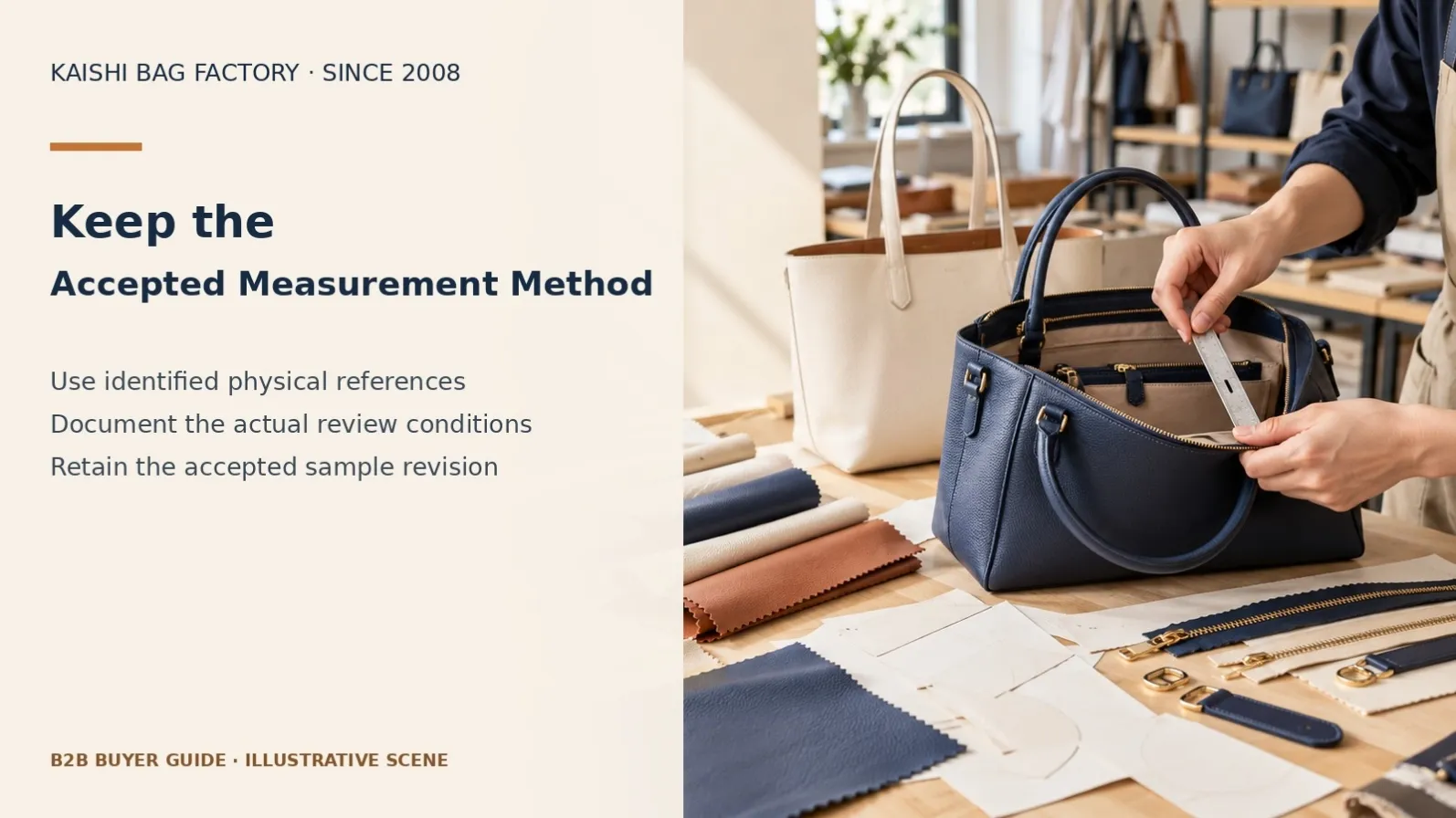
Use the same supported condition, measuring tool and endpoints for comparisons. Record the sample identity and any temporary material substitutions. Do not stretch a soft bag to reach a preferred dimension or compress reinforcement to force a match. Photographs with a ruler help explain the process, but should show the endpoints and avoid perspective distortion. Have the buyer and factory compare their methods on the same sample before interpreting a discrepancy. Measurement uncertainty and repeatability may need technical advice for demanding applications. A commercial tolerance is not a substitute for understanding the method. Keep a worked measurement example with the drawing so a later inspector does not have to reconstruct the buyer’s assumptions from a short label.
Resolve a mismatch without silently changing the brief
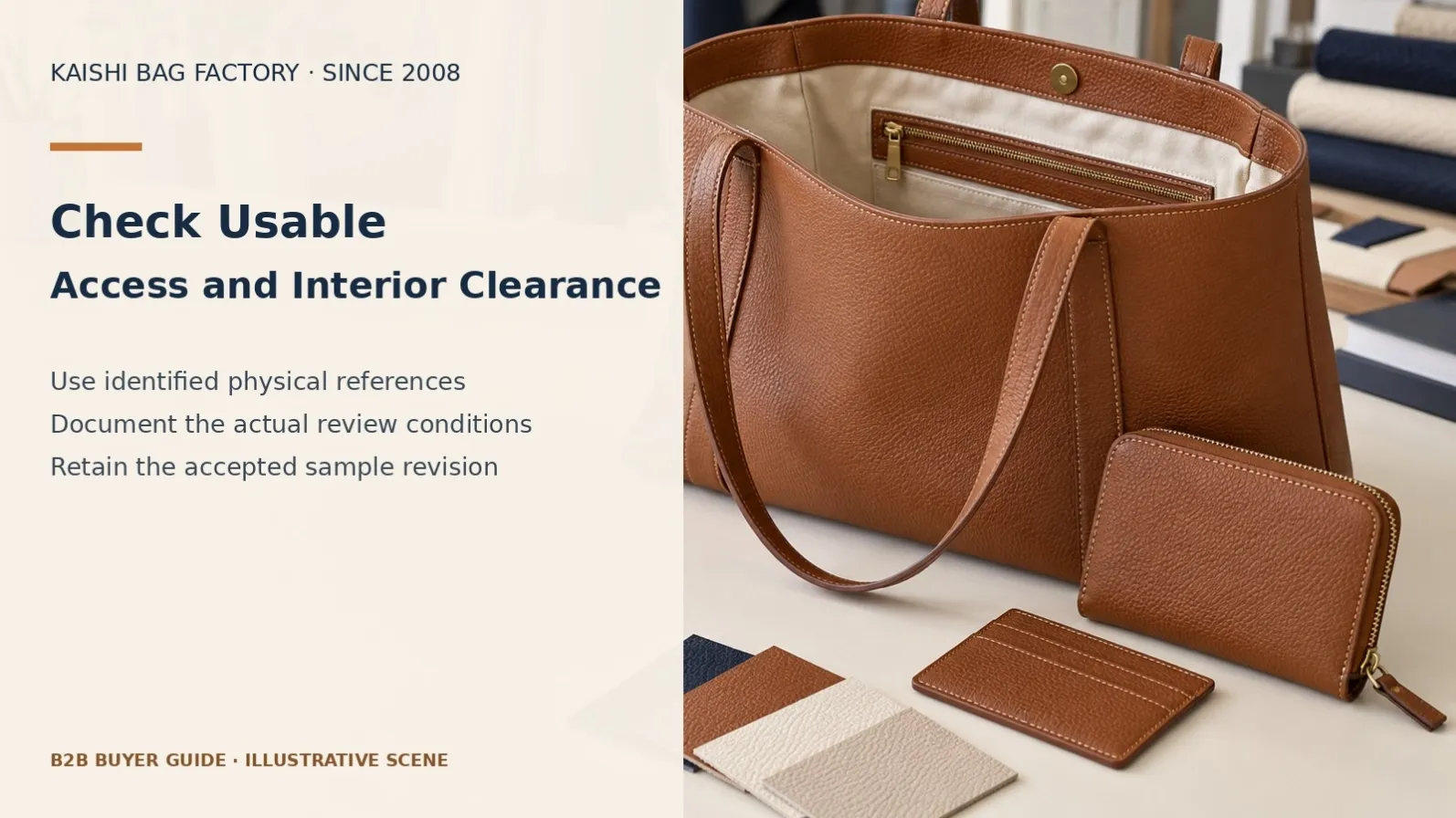
When a measured result differs, first check the method, condition and drawing revision. Then review whether material behaviour, assembly or a mistaken reference is involved. Describe the proposed correction and its effects on access, shape and packaging. Do not simply enlarge the tolerance after a sample fails unless the buyer explicitly accepts the new requirement. Consider a hypothetical tote with the right outside width but a narrow opening: increasing the body width may not fix the access problem. Test the actual opening with reference contents. Record the accepted solution and update linked dimensions. This guide addresses measurement and tolerance decisions, while the tech-pack guide explains the wider specification set. Keep both records consistent.
| Review field | Buyer record | Approval check |
|---|---|---|
| Measurement endpoints | Identified reference and decision owner | Accepted sample or applicable evidence |
| Sample condition | Identified reference and decision owner | Accepted sample or applicable evidence |
| Functional clearance | Identified reference and decision owner | Accepted sample or applicable evidence |
| Agreed limit | Identified reference and decision owner | Accepted sample or applicable evidence |
| Revision record | Identified reference and decision owner | Accepted sample or applicable evidence |
Use sample review to close the remaining decisions
Review the production-intent sample with the agreed contents, material references and component configuration. Record observations before making a correction, then explain what changed and which linked features need reassessment. A sample made with temporary parts should list them clearly. Do not approve the final specification from the silhouette alone. In a remote review, ask for the angles and measurements that address your stated question; a short promotional clip may miss the relevant detail. Photographs support communication but do not replace a physical sample where the decision depends on touch, fit or operation. Decide who approves each open item and retain the written conclusion with the current revision.
Keep wholesale handover consistent across variants
For European and US brand programs, connect technical approval to the actual SKU and any buyer documentation requirements. For Nigerian or Indian wholesale programs, keep style, colour and included-component quantities clear so receiving teams can identify what was supplied. These markets do not share one guaranteed preference or sales outcome. Base assortment decisions on the buyer’s own evidence rather than assume a universal best seller. If variants use different materials or components, identify the differences instead of allowing one approval to silently cover the collection. Keep packing and product descriptions aligned with the accepted specification. A reorder should confirm the current requirements, not automatically reuse an outdated reference.
Prepare a project-specific enquiry
Send the current drawing or tech pack, measured dimensions, intended carry contents, material references, component list, colour breakdown and proposed order quantities. Identify the sales destination and any buyer-required testing or packaging documentation. Separate mandatory requirements from design preferences, and explain which decisions remain open. This lets the factory review a real development scope rather than make assumptions from a reference photograph.
Ask the quotation to identify the selected construction, sample scope, material exceptions, packaging, delivery basis and validity conditions. Confirm who approves the physical sample and which revision becomes the production baseline. If a component changes, request an impact review before accepting the replacement. Keep commercial approval separate from technical approval: an attractive unit price does not establish that the revised bag meets the agreed use or inspection requirements.
Related buyer guides
bag tech-pack checklist and quality-control and inspection guide
Frequently asked questions
Is there a universal bag tolerance?
This guide does not prescribe one. Agree location-specific limits and a repeatable method for the actual construction.
Should we measure empty or filled?
Define the condition according to the purpose. Keep it consistent between sample approval and inspection.
Is outside width enough for fit?
No. Usable opening and internal clearance can differ. Check the intended contents in the completed sample.
Can photos replace measurements?
They support communication but should not replace an agreed physical measurement process.
What if two people get different values?
Compare endpoints, condition, tools and handling before deciding that the product is out of tolerance.
Can a tolerance change after approval?
Treat it as a documented specification change, with buyer review of its functional and commercial effects.
What are Kaishi’s order, sample and payment terms?
Kaishi Bag Factory is based in Baigou, China and has worked in OEM/ODM since 2008. Kaishi's MOQ is a fixed 300 pieces per style. A first order is also 300 pieces per style, with no exceptions. An order of 100 pieces is not workable for custom production. Mixed styles and reorders do not automatically qualify for lower minimums. Samples are prepaid and non-refundable, without automatic bulk-order credit. Payment is T/T only, usually 50% deposit and 50% before shipment. Timing depends on design, materials, sample approval and quantity. Any NDA and project-specific conditions require agreement.
Sources and next step
Sources checked on 7 October 2026: AMANN bag sewing guidance and SATRA test-method directory. Supplier examples explain general principles, not Kaishi equipment ownership, certification or guaranteed availability. The purchasing worksheets are suggested buyer practices rather than quoted standard requirements.
Contact Kaishi Bag Factory with your specification and quantities for a project review. Email donna@Kaishibagfactory.com or message Donna on WhatsApp.