
What to Include in a Bag Tech Pack Before Requesting a Quote
Prepare a bag factory quote with clear drawings, measurement points, materials, hardware, branding, quantities and packaging. Includes a buyer checklist and FAQs.
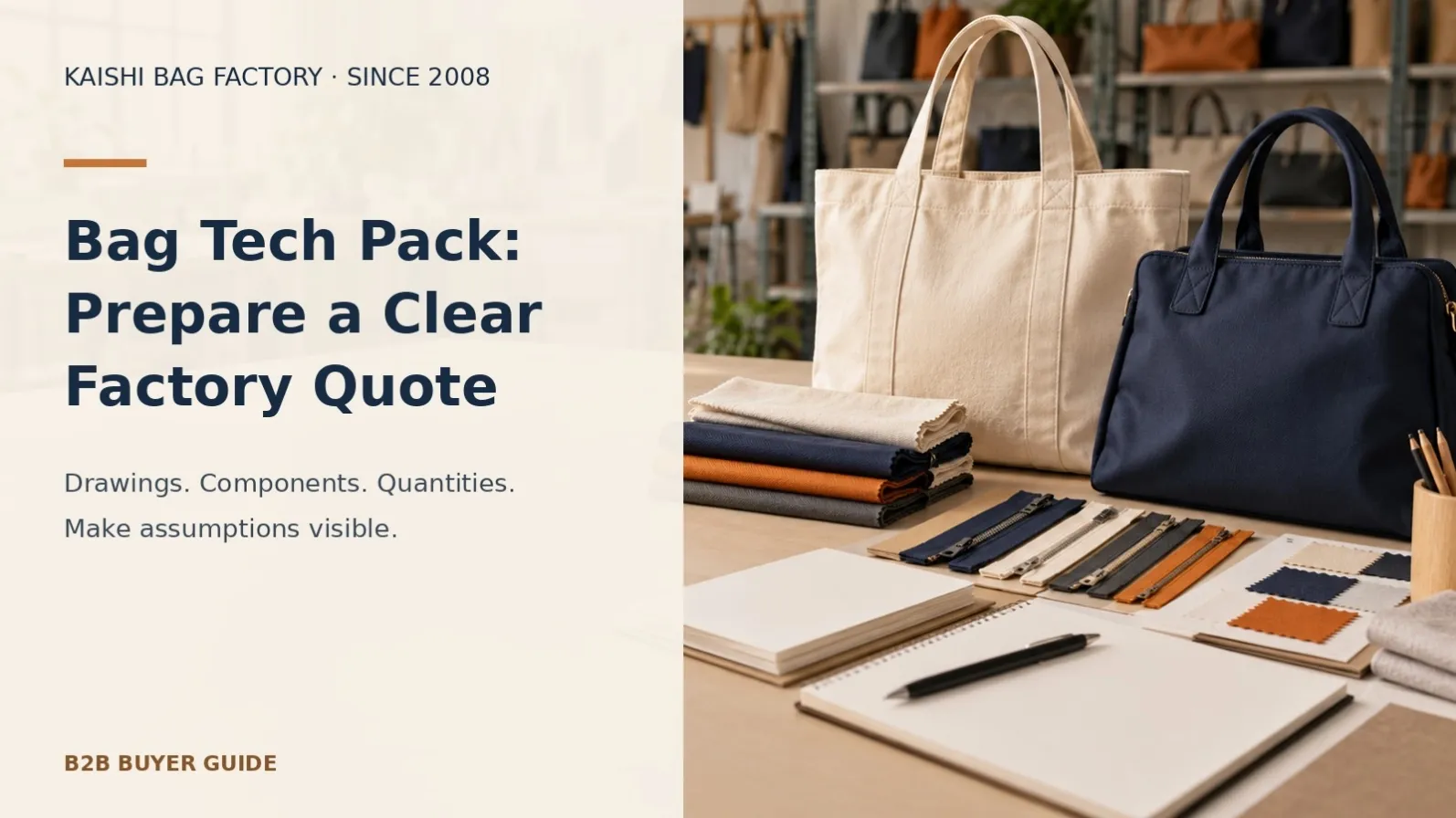
A useful bag tech pack gives a manufacturer enough controlled information to understand what you want quoted, what still needs development and what must be approved before production. At minimum, include a product overview, dimensioned drawings, materials, colours, construction details, hardware, branding, labels, packaging, quantity by style and colour, destination market and a revision number. Mark unknown items as “to be confirmed” instead of letting either side guess.
This guide focuses on the information a buyer sends before requesting a bag manufacturing quotation. It helps separate firm requirements, supplier proposals and unresolved decisions. Later sample changes need a separate approval record; an initial quote file should not be mistaken for an approved production specification.
The minimum information for a quotation
A preliminary quotation can often begin with a reference image and approximate specifications, but the factory must state which assumptions are included. A more useful quote request contains the following fields:
| Tech-pack section | What to provide | Why it affects the quote |
|---|---|---|
| Product identity | Working name, style code, intended use and target customer | Separates versions and clarifies performance expectations |
| Views and dimensions | Front, back, side, base and interior views with measurement points | Defines scale, panels, pockets and construction |
| Materials | Outer, lining, reinforcement, webbing and trim descriptions or swatches | Changes sourcing, handling, construction and testing |
| Components | Zippers, sliders, buckles, hooks, magnets, feet and closures | Affects function, finish, tooling and availability |
| Branding | Logo artwork, method, size, placement, colour and label wording | Determines process, setup and approval requirements |
| Order plan | Quantity by style and colour, destination and packaging | Supports MOQ, material and logistics assessment |
Kaishi Bag Factory’s standard MOQ is usually 300 pieces per style. A 200-piece first order may be assessed case by case without a guarantee; 100 pieces is generally not feasible. Do not assume different styles or colours can be combined into one minimum. Send the breakdown you actually intend to buy.
Draw the bag as a measurable product
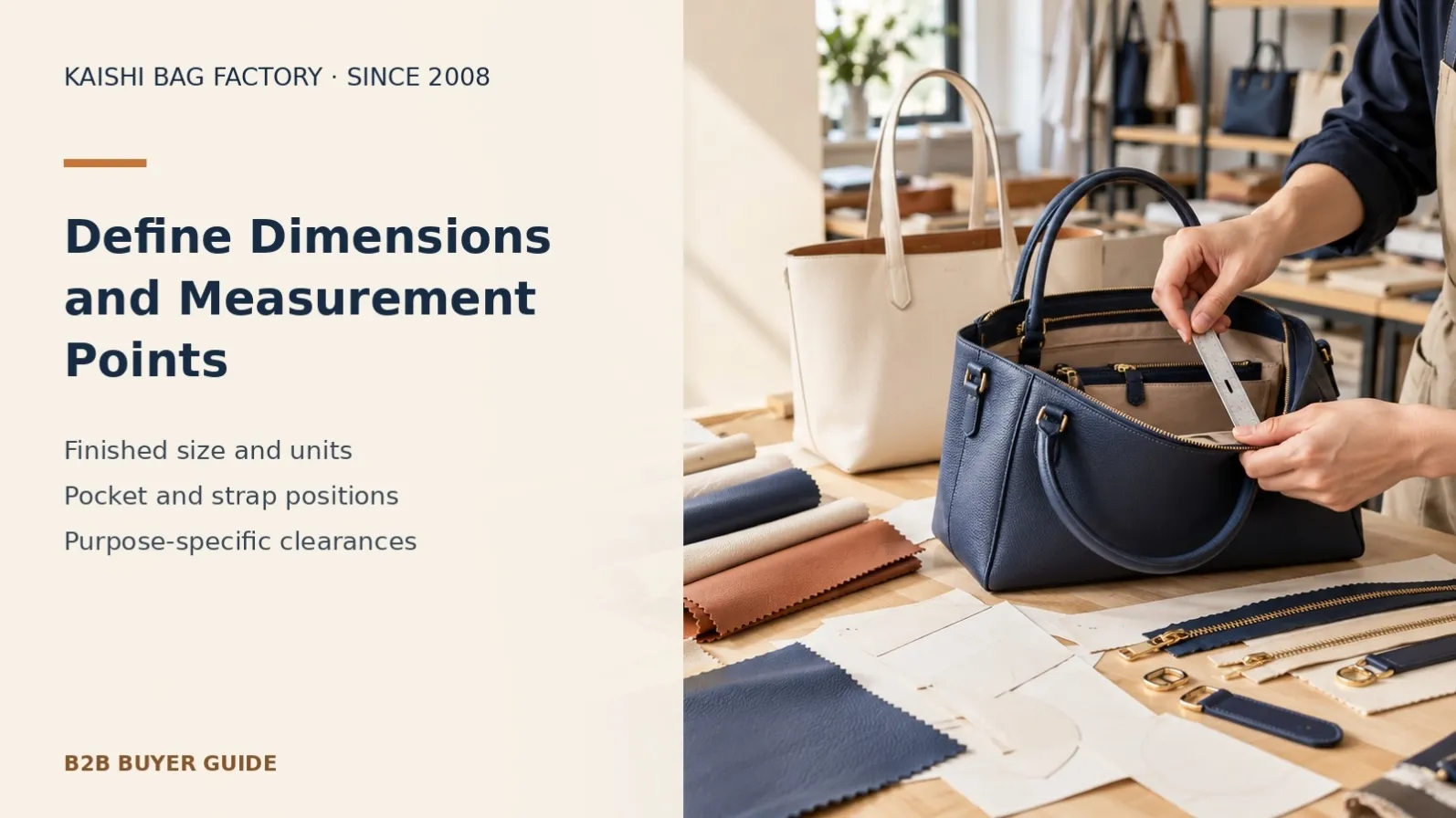
Provide front, back, side, top, base and interior views when those areas contain different features. Indicate the finished width, height and depth, but also define how each measurement is taken. A soft tote measured flat is not the same as a structured bag measured at the widest finished points. For curved shapes, show reference points instead of relying on one overall number.
Add the positions and finished sizes of pockets, handles, shoulder straps, openings and logo placements. If a strap is adjustable, state the useful adjustment range and the measurement method. If the bag must fit an object, provide the object’s dimensions and required clearance. Tolerances should be discussed for the actual material and construction; copying a universal tolerance into every style may create a specification that cannot be applied consistently.
Specify materials by function, not only by name
Terms such as “canvas,” “nylon,” “vegan leather” or “genuine leather” are categories, not complete specifications. Describe the intended appearance, hand feel, structure, backing, colour and performance priority. Attach a physical swatch or an approved supplier reference when visual and tactile matching matters.
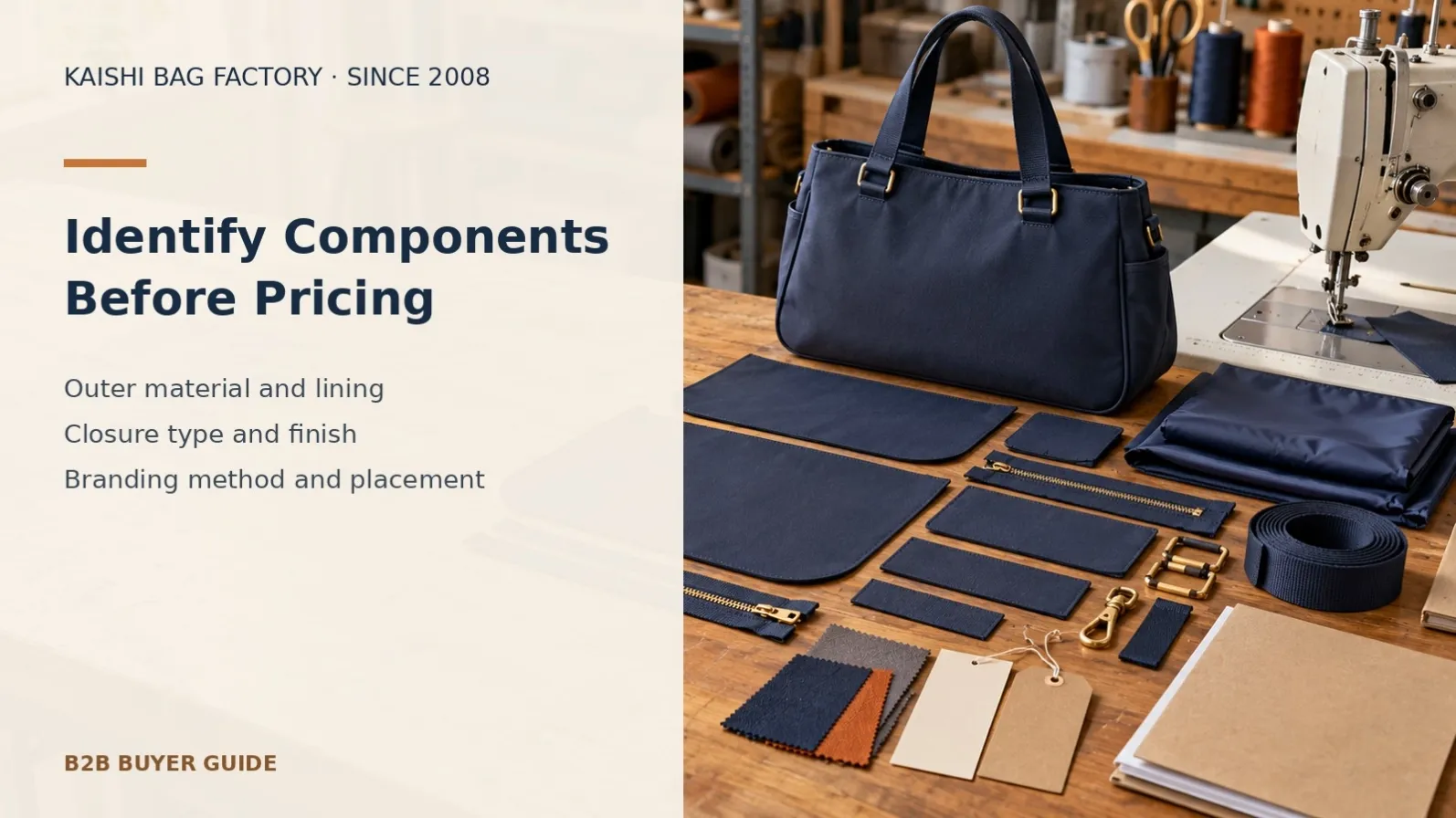
List the outer material, lining, reinforcement, foam, webbing, thread and edge treatment separately. Do not assume one standard fabric weight, a universal PU thickness or a fixed lining construction applies to every bag. If recycled, organic, bio-based or other material claims are required, name the exact claim and evidence you need. Availability and documentation must be checked for the specific project; the tech pack should not promise a certification before the applicable material and supply-chain evidence have been verified.
Make construction and hardware decisions visible
Show seam locations, stitch appearance, folded or bound edges, piping, reinforcement points, handle attachments and the intended structure. Identify the areas that will carry load. A drawing of the outside alone may not reveal the reinforcement needed behind a handle, D-ring or magnetic closure.
For hardware, record component type, size, finish, colour, logo requirements and function. A photograph can communicate style, but add a measurable description and mark whether it is a reference or a required match. The same applies to zippers: define the opening, chain appearance, puller, colour and end treatment that the sample must demonstrate. Final component selection remains subject to sourcing and sample approval. YKK’s usage manual demonstrates why zipper type, dimensions, material interactions and application conditions matter. Its product-specific guidance is not evidence that Kaishi uses a particular branded component; specify any required brand and model for separate confirmation.
Control branding, labels and market information
Supply vector artwork you are authorised to use. Define the logo method, finished size, colour, location and orientation. Specify woven labels, printed labels, hangtags, care information, country-of-origin wording, barcode placement and packaging marks as separate items. A visual mock-up is helpful, but a measured placement instruction is what makes inspection possible.
Label and safety obligations depend on the product, user and destination market. The U.S. Consumer Product Safety Commission directs businesses to determine which requirements apply to the particular consumer product; product requirements must be checked for the particular bag and intended user. The tech pack should identify the destination and intended age group so the buyer can confirm applicable requirements with qualified advisers. It should not present a generic factory checklist as legal approval.
Identify the current quotation file and protect information
Put a style code, revision number, date and responsible contact on the file. Maintain one current version and a short change log. When a pocket, material, colour or component changes, record the change and ask whether it affects cost, sample work, MOQ or timing. Do not send several differently named files and expect the receiver to infer which one is final.
For commercially sensitive designs, discuss an appropriate NDA and information-handling expectations before sharing what is necessary. WIPO explains that reasonable measures to protect trade secrets can include confidentiality agreements, restricted access and marking confidential documents. An NDA is not an absolute guarantee, and its effect depends on its terms and applicable law, but disciplined file control reduces avoidable confusion and exposure.
State order quantities, packing and open decisions
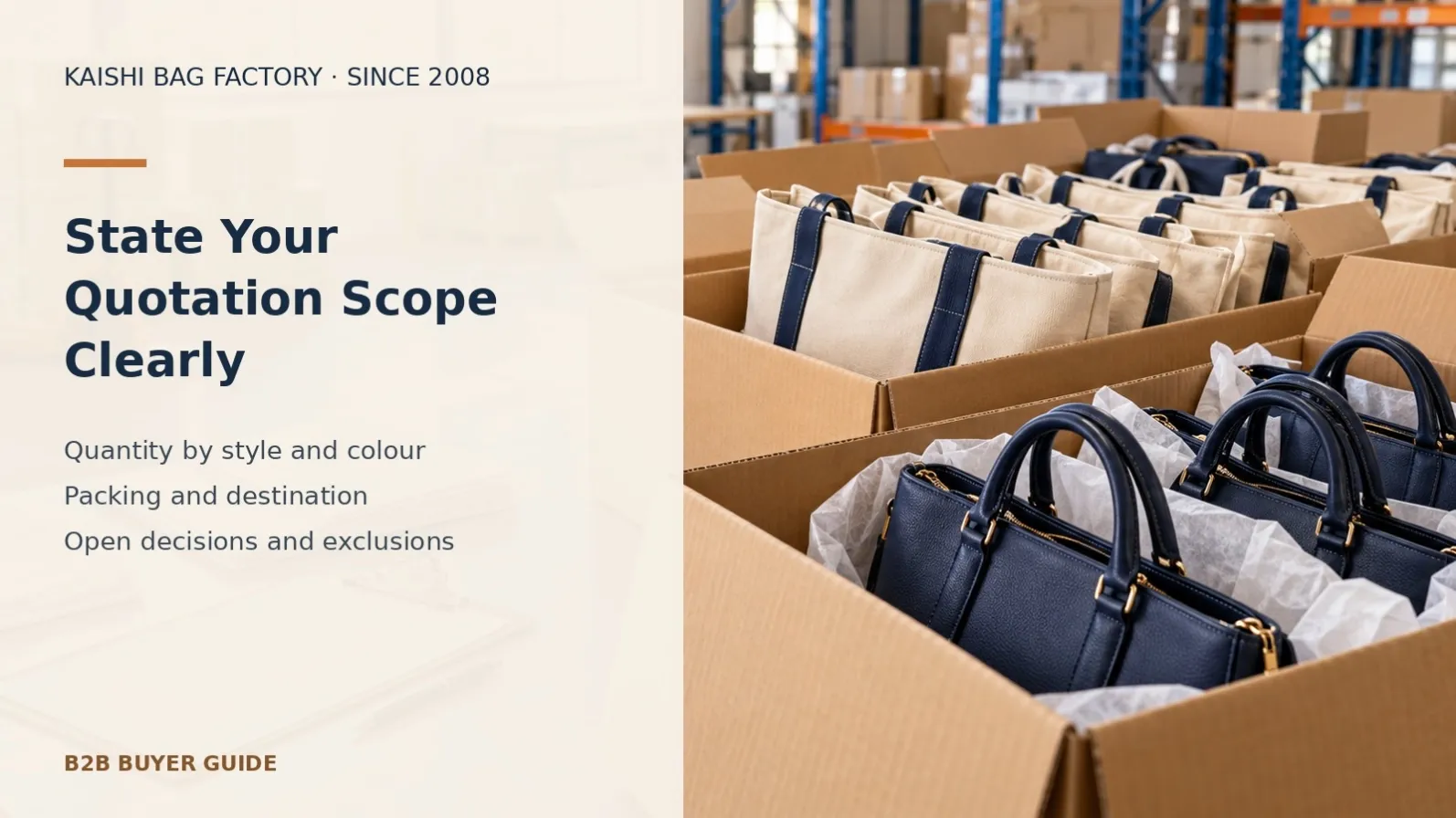
Specify quantities by style and colour rather than only a total. Identify whether a colour is a physical reference, an available option to be confirmed or a new development request. Include unit packing, carton requirements, destination and any buyer-provided label artwork. Packing changes can affect both the quoted work and the shipment volume.
Compare quotations using the same assumptions
Ask each supplier to identify the specification version used, proposed substitutions, excluded charges and unresolved inputs. Check whether development, tooling, testing, inspection, packing or transport is included. A lower price for a different construction is not a like-for-like saving. Mark preliminary prices as provisional and request confirmation when material and sample decisions change the scope.
Pantone recommends a recent physical colour reference when moving from digital selection to a physical product. Review achievability on the proposed substrate; a screenshot alone is not a complete matching instruction. Describe how physical material and colour approval will be obtained without promising an exact match across every surface.
At Kaishi, samples are paid upfront and the fee is non-refundable; do not assume a free sample or automatic credit against a bulk order. Bulk payment is T/T only, normally 50% deposit and 50% before shipment. Timing depends on the design, materials, sample confirmation and quantity, so it must be confirmed for the project rather than copied as a fixed promise.
Frequently asked questions
1. Can I request a quote without a finished tech pack?
Yes, you can request an initial assessment using a clear reference, approximate dimensions, materials, branding and quantity. The quote should identify assumptions and open items. Exact pricing may require a revised specification, material confirmation or sample development.
2. Should I include reference photos from another brand?
You may use a reference to explain a general feature or proportion, but state what you want to develop and provide artwork you have the right to use. A reference image is not permission to copy protected branding or a third party’s design.
3. Do I need to specify every stitch?
Not every decorative or routine detail needs a separate drawing, but load points, visible seam appearance, edge finishing, reinforcement and any inspection-critical construction should be clear. Ask the development team which unknowns need decisions.
4. How should I handle an item that is not decided?
Mark it “to be confirmed,” name the decision owner and set the approval stage. If the factory proposes an alternative, record whether it is for quotation, sampling or final production. Never leave a critical field blank and assume both parties interpret it the same way.
5. Is the sample itself enough as the final specification?
The approved sample is important, but it works best with a written, version-controlled specification. Materials or colours can vary, and hidden construction may not be obvious from the sample alone. Record approved substitutions and measurable criteria.
6. When should the tech pack be updated?
Update it whenever a change affects the product, quotation, sample, compliance information, packing or approval criteria. Issue a new revision rather than silently editing an old file, and obtain written confirmation of the version used for the order.
7. What should I send Kaishi for a first review?
Send the current drawing or reference, dimensions, intended use, materials, branding method, quantities by style and colour, destination market, target arrival window and any required tests or documents. Donna can then identify missing inputs and the appropriate next step.
Sources and next step
Compare product examples, review Kaishi’s background, and consult the payment guide and import planning guide when preparing the commercial scope.
This guide uses Kaishi’s confirmed order policies. General external guidance includes the U.S. CPSC Business Education resources, the CPSC backpacks and handbags guidance, and the WIPO trade-secrets FAQ. Other technical references include Pantone’s physical colour reference guidance and YKK’s zipper usage manual. Buyers remain responsible for confirming requirements for their product and market.
Ready to prepare your custom bag quote? Send your current brief through the Kaishi contact page, email donna@Kaishibagfactory.com, or use WhatsApp. Kaishi Bag Factory, based in Baigou, China, has worked on OEM/ODM bag projects since 2008.
Reviewed 4 October 2026. Images are generated material and workshop illustrations, not documentary Kaishi photographs. No universal material specification or product certification is implied.