
Understanding Bag Hardware: Zippers, Buckles and Metal Finishes
B2B guide to specifying zippers, buckles, hooks and metal finishes for custom bags. Compare function, samples and test methods before bulk production.
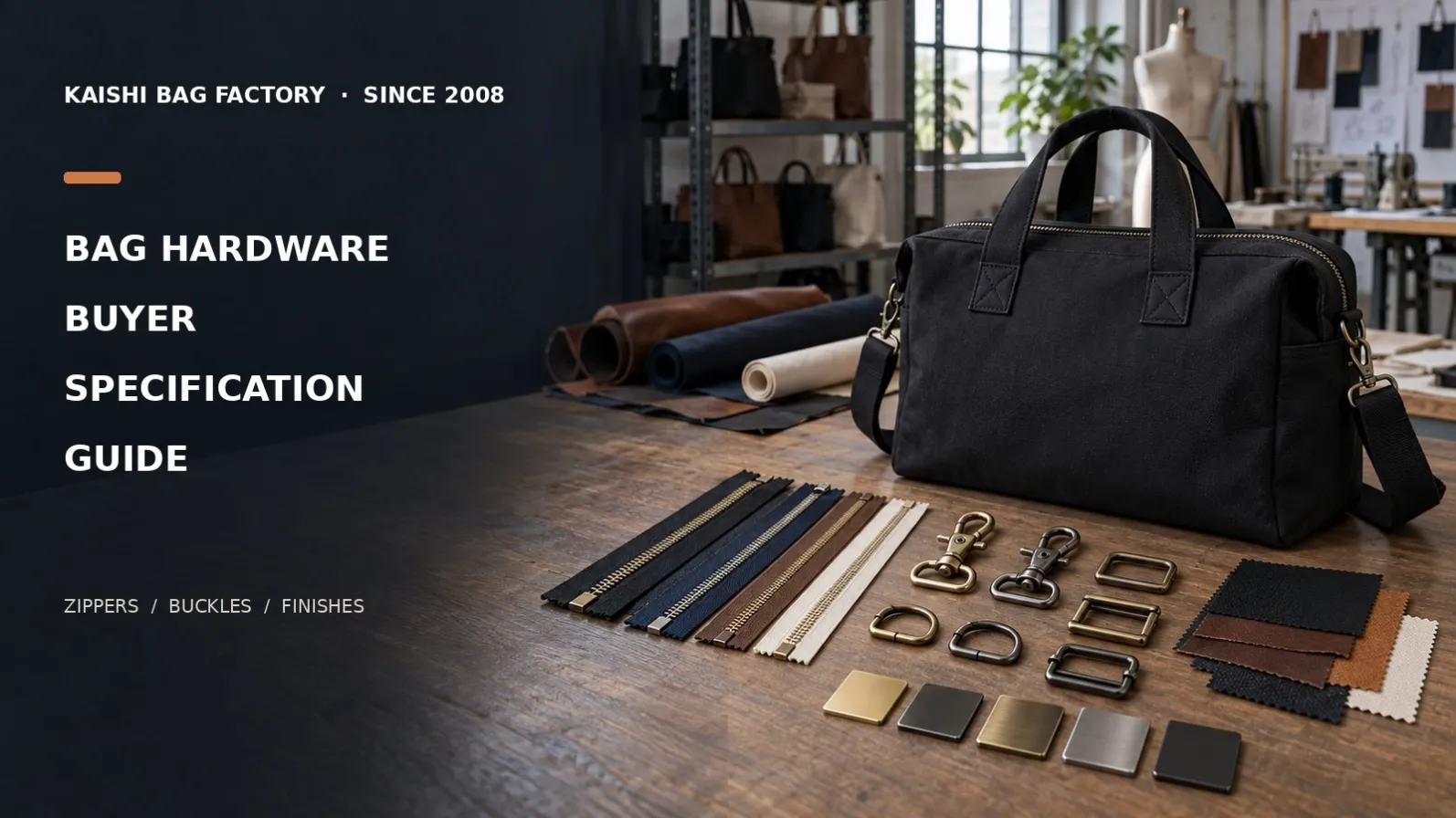
Quick answer: buy hardware against a written specification
For an OEM handbag or backpack, choose zippers, sliders, pulls, buckles, hooks, rings and finishes according to function, dimensions, intended load and appearance. Ask for physical component samples, then test the assembled bag under its intended use. A larger zipper number or a metal finish alone does not guarantee longer life. Record an approved sample, component reference and acceptance criteria before bulk production.
This guide is for brand owners, importers and wholesale buyers comparing bag hardware proposals. Kaishi Bag Factory in Baigou, China has worked on OEM/ODM bags since 2008. Hardware availability, custom tooling and any product-specific testing are reviewed with the project, not promised for every style.
Start with the use case and failure point
Map each component to the job it performs. A main opening must be easy to operate along its full curve; a detachable shoulder-strap hook has a load-bearing role; a logo plate may be decorative. Specify the expected bag contents, frequency of opening, exposure to moisture or sweat, and destination market. Those details matter more than choosing components from a photo alone. Test the actual bag, because strap anchoring, stitching and panel reinforcement can fail even when a loose hook passes a component check.
| Component | Buyer should define | Sample check |
|---|---|---|
| Zipper assembly | Type, nominal size, length, slider, tape and end stops | Operate across the full opening when loaded |
| Strap hook and ring | Shape, inside width, base material and finish | Engagement, rotation, edge finish and anchoring |
| Buckle or adjuster | Webbing width, adjustment range and use | Secure release or retention under the agreed load |
| Metal trim | Colour reference, finish and contact surfaces | Visual match, sharp edges and agreed corrosion evaluation |
Specify the entire zipper, not just a number
Coil, metal and molded plastic element zippers are distinct constructions; the YKK product catalogue lists examples of each. A nominal size such as #3, #5 or #8 is only one dimension in a particular supplier's range. It does not, by itself, prove component quality or mean that every backpack requires #8 or every handbag needs #5. Compare tape strength, slider compatibility, chain, length, stops, pull and the curve of the opening. Ask the component supplier for a reference sample and any relevant product test information.
On the production-intent bag, load it with representative contents, open and close the zipper along its complete path, inspect the corners and check whether the slider catches the lining. Note the orientation of a locking slider and whether a double opening is needed. A coated zipper can reduce ingress at the chain but does not make the entire bag waterproof; seams, corners and other openings require separate consideration. For bag construction and strap load paths, see our backpack specification guide.
Choose buckles, hooks and rings by interface
A hook's opening must engage the ring reliably and rotate or sit as intended. The ring's internal width should suit the strap and avoid pinching. An adjuster should grip the selected webbing without cutting or polishing it excessively. A side-release buckle should release deliberately, not unexpectedly, in the intended use. Check edges by hand, then inspect the adjacent webbing after a representative load and movement test agreed with the buyer. Do not claim a universal load rating for an unspecified component or assembled bag.
Magnetic snaps, press studs and rivets need suitable placement and attachment support. A magnet can be convenient for a flap but should be evaluated for holding force, contents and applicable market requirements. Rivets can be decorative or structural depending on the design; inspect seating and backing on the finished sample. If custom-shaped hardware or branded pulls are requested, agree artwork ownership and tooling responsibility in writing. A custom item may alter minimum purchases, sample cost and timing.
Describe the metal finish precisely
“Gold hardware” is not a sufficient specification. Identify the base material, plating or coating process where known, approved colour reference, gloss and texture, and which components must match. Compare under consistent lighting with a physical reference; different alloys and suppliers may yield different tones even when their catalogue names match. A brushed finish can disguise some fingerprints, while a glossy finish can make scratches more visible; neither is intrinsically durable without knowing its coating and use.
For products exposed to sweat, coastal air or water, decide whether corrosion evaluation is relevant. ISO 9227:2022 defines salt-spray test procedures for metallic materials and coatings. It does not set a universal number of hours every bag must pass, and laboratory exposure is not a direct prediction of years of real-world use. Define test method, sample preparation, duration and acceptance with the buyer and laboratory. Check the destination market's applicable product rules separately; a general article cannot certify a particular bag.
Control cost without weakening a critical part
Price depends on base material, finish, supplier, order quantity, tooling, zipper length and design. Compare quotations using the same component list and sample standard. Standard components can be a useful starting point when the appearance is acceptable; evaluate custom options if they solve a clear brand or functional need. A cheaper hook that forces a heavier reinforcement or a replacement can increase total project cost. Avoid blanket claims that moving from one nominal zipper size to another has a predictable unit-price effect.
Kaishi's MOQ is a fixed 300 pieces per style. A first order is also 300 pieces per style, with no exceptions. An order of 100 pieces is not workable for custom production. Sampling is paid in advance. We accept T/T only, typically 50% deposit and 50% before shipment. Sampling and bulk timing depend on the design, material and component availability, sample approval and order quantity.
Approve hardware on a production-intent sample
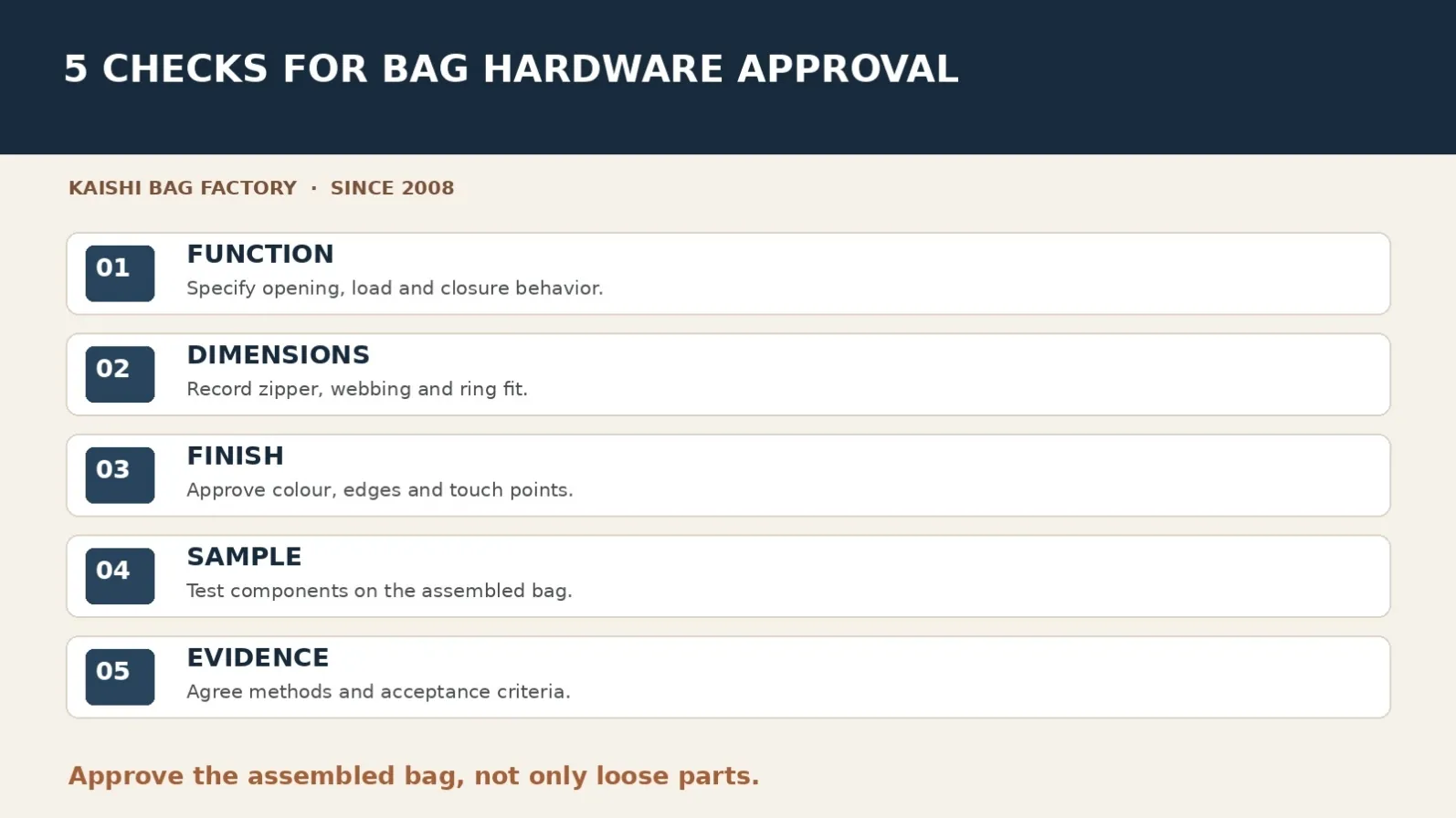
- List every component location, supplier or approved reference, dimensions and finish.
- Check the complete bag under a representative load and normal opening motion.
- Inspect edge finishing, attachment stitching and the fabric or webbing surrounding each component.
- Agree any relevant component, corrosion or finished-bag tests and acceptance values before testing.
- Photograph and label the approved sample version; record authorized changes after approval.
Keep a physical finish swatch and sample as the reference for bulk inspection. A supplier substitution after approval should be assessed against the same requirements, especially for load-bearing parts.
Frequently asked questions
Does a larger zipper number always mean a stronger bag?
No. Nominal size is one feature. Chain, tape, slider, sewing, opening geometry and overall bag construction must be reviewed together.
Should every backpack use a #8 main zipper?
No universal rule applies. Select a suitable assembly by opening, expected contents and intended use, then approve it on the sample.
Is a coated zipper waterproof?
It may address one route of water ingress, but the seams, corners and other openings of the finished bag need separate assessment.
Can we use our logo on a zipper pull?
Possibly, subject to artwork authorization, component feasibility, tooling, minimum purchases and a project-specific quotation.
How should we compare gold finishes?
Use an approved physical reference under consistent lighting and specify base material, finish, texture and acceptable variation for every visible part.
What does a salt-spray result prove?
It reports performance under the specified laboratory method and conditions. It is not a universal warranty against real-world corrosion.
When should hardware be approved?
Before bulk production, on a production-intent bag that records all components and their function, appearance and agreed checks.
Sources and project inquiry
- YKK Fastening Products — zipper constructions and component catalogue
- ISO 9227:2022 — corrosion tests in artificial atmospheres
Send the bag drawing, hardware schedule, expected use, quantity and target market through the Kaishi contact page. We can review the component options and plan a production-intent sample.