
Custom Backpack Manufacturing: A Complete Guide
OEM backpack buyer guide: define load paths, materials, pockets and tests; approve a sample before bulk production. Kaishi MOQ is usually 300 pieces per style.
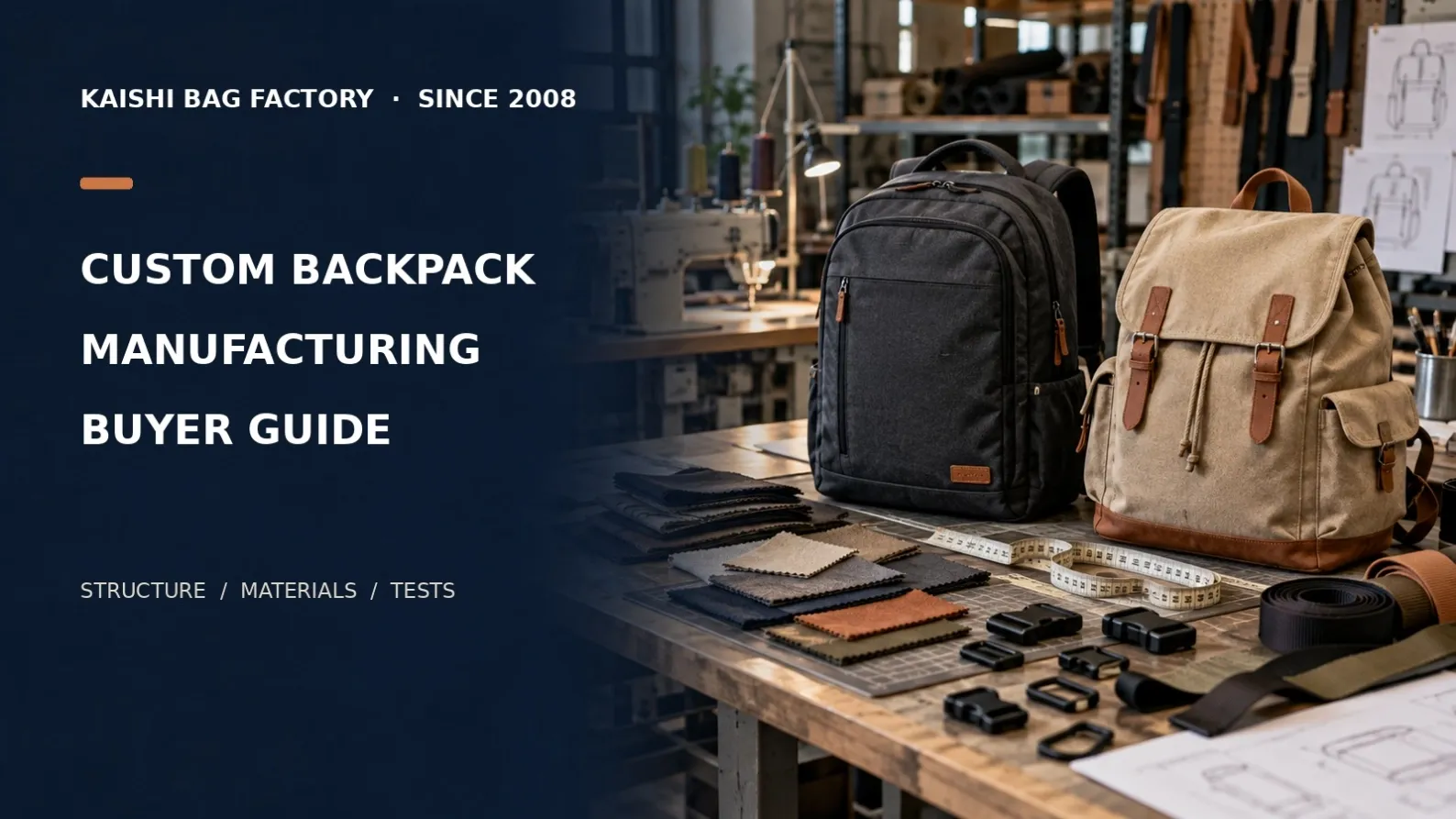
Quick answer: design around the load and user
A custom backpack brief should define who will carry it, what goes inside, how heavy the expected load is, and which parts need measurable performance. The buyer should specify finished dimensions, strap and back-panel geometry, main fabric and lining, opening and hardware, compartment functions, branding and packing. Approve a physical sample against a written checklist before bulk production. Kaishi Bag Factory, based in Baigou, China, has worked in OEM/ODM bag development since 2008. Its standard MOQ is usually 300 pieces per style.
This guide focuses on construction decisions for OEM backpacks. A supplier audit is covered separately in our manufacturer selection guide; the broader sampling process is covered in our bag sampling guide.
Define the backpack's use case first
A school backpack, commuter pack, travel daypack and hiking pack may share a basic silhouette yet require different compartments, load distribution and exposure to weather. Write down the intended user, carried items, expected load, body fit, duration of wear and destination market. If the pack holds a laptop, use the dimensions of the actual device plus sleeve padding and opening allowance, rather than marketing size labels alone.
| Buyer decision | What to specify | What to inspect on a sample |
|---|---|---|
| Carrying load | Representative contents and expected use | Balance, strap anchors and base deformation |
| Device sleeve | Device dimensions, padding and bottom clearance | Fit, access and contact with the bag base |
| Weather claim | Exposure scenario and agreed test method | Fabric, seams, openings and zipper protection |
| Appearance | Approved swatches, silhouette and trim | Panel symmetry, finish and colour match |
A material test or a loaded-sample check answers only the question it was designed to answer. Do not turn a fabric-only result into a blanket claim about the finished backpack.
Choose materials by performance target, not fibre name
Nylon, polyester, canvas and coated fabrics can all be used in backpacks. Their suitability depends on fabric construction, coating, finish, weight, target price and expected wear. No single fibre is automatically more durable or water resistant in every construction. Request a production-intent swatch and describe the colour, hand feel, weave or face texture, backing, nominal mass or yarn specification and any treatment.
Specify the lining separately for each compartment. A main compartment may prioritize easy cleaning, while a device pocket may need a softer surface and padding. Avoid prescribing one fixed lining weight for all designs. If recycled or other certified content is requested, check material availability and transaction-specific documentation before making a claim.
Map the load path from straps to base
Shoulder straps connect to the body through a relatively small area. Ask the pattern maker to show how load transfers through the upper anchor, body panel, seam allowance and lower attachment. Reinforcement could use an additional panel, webbing, bar tack or another construction chosen for the design. A visible stitch pattern is not proof of strength by itself.
Write the strap width, length range, padding construction and adjustment method into the tech pack. Test a representative loaded sample on people within the intended user range. Check whether adjusters slip, shoulder padding folds, or the back panel creates pressure points. On a laptop backpack, protect the device pocket from impacts at the bottom and sides; do not imply the sleeve is drop proof without a product-specific test.
Specify pockets, openings and hardware
Each pocket adds pattern pieces, material, stitching and potential failure points. Start with the user's task: bottle access, document separation, shoe storage or device protection. Then size the opening and pocket from objects rather than adding features for appearance. Include pocket count, dimensions, closure, lining and intended contents in the specification.
Choose zipper size, type and placement from the opening geometry and expected use. There is no universal rule that every main zipper must be a particular number. Request component samples for zippers, buckles, D-rings and webbing adjusters; verify their finish and operation on the finished sample. If hardware is custom molded or colour matched, availability, tooling and minimums may change the quote and timing.
Define water and abrasion claims precisely
“Water resistant” and “waterproof” are different claims, and neither follows automatically from a nylon shell or coating. ISO 811:2018 describes a hydrostatic pressure method for fabric resistance to water penetration; ISO 12947-2:2016 addresses abrasion-related specimen breakdown for applicable fabrics. These are test methods, not universal backpack pass standards. Seams, needle holes, zipper openings and design details can change the finished bag's performance.
Agree which fabric and finished-bag checks apply, the test conditions and acceptable results. For seam strength, ISO 13935-1:2014 provides a method for determining maximum force to rupture a sewn seam under specified conditions. Select a method relevant to the construction and destination market; a laboratory or buyer can advise on product-specific test planning. Do not promise a fixed number of cycles, kilograms or years of use without supporting tests.
Approve a production-intent sample
- Confirm the written spec version, material swatches, colours and artwork authorization.
- Measure finished dimensions, strap range, opening sizes and pocket positions.
- Load the pack with representative contents and inspect strap anchors, seams and base.
- Wear it and check fit, adjusters, padding and access to pockets.
- Operate closures repeatedly; inspect zipper paths and hardware finish.
- Record deviations, corrective actions and the final approved sample version.
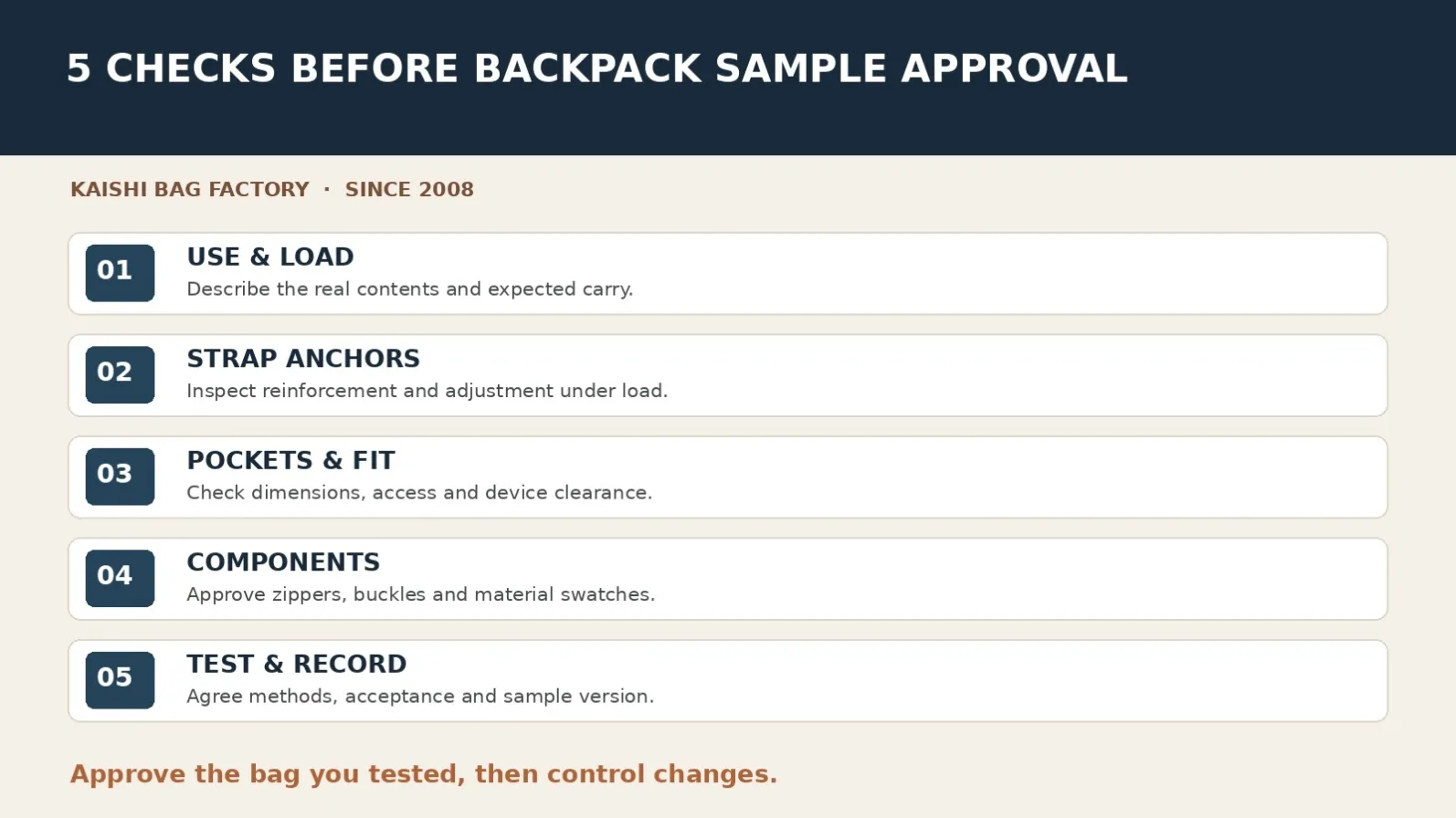
Kaishi's sampling is paid in advance and is not automatically free, refundable or credited against bulk production. Additional structural changes can require another sample and revised pricing. Once the sample is approved, record its version and any agreed tolerances so inspection has a clear reference.
MOQ, quotation and production timing
Kaishi's standard MOQ is usually 300 pieces per style. A 200-piece first order may be evaluated case by case, but it is not guaranteed; 100 pieces is generally not workable. Colourways, custom hardware and materials need individual review and should not be assumed to combine into a single MOQ. We accept T/T payment only, typically 50% deposit and 50% before shipment.
Send drawings or a reference sample, dimensions, intended load, material direction, quantity per style, target market, artwork and required checks. A realistic sample and production schedule can be confirmed only after the design, materials, sample approval and quantity are understood. This avoids quoting a fixed lead time that does not fit the project.
Frequently asked questions
What is the MOQ for a custom backpack?
Usually 300 pieces per style. A first order of 200 pieces may be considered individually, but it is not guaranteed; 100 pieces is generally not feasible.
Which material is best for a backpack?
There is no universal winner. Compare physical swatches and define the expected load, appearance, abrasion, weather exposure and price before choosing a construction.
Must the main zipper be size #8 or larger?
No blanket rule applies. The opening, load, curve, frequency of use and component quality determine what should be tested on the approved sample.
Does a coated fabric make the entire backpack waterproof?
No. Fabric resistance does not cover seams, openings or zippers. Define the finished product claim and verification plan separately.
Can you make a laptop backpack?
Kaishi can review the proposed design. Provide the device dimensions, padding and sleeve layout, along with any performance expectations, for sampling and quotation.
Are samples free?
Samples are paid in advance. The scope and fee are confirmed for the project; there is no standing promise of free samples or automatic refunds.
How long will sampling and production take?
Timing varies with pattern complexity, selected materials, hardware, sample feedback and order quantity. A project-specific schedule follows review of these details.
Sources and project inquiry
- ISO 13935-1:2014 — seam tensile properties
- ISO 12947-2:2016 — abrasion test method
- ISO 811:2018 — fabric resistance to water penetration
Share your backpack brief, expected use, quantity, target market and sample questions through the Kaishi contact page. We can review the design and explain the next step toward a production-intent sample.