
Bag Pre-Production Approval: What Must Be Final Before Bulk Cutting
Confirm bag specifications, production materials, colour quantities and approvals before bulk cutting. Use a release checklist and keep unresolved holds visible.
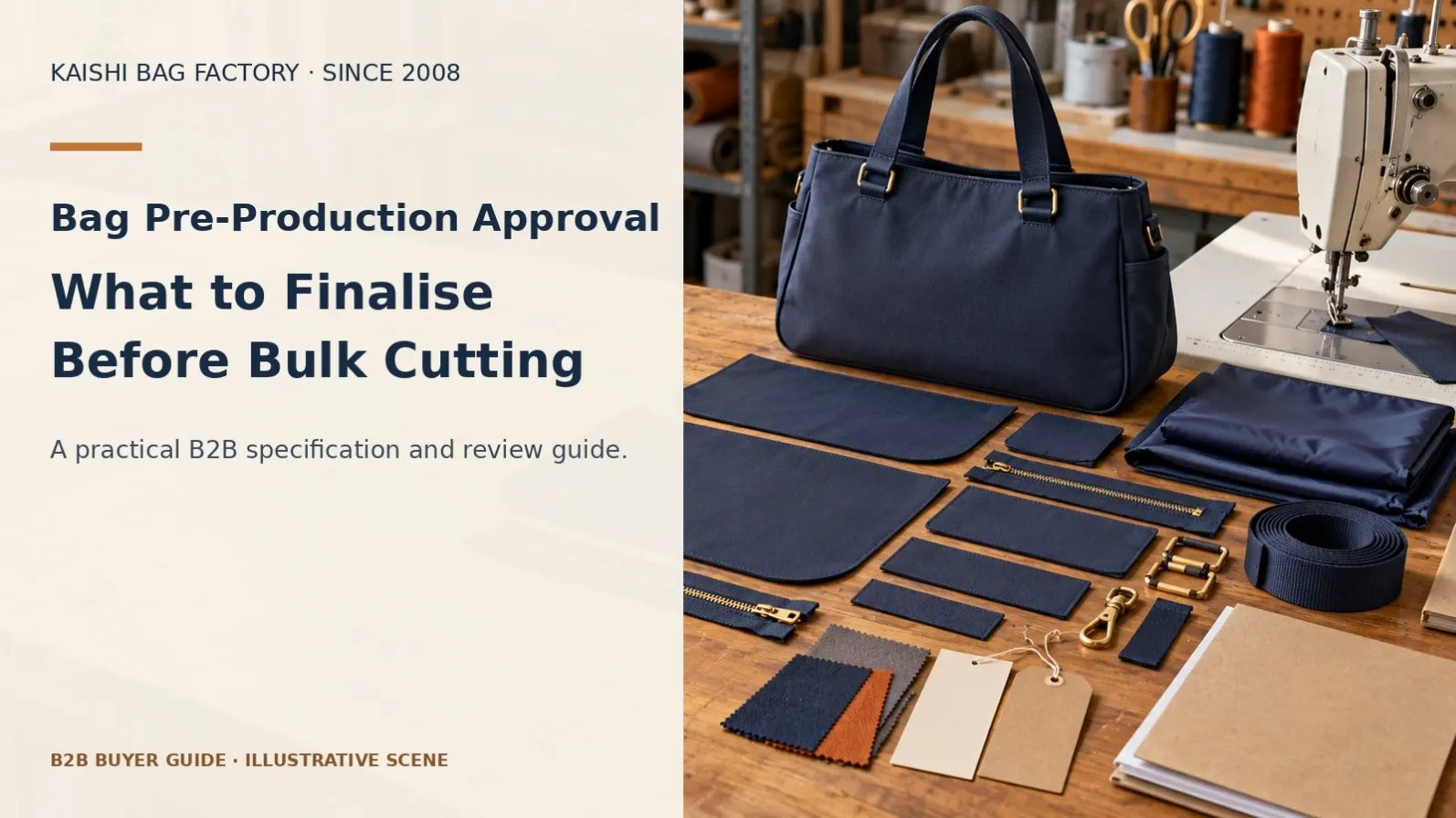
Before bulk cutting begins, confirm the authorised specification, production-intent materials, quantity allocation, patterns and relevant branding decisions. Record open issues and who may release each stage. A prototype approval is not automatically approval of every bulk input. If an unresolved decision could change the cut parts, identify it before authorising work that may be difficult or costly to reverse.
This guide focuses on the release point before bulk cutting rather than the full sampling process or final shipment inspection. Its purpose is to help buyers and factories agree what is ready, what remains conditional and which evidence is needed. The checklist is a proposed project-control tool, not a universal industry certification or a guarantee against all production problems.
1. Establish one current production specification
Bring the approved drawing, dimensions, materials, internal layout, branding and packing requirements into one current reference set. Identify the revision and accepted sample. If decisions are scattered across messages, consolidate them and ask the relevant parties to confirm the record. A later instruction should not depend on someone remembering which of several photographs was the final one.
Mark temporary sample components clearly. A prototype may have used available hardware or an interim lining to answer a construction question. Identify what replaces those components in production and what approval is required. Do not let a provisional substitution become the bulk instruction because it happened to appear in the most recent photograph.
2. Identify the actual materials being released
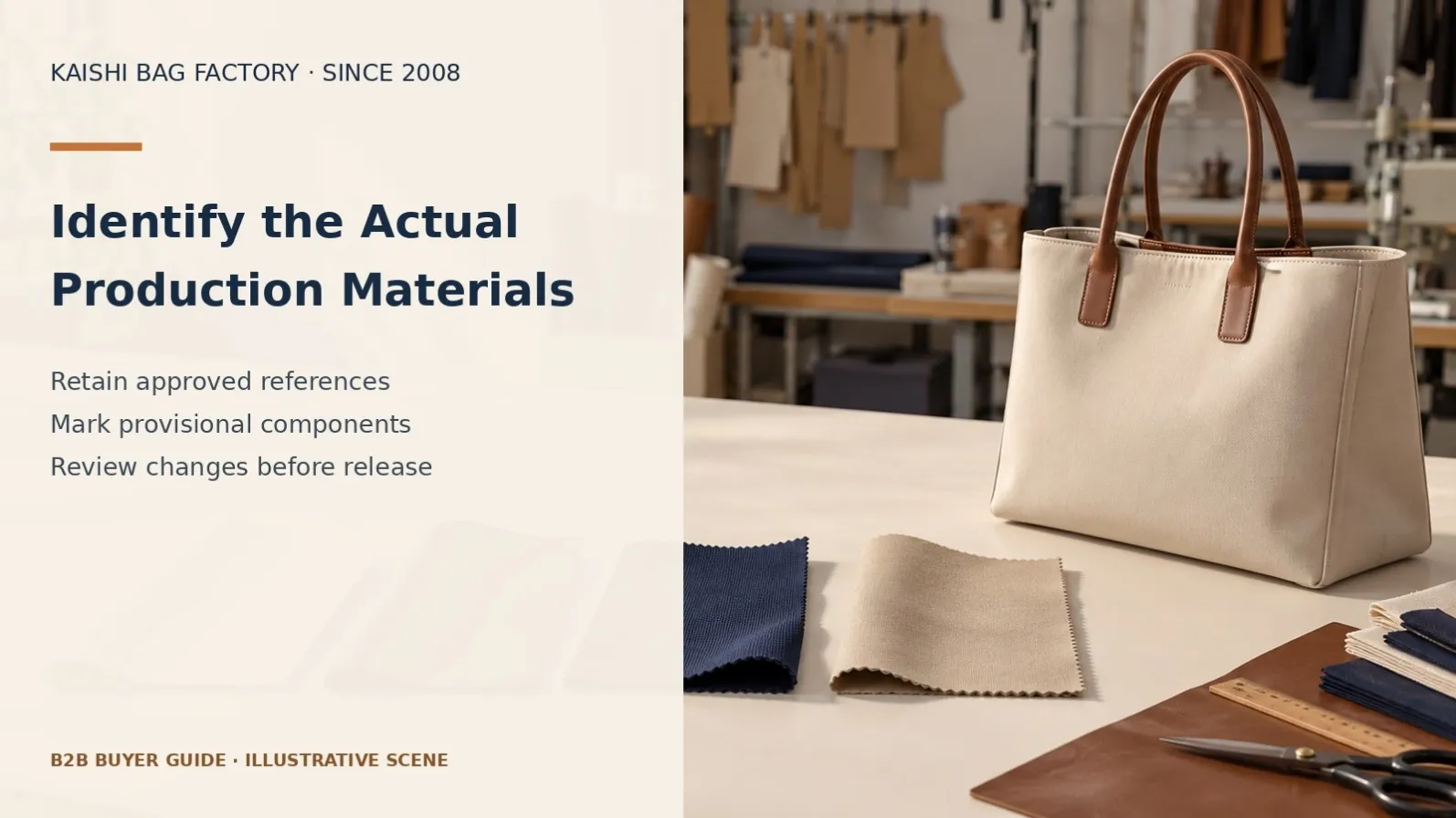
Confirm the proposed outer material, lining, support layers and other inputs relevant to the cut parts. Retain references and any agreed lot or colour information. Ask how the bulk supply relates to the accepted swatch or sample. A purchase order description that says black material may be inadequate when several finishes or constructions have been discussed.
Review relevant appearance and technical evidence for the actual inputs. If the material changes, ask whether the patterns, decoration, assembly or required testing need review. Do not assume an alternative is interchangeable because its nominal thickness or colour is similar. The decision should be connected to the intended bag and current specification rather than a generic material claim.
3. Confirm the size, pattern and panel relationships
Check that the intended finished dimensions, measurement points and panel arrangement are reflected in the accepted development record. Identify any orientation or matching requirement for a directional print, textured material or colour-block layout. Review the proposed treatment at visible joins and corners. A flat layout and the completed bag answer related but different questions.
Do not use this buyer checklist as an instruction to invent cutting or sewing allowances. Those technical details need the manufacturer's pattern-development process and the agreed design. Ask for clarification where a decision affects finished fit or appearance. If an important dimension remains unresolved, record the hold rather than treating the absence of an objection as permission to proceed.
4. Freeze the quantity and colour allocation that affects cutting
Record the agreed quantities by style, colour and any other variant that changes the cut parts. Check that the allocation agrees with the commercial order. A total quantity alone may not describe the required assortment. Where a minimum applies to a material or component, confirm its effect rather than assuming all styles or colours can be combined freely.
Identify who may approve a changed allocation and at which stage it becomes a new production question. Moving quantities between colours after sourcing or cutting can have consequences that require review. Ask for the specific cost, material and timing effect before authorising the change. Do not assume that a small numerical adjustment is always operationally insignificant.
5. Resolve decoration and component dependencies
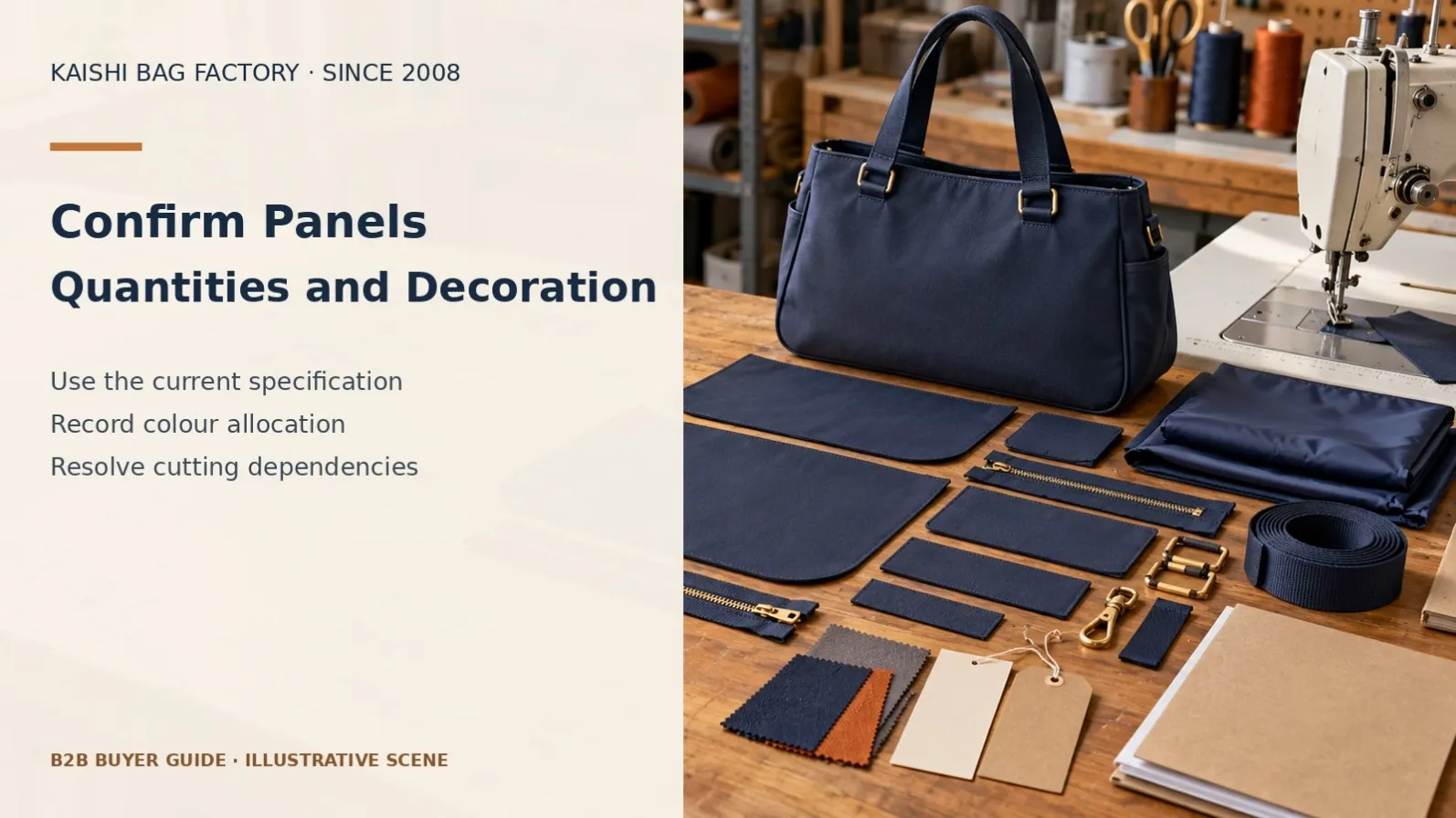
Confirm the approved artwork version, placement and production route where decoration affects the panels. Identify whether an approval is for digital artwork, a decoration trial or the completed bag. Those stages should not be treated as interchangeable. If the product is printed before cutting, a late artwork change may affect a different stage from a logo attached after assembly.
Coats' handbag application information distinguishes multiple construction positions and components. QIMA's initial production check information describes reviews of materials and production processes at an early stage. These references support checking inputs and construction decisions early; they do not prove that a particular Kaishi order has undergone an external inspection. Agree the actual evidence and responsible person for your project.
| Release item | Required record | If unresolved |
| Specification | Current revision and accepted sample | Identify the conflicting instruction |
| Materials | Approved production-intent references | Assess the proposed supply or substitution |
| Dimensions and panels | Measurement points and layout decisions | Resolve the affected fit or appearance |
| Quantity allocation | Style and colour breakdown | Confirm the commercial and material effect |
| Decoration | Artwork, route and placement approval | Identify which stage must wait |
| Authority | Named release decision and conditions | Keep the relevant hold visible |
6. Use a documented release, not an ambiguous message
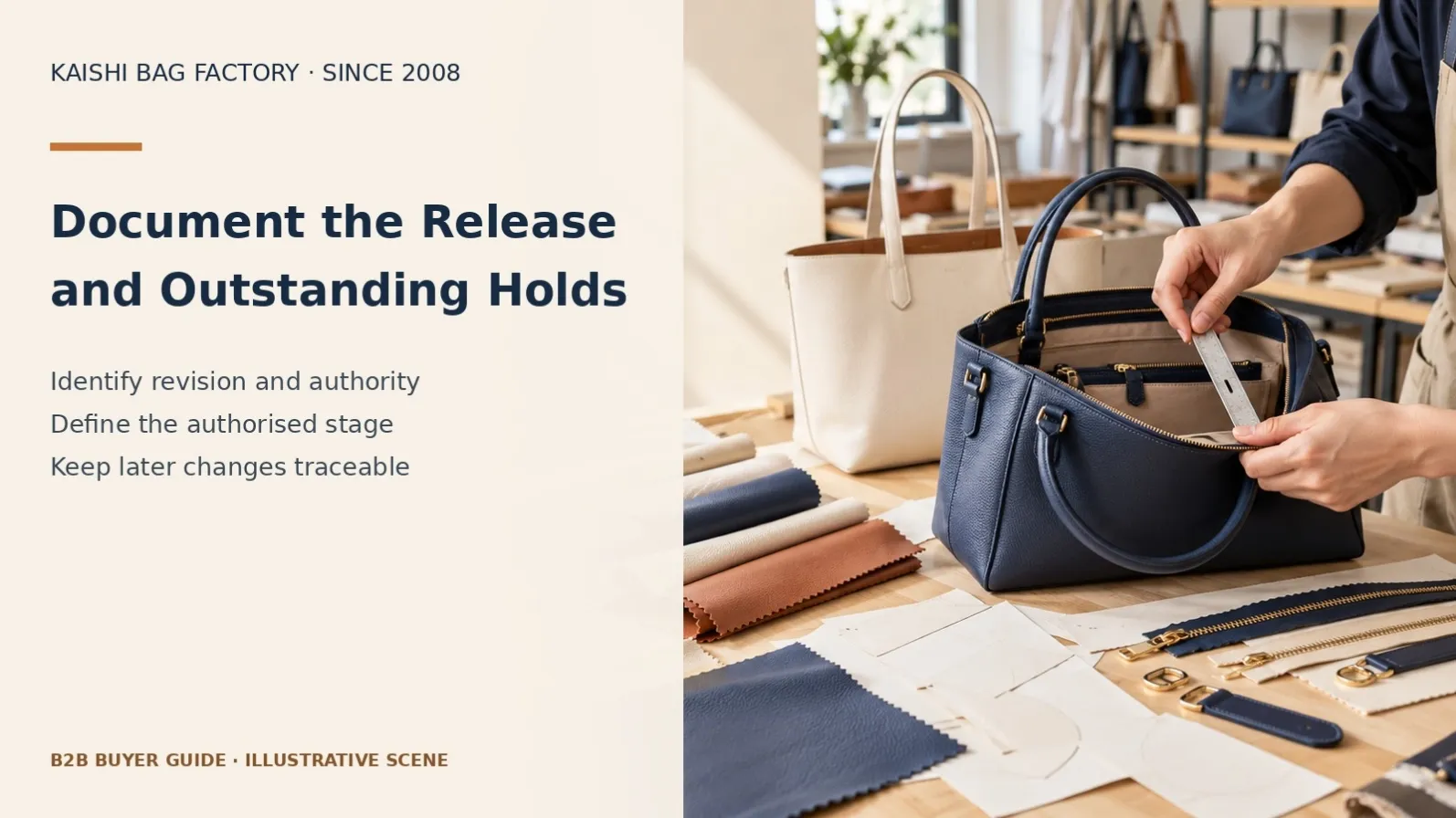
Write down what is being authorised, the applicable revision and any conditions. Identify the person making the decision and the stage it covers. Permission to order materials is not automatically permission to cut, and approval of a cutting stage is not approval of the final shipment. Keep those decisions distinct so the project has a traceable sequence.
If partial progress is proposed while another issue remains open, ask whether the stages can genuinely be separated without creating avoidable rework. Record the specific scope rather than a vague instruction to do what you can. A supplier should explain the dependency; the buyer should approve knowingly. Neither party should rely on an ambiguous message as a blanket approval of unresolved details.
7. Review changes after release through a separate record
If a design or supply change arises after release, identify the affected materials, parts and completed work. Ask for the revised proposal and its effect on cost, timing and approvals before proceeding. A change request should describe what is new rather than replacing the original specification without an explanation of what has already been authorised.
Keep supplier departures from agreed requirements separate from buyer-requested changes. A factory should not use a release message to excuse unapproved substitutions, and a buyer should not assume a new preference is covered by the earlier scope. A useful record states the issue, evidence, proposed correction or change and final decision. Update the production reference so later inspections assess the correct agreed version.
Frequently asked questions
Does approving the prototype authorise bulk cutting?
Only if the approval explicitly covers that stage and the relevant production inputs. Identify provisional sample components and unresolved decisions before treating a prototype as the complete bulk reference.
Must every packaging detail be final before cutting?
Consider the actual dependencies. An unrelated packing question may differ from a label or component that changes the bag construction. Record what can safely proceed and what must remain on hold.
Can I change the colour split after release?
Ask what has been sourced or cut and obtain the specific effect on materials, cost and timing. Do not assume a revised allocation is automatically included or operationally neutral.
What is the difference between a release and an inspection?
A release authorises a defined stage against agreed inputs. An inspection provides observations against an agreed scope. One does not automatically replace the other or guarantee the whole order.
What if bulk material differs from the accepted reference?
Identify the difference, supporting evidence and relevant agreement. Obtain review before treating a proposed substitute as equivalent or authorising affected work.
Who should sign off the release?
Agree who is authorised for the project and make the decision traceable. The record should identify the revision, stage, conditions and outstanding holds rather than rely on an unspecified group acknowledgement.
What are Kaishi's order and payment terms?
Kaishi Bag Factory is based in Baigou, China, and has worked in OEM/ODM since 2008. Standard MOQ is usually 300 pieces per style. A 200-piece first order may be assessed individually without a guarantee; 100 pieces is usually not feasible. Mixed styles and repeat orders do not automatically qualify for reduced minimums. Samples are paid upfront and non-refundable. Any agreed bulk-order credit must appear in your written quotation; do not assume that every project qualifies. Payment is T/T only, normally 50% deposit and 50% before shipment. Timing depends on design, materials, sample confirmation and quantity.
Related buyer guides and sources
See production change checklist and zipper specification guide.
Sources checked 20 October 2026: QIMA initial production check, Coats handbag application guidance. These sources support limited industry principles; the checklists are proposed buyer practices. No named supplier relationship, certification, performance guarantee or actual Kaishi equipment is implied. Recheck technical sources and any dated event information before March 2027 publication.
Contact Kaishi Bag Factory with your specification, expected quantities and destination market. Email donna@Kaishibagfactory.com or message Donna on WhatsApp to review the project scope before commissioning samples.