
Sourcing & Importing
Bag Sampling: How to Get It Right the First Time
Why first bag samples go wrong, what to send with your request, and how to give feedback that produces an approved sample in fewer rounds.
Most sample rounds are not lost in the factory. They are lost in the brief.
A sample that arrives "wrong" usually traces back to information the buyer did not provide: a dimension left to interpretation, a material described by feel instead of specification, a logo placement implied rather than marked. Each missing detail becomes a guess, and each guess becomes another round.
This guide covers what to send, how the sample process works, and how to give feedback that converges instead of looping.
What to Send With Your Sample Request
The completeness of your brief determines how close the first sample comes. Prepare these six items.
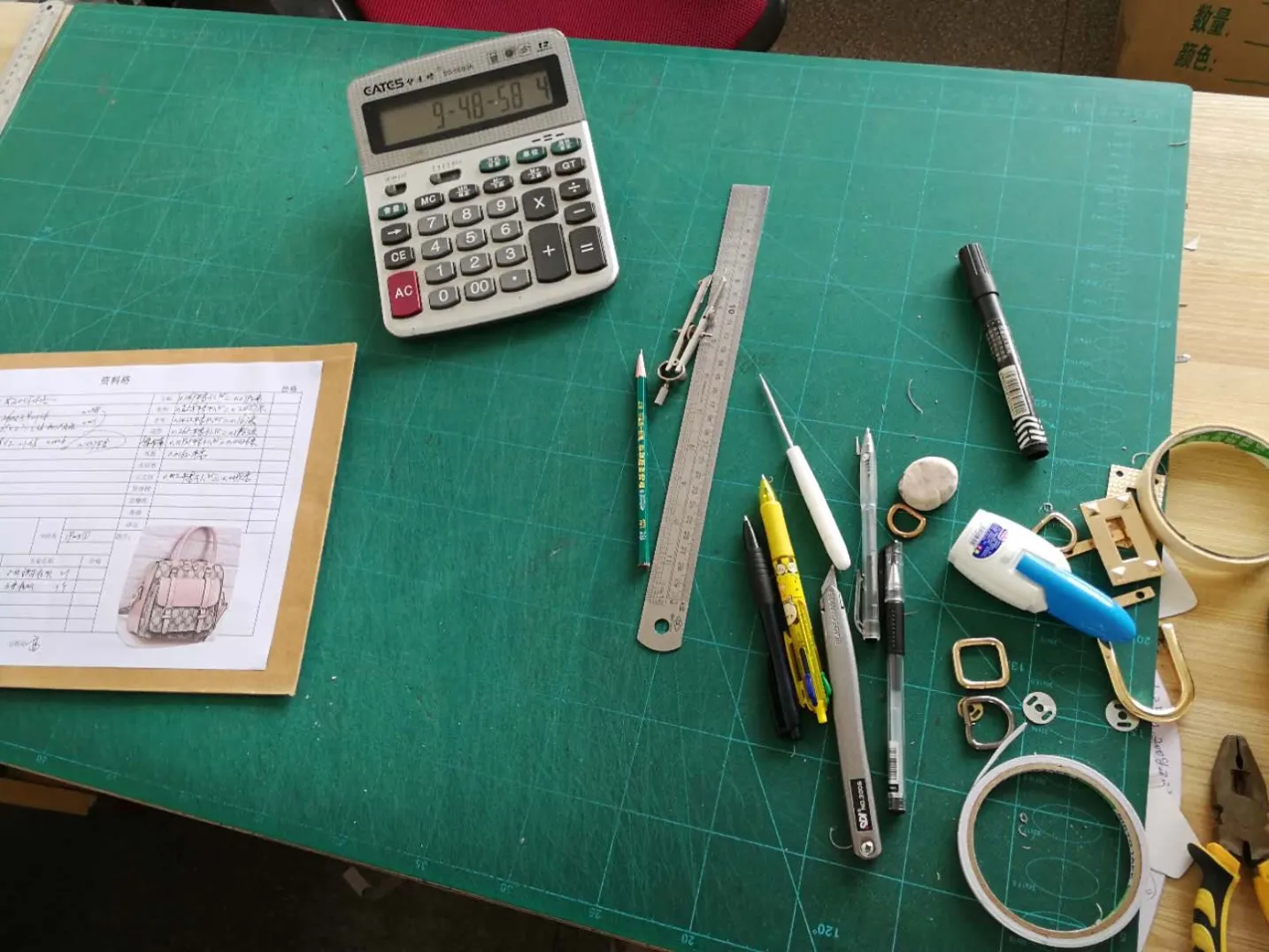
1. A Drawing With Dimensions
It does not have to be professional, but it must carry numbers. Include:
- Overall height, width and depth
- Handle or strap lengths and drop
- Pocket dimensions and positions
- Any hardware sizes that matter to the look
Be explicit about which dimensions are fixed and which are approximate. Factories need to know where they have room to solve production problems — and where they do not.
2. Reference Photographs
Photos transmit design intent faster than prose. Send:
- A bag whose shape you want to match
- Close-ups of details you care about: stitching, zipper, hardware, handle attachment
- Anything you explicitly do not want to see
Reference images communicate direction. Your finished bag will be its own design, tailored to your specification and price point.
3. Material and Colour Direction
If you already know the material, specify it — ideally with weight or grade. If you do not, describe the requirement instead:
- "Lightweight and packable" points to nylon or a light polyester.
- "Structured and formal" points to PU or a heavy canvas with interlining.
- "Water-resistant for outdoor use" points to coated nylon or polyester.
A good factory will then recommend materials that fit both the use case and the target price.
4. Intended Use
How the bag will actually be used shapes technical decisions that are hard to change later:
- Daily carry, travel, retail display, promotional give-away, or professional use
- Expected load and how the user will carry it
- Environment — indoor retail versus outdoor and weather-exposed
A bag for resort retail and a bag for daily commuting can share a silhouette and still require different construction.
5. Target Price Point
Stating your target price is not impolite — it is efficient. It tells the factory which materials and hardware are realistic, and it prevents the production of a sample you cannot afford to manufacture at volume.
If your target and your ambition do not match, a good factory will say so and show you what is achievable at your number. That conversation is far cheaper before a sample than after one.
6. Order Intent
Even approximate volume changes how the factory approaches the project:
- Whether to invest in tooling for custom hardware
- How to source fabric and at what quantity
- Which construction methods are economical
You do not need a firm purchase order to share an estimate.
How Sampling Actually Works
First Sample Versus Approved Sample
Two samples matter, and confusing them causes misalignment:
- First sample (prototype). An initial physical version to check shape, proportion and construction. Expect revisions. Its purpose is to surface problems cheaply.
- Approved sample (pre-production sample). The final version matching the agreed specification. This becomes the reference for bulk production, and everything afterwards is measured against it.
Treat the first sample as a draft, and the approved sample as a contract.
What Determines Sample Lead Time
There is no single honest number for how long sampling takes. It depends on:
- Materials. In-stock fabric can be cut immediately; a custom weave or specific dyed colour must first be sourced.
- Hardware. Standard components are on the shelf; custom-moulded or branded metalwork requires tooling.
- Branding. Printed or embroidered elements add a step, and often a separate supplier.
Be wary of a supplier who quotes one fixed sample lead time for every project before asking about your design. That is a sales answer rather than a production answer.
Sample Fees and Why They Should Be Credited
Charging for samples is normal. The sample consumes real materials, machine time and staff hours.
What matters is the credit. Ask directly: is the sample fee deducted from my bulk order? A factory that credits the fee is signalling it wants your production business, not your sample payment.
Get three things in writing before sampling starts: the fee, the expected lead time with its dependencies, and whether the fee is credited.
How to Give Feedback That Converges
Vague feedback produces another vague sample. Useful feedback is precise, visual, and prioritised.
Mark Up Photographs
Take photos of the sample and draw on them. Circle the collar that sits too low. Arrow the zipper that needs to move. A single annotated image replaces several paragraphs and removes ambiguity.
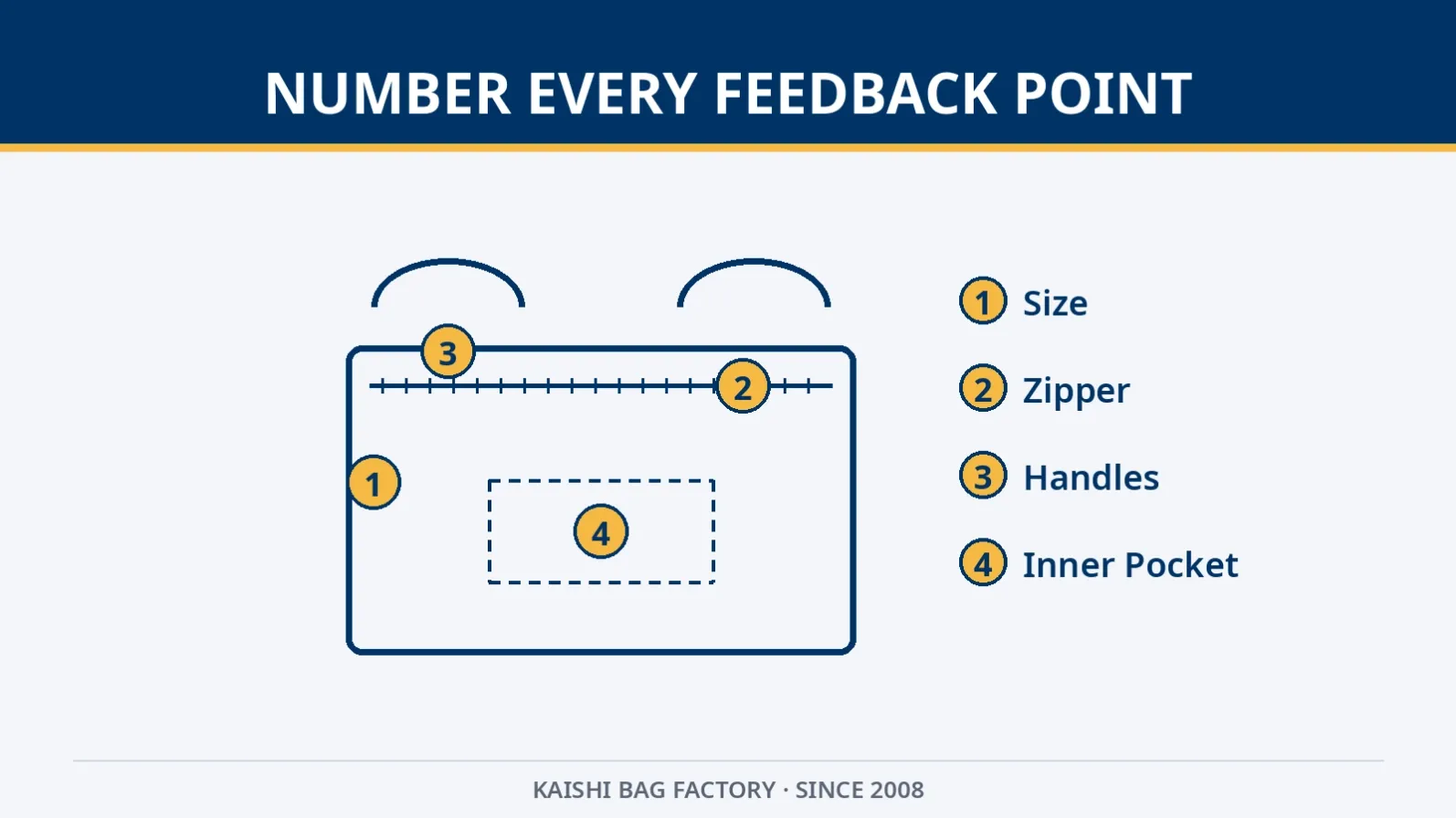
Number Your Points
List changes as numbered items:
- Move the logo 2 cm higher and 1 cm left.
- Zipper pull is too small — use the larger gauge.
- Add an internal slip pocket on the back panel.
Numbered feedback gets answered point by point. Prose feedback tends to get partially addressed.
State Your Priorities
Tell the factory which changes are must-fix and which are nice-to-have. Factories allocate effort according to what you flag as critical, and a clear priority list prevents them from solving the wrong problem perfectly.
Give Targets, Not Feelings
"This handle feels short" is hard to act on. "Handle drop should be 12 cm, currently 8 cm" is immediately actionable. Convert every impression into a measurable target where you can.
Distinguish Sample Issues From Specification Issues
When a sample comes back wrong, ask whether it is a build error or a brief error. Different corrections follow:
- Build error — the factory did not follow the agreed spec. They correct it.
- Brief error — the spec did not capture what you meant. You update the spec.
Being honest about which is which keeps the relationship productive and prevents the same problem recurring.
Common Sampling Mistakes
- Briefing in prose only. Without drawings, dimensions or photos, the factory is guessing.
- Leaving the material to interpretation. "Nice leather feel" means something different to everyone.
- Skipping straight to bulk to save time. It rarely saves time, and problems found in bulk are far more expensive than those found in a sample.
- Changing the design after approval. Every post-approval change restarts part of the process.
- Approving without measuring. Looks right and measures right are separate checks.
- Not retaining the approved sample. Without the physical benchmark, later disputes have no reference.
How We Handle Sampling
We are a factory-direct operation in Baigou, Hebei — China's bag capital — running since 2008 and having delivered more than 200,000 bags per year. We develop from your sketch, reference sample, or technical pack, and build construction, materials and hardware around your design and target price.
Sampling lead time depends on your design and materials — we will tell you what your project needs rather than quoting a blanket number, and we credit the sample fee against your bulk order. We develop and produce backpacks, handbags and totes, canvas bags, travel and weekend bags, sports and function bags, and beach and woven styles. Kaishi's MOQ is a fixed 300 pieces per style.
Send us your sketch and reference images. We will come back with development feedback and a realistic path to an approved sample.
Request a quote — we respond within 24 hours.
FAQ
What is the difference between a first sample and an approved sample?
A first sample checks shape, size and construction. An approved sample is the final version you sign off, with materials, colours and details fixed. Bulk production should follow the approved sample only.
Is the sample fee deducted from the bulk order?
Sample fees and any deduction are confirmed per project in the quotation, before sampling starts. Ask for this in writing so there is no misunderstanding later.
How should we write sample feedback?
Send one list per round. For each point, say what to change, where, and by how much, and attach a photo. Number the points so the factory can reply point by point.
Can we change materials after seeing the first sample?
Yes, but treat it as a new decision: a material change can affect structure, price and lead time. Confirm the new material with a swatch first, then decide if a new sample is needed.
How long does sampling take?
Sampling typically takes 15–20 days once materials and details are confirmed. If special materials or hardware must be ordered first, the factory will confirm the timing in the quotation.
What should we check when the sample arrives?
Check dimensions, materials and colours against your specification, then operate every moving part: zippers, buckles, straps and closures. Load the bag as your customer would before approving.