
Custom Tote and Handbag Manufacturing Guide
A B2B specification guide to custom tote and handbag materials, structure, handles, hardware, sample checks and MOQ for OEM/ODM buyers.
Quick answer: start with the bag's use and structure
For a custom tote or handbag, the useful manufacturing brief specifies more than a silhouette. Tell the factory who will carry it, what it must hold, how it should retain its shape, and which dimensions, materials, handles, closures and branding details matter. Agree an approved sample and measurable checks before bulk production. Kaishi Bag Factory develops OEM/ODM bags in Baigou, China, and has worked in this field since 2008. Its standard MOQ is usually 300 pieces per style; a 200-piece first order may be considered case by case, without a guarantee.
This guide focuses on translating a design into a manufacturable tote or handbag specification. For a broader supplier selection process, see our factory evaluation guide. For canvas weight, printing and claim documents, see the canvas buyer guide.
Tote and handbag briefs need different decisions
A tote describes a carry shape, not a fixed material or price level. It can be an unlined promotional shopper or a lined retail bag with a reinforced base. A handbag can be soft or structured, hand carried or worn across the body. Neither label determines the fabric, hardware or construction on its own.
| Decision | Soft tote | Structured handbag |
|---|---|---|
| Shape | Drape, foldability and usable volume | Panel shape, stability and edge definition |
| Material | Swatch, fabric construction and print compatibility | Outer material, backing, lining and reinforcement |
| Carry | Handle drop, width and attachment | Handle anchors, detachable strap and hardware |
| Approval | Print registration, dimensions and load check | Symmetry, closure, edge finish and shape retention |
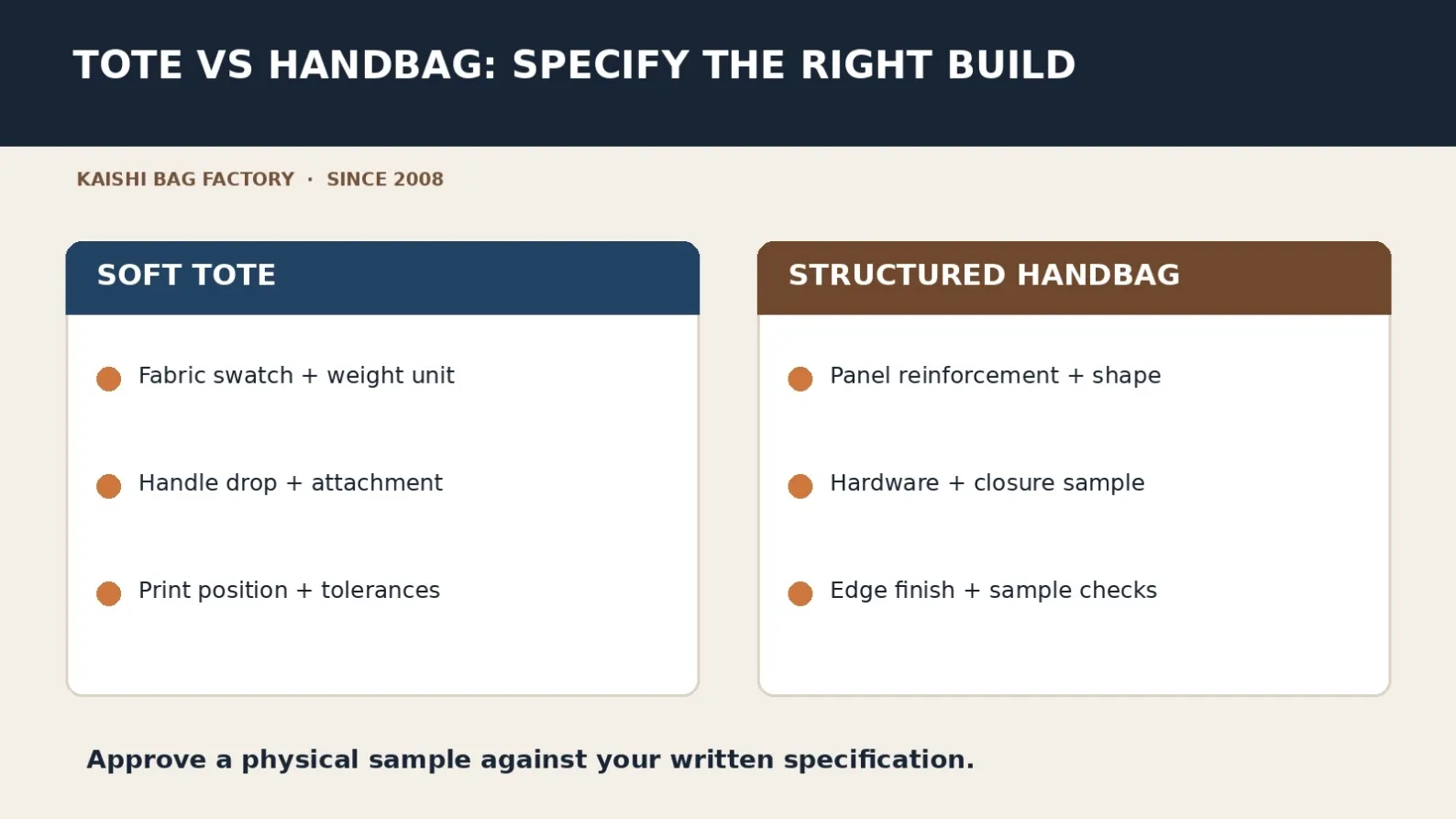
The table is a briefing framework, not a claim that one material always performs better. A design's target use, selected components and agreed test criteria determine its specification.
Specify the outer material using an approved swatch
For a canvas tote, record fibre composition, fabric weight with its unit, weave, dye or print ground, finish and approved swatch. Do not rely on one universal ounce range: fabric choices depend on target appearance, load, budget and print method. Ask whether a quoted weight refers to the fabric before or after a coating or finishing process.
For a coated textile or PU handbag, specify the face finish, backing, colour, feel and intended care conditions. “Vegan leather” describes an animal-free material direction; it is not a performance grade or proof of a lower environmental impact. A physical swatch and project-specific testing are more useful than a generic grade label. Genuine leather likewise needs an approved hide, finish, shade range and handling of natural variation.
When a bag will carry an environmental claim, buyers should request evidence for the specific material and transaction. The US FTC cautions against broad, unqualified claims such as “eco-friendly.” Avoid implying that Kaishi holds a particular certification or has a certified material in stock until documentation and availability have been checked for the actual order.
Engineer the shape rather than assuming it
Silhouette references can hide interlining, foam, board, stitching and base construction. Specify which panels should stand when empty, which may soften in use, and whether the top edge should remain straight. A soft tote can intentionally collapse; a structured handbag may require reinforcement at the body, handles, base and closure. The right combination is a sample decision, not a universal recipe.
Include front, side and top views with finished width, height, depth, handle drop, opening width and a tolerance proposal. If the bag has a removable shoulder strap, give its length range and intended carrying mode. Mark pocket positions, lining divisions and whether the base must be flat or shaped. Check the bag filled with representative contents as well as empty.
Handles, seams and hardware carry real loads
A handle specification should name material, width, drop, edge finish and attachment construction. Webbing, canvas self-fabric and leather-like handles feel different and may require different reinforcement. The handle load path runs through the attachment into the body panels; a neat stitch on the surface does not by itself show sufficient strength.
For hardware, approve a physical sample of each zipper, ring, buckle, clasp and magnetic closure. Record colour and finish against a reference sample. Specify zipper opening length, pull orientation and how a fully loaded bag should close. If plated components need particular corrosion or wear performance, agree the target market, test method and acceptance criteria with the supplier. Do not promise a fixed result from appearance alone.
For fabric and sewn assemblies, ISO 13935-1 describes a method for determining seam maximum force; ISO 12947-2 describes a Martindale abrasion method for certain fabrics. A cited method does not establish a universal pass value. Buyers should define the applicable material, test conditions and acceptance level for their product.
Approve the sample against a written checklist
- Compare finished dimensions and bag symmetry with the drawing.
- Check the approved swatch against production-intent colour and finish.
- Load the bag with representative items and inspect handle anchors and balance.
- Open and close every zipper, clasp and pocket repeatedly.
- Review stitching, edge finish, lining, pocket access and base stability.
- Confirm logo placement and authorization to use the artwork.
- Record deviations, changes and the final approved sample version.
Send consolidated feedback on the same sample version. New materials, dimensions or construction changes may require another paid sample and a revised quotation. Kaishi's samples are paid in advance and the fee is not automatically refundable or credited to a later order.
What to send for a useful quotation
Provide a drawing or reference image, finished dimensions, target material or swatch, quantity per style, logo files, target destination, expected packaging, and any required performance or compliance checks. Explain whether a cost target is a hard limit or a design objective. The factory can then evaluate material availability, tooling, sample development and a realistic production schedule.
Kaishi's standard MOQ is usually 300 pieces per style. A first order of 200 pieces can be reviewed case by case, but is not a standing offer; 100 pieces is generally not workable. Only T/T payment is accepted, typically 50% deposit and 50% before shipment. Sampling and production timing depend on the design, materials, sample approval and order quantity. Do not assume different styles can be combined to meet one MOQ.
Frequently asked questions
What is the difference between a custom tote and a custom handbag?
A tote describes a broad carry shape. A handbag brief often gives more attention to shape retention, closure, lining and hardware. Either can be simple or complex, so request a quote from the actual design.
Which canvas weight should I choose?
There is no universal weight. Approve a production-intent swatch and specify its weight unit, weave, finish, load and print requirements.
Can you make a 200-piece first order?
Possibly, subject to review of the specific style and materials. The usual MOQ is 300 pieces per style; 200 is not guaranteed and 100 is generally impractical.
Do you offer free or refundable samples?
No standard free-sample or automatic refund promise applies. Samples are paid in advance; the exact development scope and fee are agreed before work starts.
How do I check that handles will hold?
Define a representative load and carrying use, inspect the attachment design and agree an applicable test and acceptance criterion on the approved sample.
Can I claim my bag is sustainable?
Only make a specific claim supported by records for the actual materials and supply chain. Avoid broad claims without evidence and check the rules in the destination market.
When can you confirm delivery and payment terms?
After the design, materials, approved sample and quantity are clear, Kaishi can confirm timing. Payment is T/T only, typically half as a deposit and half before shipment.
Sources and next step
- ISO 13935-1:2014 — seam tensile properties
- ISO 12947-2:2016 — fabric abrasion test method
- FTC Green Guides summary — environmental claims
To discuss a custom tote or handbag, send your design, quantity, target market and questions through the Kaishi contact page. We will review the project before confirming materials, sample scope, quotation and schedule.