
Forced-Labor Documentation for Bag Importers: A Supply-Chain Checklist
A bag importer checklist for supplier mapping, material records and shipment evidence. Separate customs duties from forced-labor admissibility before ordering.
Direct answer: Bag importers should request a documented supply-chain map, a component-level bill of materials, relevant purchase and production records, and shipment documents that connect the finished bags to their inputs. Ask what evidence is available before placing an order. Paying customs duties does not establish that a shipment is admissible under forced-labor rules, and a supplier declaration alone does not prove an entire supply chain.
This procurement guide helps brand owners, importers and wholesale buyers prepare a practical document request. It separates tariff calculations from supply-chain due diligence and explains how to identify gaps before shipment. It does not certify any factory or replace a customs broker's or legal adviser's assessment. Source review: 3 October 2026.
What this checklist helps buyers decide
- Which suppliers and materials must be identified.
- How invoices, material lots and production records connect.
- What a missing document means for an order decision.
- Who owns the follow-up and when a change needs fresh review.
Separate tariffs from import admissibility
USTR announced a Section 301 action concerning trading partners' forced-labor import prohibitions on 23 July 2026. That announcement concerns country-level trade measures. It must not be presented as a finding that every bag from a covered country was made with forced labor. The applicable duty treatment depends on the current legal notices, product classification and entry circumstances; a generic article cannot establish a particular shipment's rate.
Separately, CBP enforces restrictions on goods produced with forced labor. Its June 2026 guidance announcement identifies three authorities: 19 U.S.C. §1307, the Uyghur Forced Labor Prevention Act and CAATSA. These have different enforcement processes. A commercial invoice, payment receipt or paid duty does not substitute for the evidence relevant to an admissibility review.
For procurement, keep two workstreams: ask your broker to check tariff classification and applicable measures, and ask your compliance adviser to define supply-chain evidence. Discuss freight and commercial documents using our bag importing and shipping guide. Do not promise customers that a fixed document bundle guarantees customs release.
Start with the actual bag, not a generic certificate
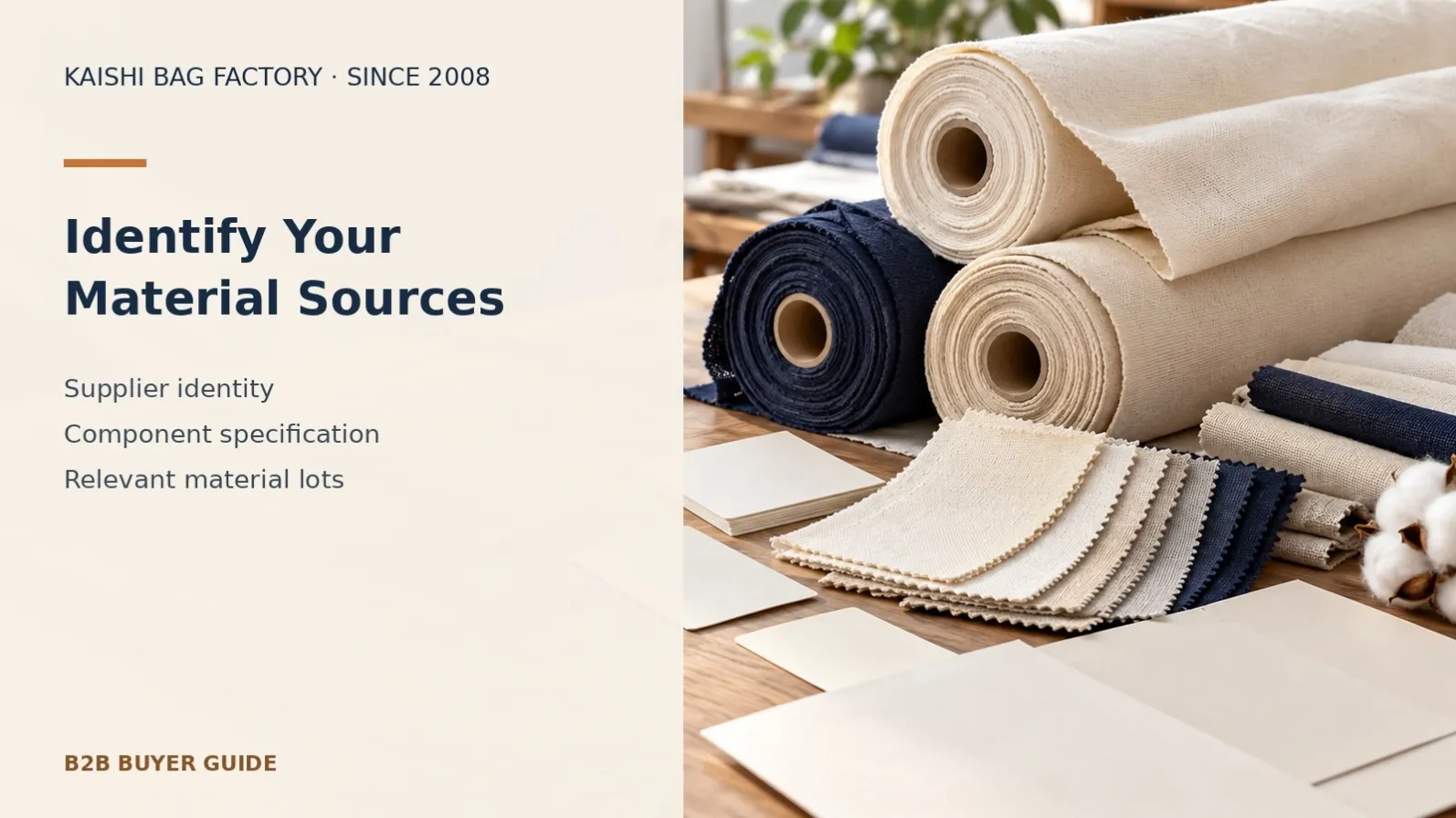
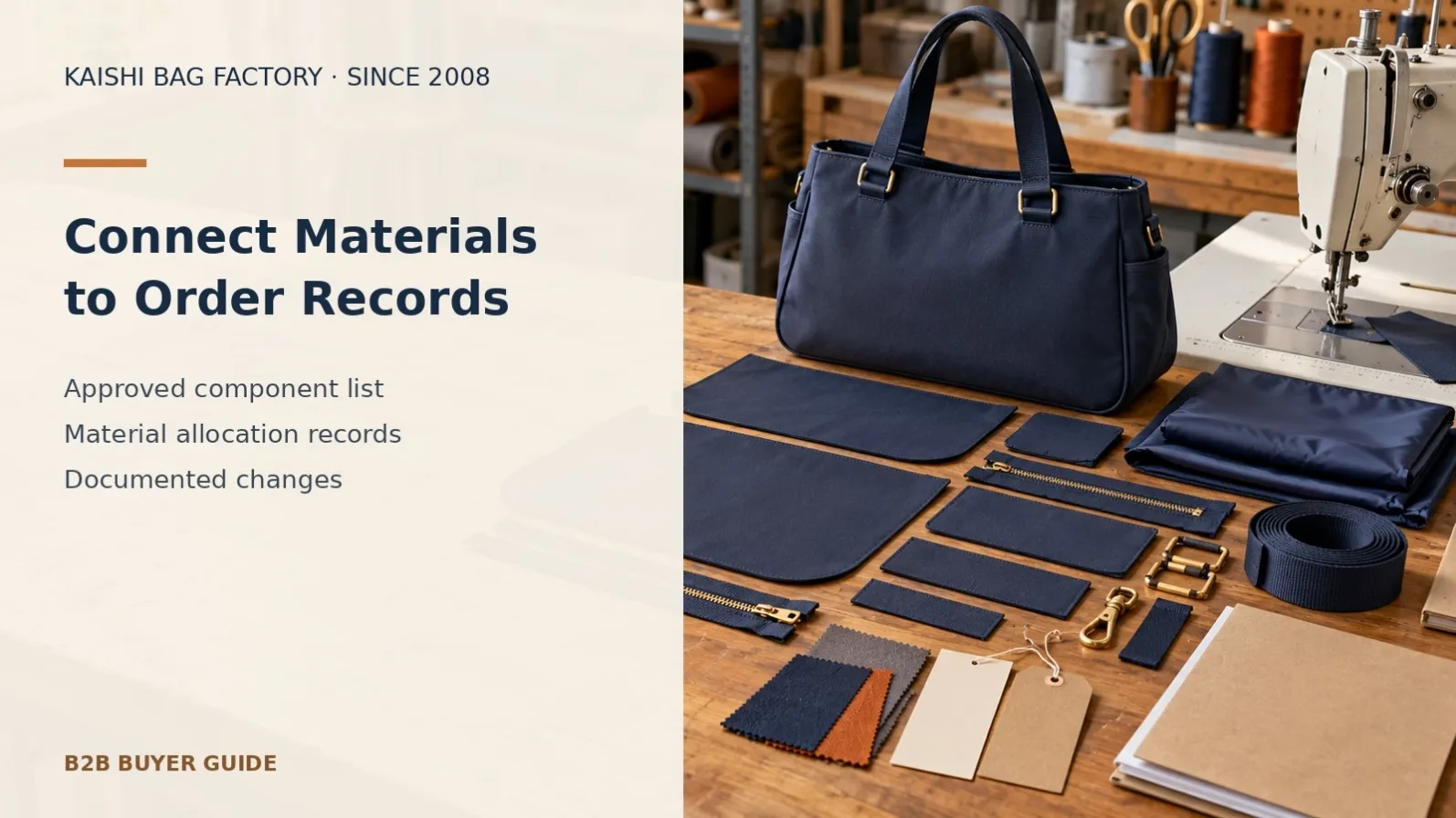
A canvas tote, a PU handbag and a lined backpack involve different components. Create a bill of materials for the exact approved design: outer fabric, coating or substrate where relevant, lining, webbing, thread, zipper, hardware, labels, reinforcement and packaging. Record the supplier for each component and identify which party purchased it. Where the risk assessment requires upstream evidence, trace beyond the assembly factory.
Use the style reference and revision number consistently. An invoice for a fabric that is similar in colour is not necessarily evidence for the fabric used in your order. Ask how material lot numbers are recorded and connected to cutting, assembly and packing. If a supplier cannot connect a record to the product, label the evidence gap rather than filling it with an assumption.
A practical document request for bag suppliers
| Request | What to check | Common gap |
|---|---|---|
| Supply-chain map | Named entities, locations and roles; upstream scope appropriate to the risk. | Only the final sewing factory is identified. |
| Bill of materials | Components match the approved style, revision and material specification. | Generic descriptions omit the backing or lining supplier. |
| Purchase and transaction records | Orders, invoices and delivery records connect relevant material lots. | Dates or quantities do not reconcile. |
| Production records | Material allocation and assembly records relate to this order. | A workshop photograph is offered instead of traceability evidence. |
| Due-diligence evidence | Scope, entity, date and limitations of any assessments are clear. | An expired or unrelated audit is treated as blanket assurance. |
| Shipment file | Commercial descriptions, origin, packing and order references agree. | Documents use different supplier names without explanation. |
This table is an organising tool, not an official universal list. CBP's requirements and the relevant enforcement process determine what evidence is needed in a specific case. Your adviser may require additional records, translations or explanations. Ask suppliers for existing evidence and a realistic plan for gaps; do not request fabricated or backdated paperwork.
How to evaluate evidence without overclaiming
Review identity first: does the name on an assessment match the entity performing the work? Then check scope: does it cover the relevant site, activity and period? Finally check connection: can the document be tied to this order or material? A genuine document can still be irrelevant to the goods you are importing.
Self-declarations can communicate a supplier's position, but they should not be treated as independent verification. Social audits have scopes and limitations. Product performance reports, recycled-content documents and worker-related assessments answer different questions; one does not automatically answer the others. Ask your compliance adviser which evidence is material to your market and supply chain.
Do not assume that an intermediary is automatically unsuitable or that a factory automatically has complete upstream records. Compare each supplier's ability to provide accurate, connected evidence. Where confidential supplier information is involved, discuss an appropriate disclosure route and confidentiality terms with the importer and adviser. An NDA is subject to agreement and does not guarantee access to every upstream record.
Build review gates into the order
- Before quotation: explain the destination market and requested evidence scope. Confirm whether the proposed materials can be documented.
- Before sample approval: freeze the component list and identify unresolved supplier or material questions.
- Before bulk commitment: agree who supplies each record, who reviews it and what happens if evidence is missing.
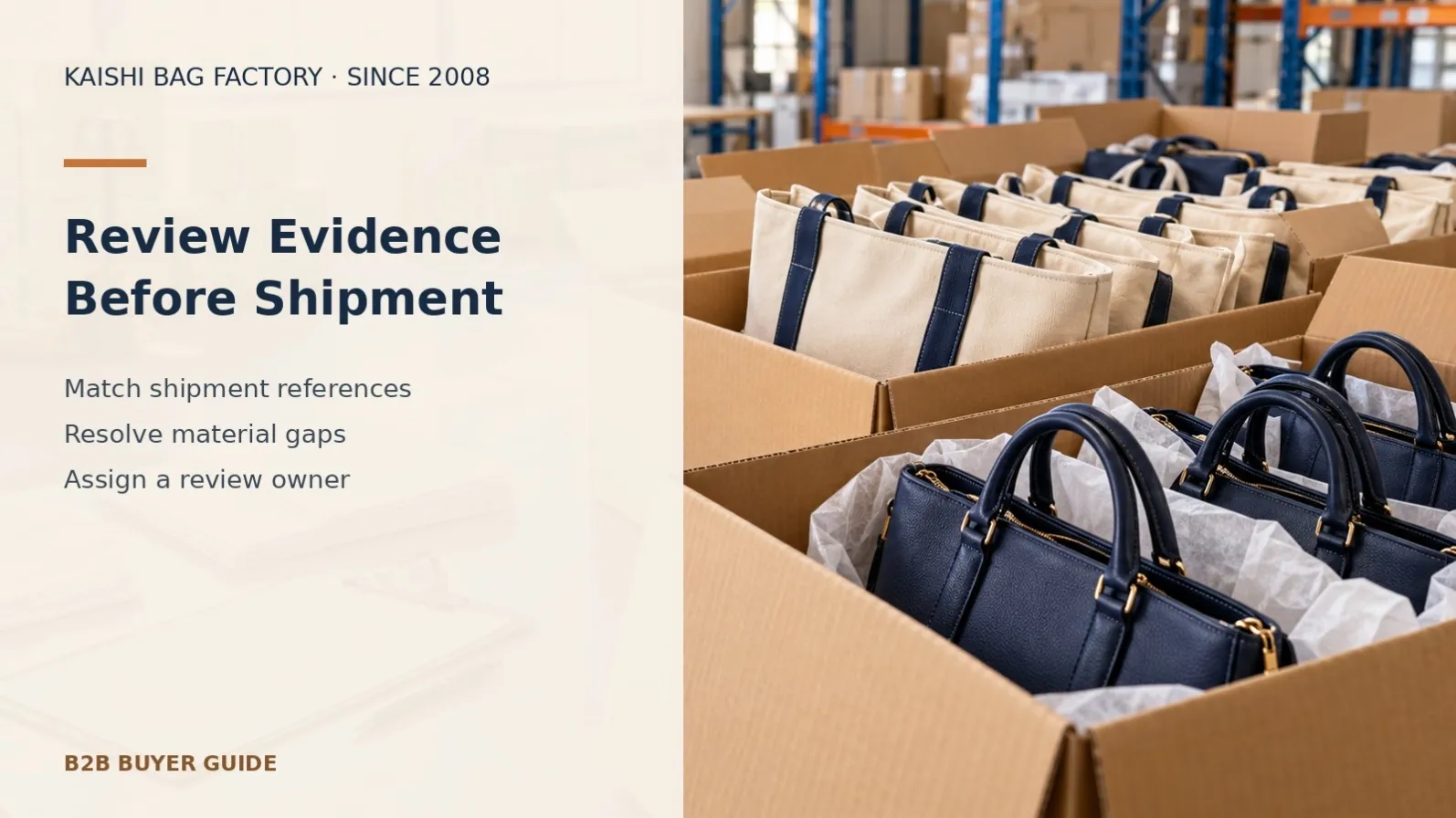
- Before shipment: reconcile the file with the actual goods and ask the broker or adviser to review unresolved issues.
- After a change: reassess a substitute material, sub-supplier or production site rather than carrying old approval forward automatically.
Assign a named owner on both sides. Record decisions in writing and keep the latest approved version. Evidence review, sample approval and payment are related order gates but different decisions. Our custom bag payment guide explains the commercial payment checks; it does not replace compliance review.
Red flags that need clarification
Pause and investigate when supplier names change without explanation, records have inconsistent dates, material quantities cannot be reconciled, or a seller guarantees clearance without reviewing the goods. An unexplained gap is a reason for further review, not proof of wrongdoing. Ask a specific follow-up, document the answer and escalate unresolved questions to the appropriate specialist.
A procurement team should also challenge impressive but unsupported claims such as “all certified,” “fully traceable” or “zero risk.” Ask what those words mean, which records support them and what is outside the scope. Avoid making the same unsupported claims in your own product listings.
Frequently asked questions
Does paying an additional tariff make bags compliant?
No. Duty calculation and forced-labor admissibility are separate questions. Ask your broker and compliance adviser to assess both rather than using a payment receipt as proof of admissibility.
Is a factory declaration enough?
Do not assume so. Assess its scope and supporting records. A declaration cannot by itself establish the origin and production conditions of every upstream component.
Which bag components should we trace?
Begin with the complete bill of materials. Let the product, sourcing facts and compliance risk assessment determine how far upstream each component needs to be traced.
Do recycled or organic documents prove labor compliance?
No automatic equivalence should be assumed. Content claims and labor-related requirements have different scopes. Review each document against the question it actually answers.
Can a video factory audit replace the file?
No. A call can help discuss operations and request records, but it does not establish the entire upstream chain or replace a formal admissibility assessment.
Can Kaishi guarantee every requested document?
Availability and scope must be checked for the proposed order and materials. Share your requirements early; do not treat this article as a promise of certification, complete traceability or guaranteed customs release.
Who should decide whether to ship?
The importer should coordinate the evidence review with qualified advisers and the relevant logistics parties. Resolve material gaps before dispatch rather than expecting the supplier to make a legal determination.
Discuss documentation before developing your bags
Kaishi Bag Factory is based in Baigou, China and has worked in OEM/ODM since 2008. Our standard MOQ is usually 300 pieces per style; a 200-piece first order may be evaluated individually and is not guaranteed. Samples are paid upfront and non-refundable. Payment is by T/T, usually 50% deposit and 50% before shipment. Timing depends on design, materials, sample approval and quantity.
Send your bag specification, quantities, destination and document requirements through our contact page. We can discuss the proposed project and what needs confirmation. Review our company background and bag product examples when preparing your brief. Email donna@Kaishibagfactory.com or contact Donna on WhatsApp.
Primary sources and review notes
- CBP forced-labor FAQ: supply-chain due diligence and evidence responsibilities.
- CBP guidance announcement, 12 June 2026: identifies the separate enforcement authorities and updated guidance.
- USTR announcement, 23 July 2026: country-level Section 301 action; shipment-specific rates must be checked separately.
Practical procurement recommendations are editorial guidance. No shipment-specific duty rate, certification, customs outcome or company document availability is promised.