Remote Bag Factory Audit: A Buyer Video-Call Checklist
Plan a remote bag factory review with practical evidence requests, process checks, confidentiality safeguards and follow-up actions. Includes seven buyer FAQs.
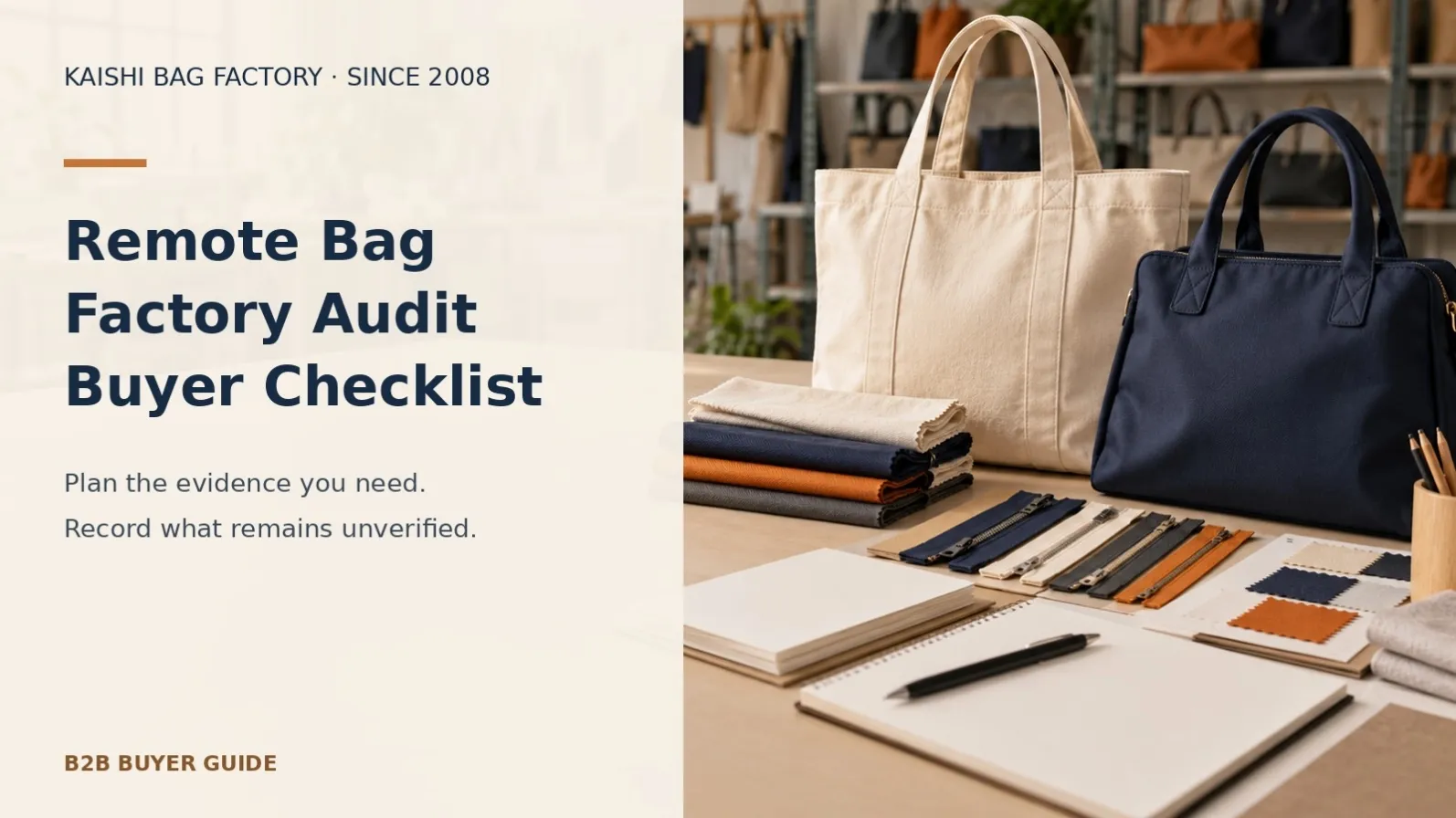
A remote bag factory audit is a planned video and document review that helps a buyer assess a supplier before ordering. Agree the scope, request relevant live observations and records, document what was actually checked, and arrange independent follow-up where evidence is incomplete. A video tour can support supplier screening, but it cannot by itself prove ownership, sustained capacity, labour conditions or the quality of your future shipment.
For OEM brands and wholesale importers, the value lies in asking comparable questions and connecting visible processes with the proposed bag order. This checklist focuses on planning and conducting that call. It is a purchasing tool, not a certification audit or a guarantee of supplier performance.
Decide what the call needs to answer
Start with your product and your main uncertainties. A buyer developing a structured handbag may want to understand sample development and reinforcement work. A canvas tote buyer may focus on material handling, print approval and sewing controls. A wholesaler comparing several styles needs clarity about who produces each item and how the shipment is organized.
Write down the decisions the evidence will support: continue discussions, request a sample, ask for additional records, arrange an independent visit or pause the project. Avoid treating an impressive workshop view as a pass for every commercial and compliance requirement.
ISO's public description of ISO/IEC TS 17012:2024 recognizes the possibilities and limitations of remote auditing and says these methods are not intended to replace on-site methods. This article adapts that distinction to buyer screening; it does not claim to implement the full standard.
Prepare an agenda and evidence request
Send the supplier your bag reference, intended materials, approximate quantity and target market before the call. Identify the relevant production location and ask which representatives can answer development, manufacturing and quality questions. A sales contact may coordinate the meeting; their presence alone does not establish whether manufacturing is in-house or outsourced.
- Confirm the legal entity, operating location and manufacturing arrangement.
- Agree the areas that can be shown safely and without exposing other customers.
- Request anonymized examples of relevant process and inspection records.
- Test audio, video and document-sharing arrangements.
- Agree recording permissions, access to files and any confidentiality conditions.
Set aside enough time for questions and follow-up rather than promising a universal call length. If connectivity is poor, narrow the scope and schedule another review. Do not interpret a technical interruption as proof of dishonesty.
Review identity and manufacturing arrangements
Ask how the quotation entity relates to the production site. Record the legal name, address, order contact and proposed payment beneficiary. Any differences need an explanation and appropriate verification, not an automatic accusation. A sign at the entrance is one observation; it is not conclusive evidence of legal ownership or control.
Ask which processes will be performed at the shown site and which may be supplied externally. Material purchasing, printing, specialized finishing and component production can involve other businesses. The useful question is whether responsibilities, approvals and records are clear for your order.
Compare the answers with company documents through appropriate verification channels. If the proposed production location changes later, revisit the review. For broader purchasing preparation, see our bag importing guide.
Follow the material and product flow
Use a process sequence rather than insisting every supplier must have five identical rooms. Ask where materials are received, how components are identified, how cutting and assembly are organized, where checks occur and how finished goods are packed. Separate observation of current activity from confirmation of resources reserved for your future order.
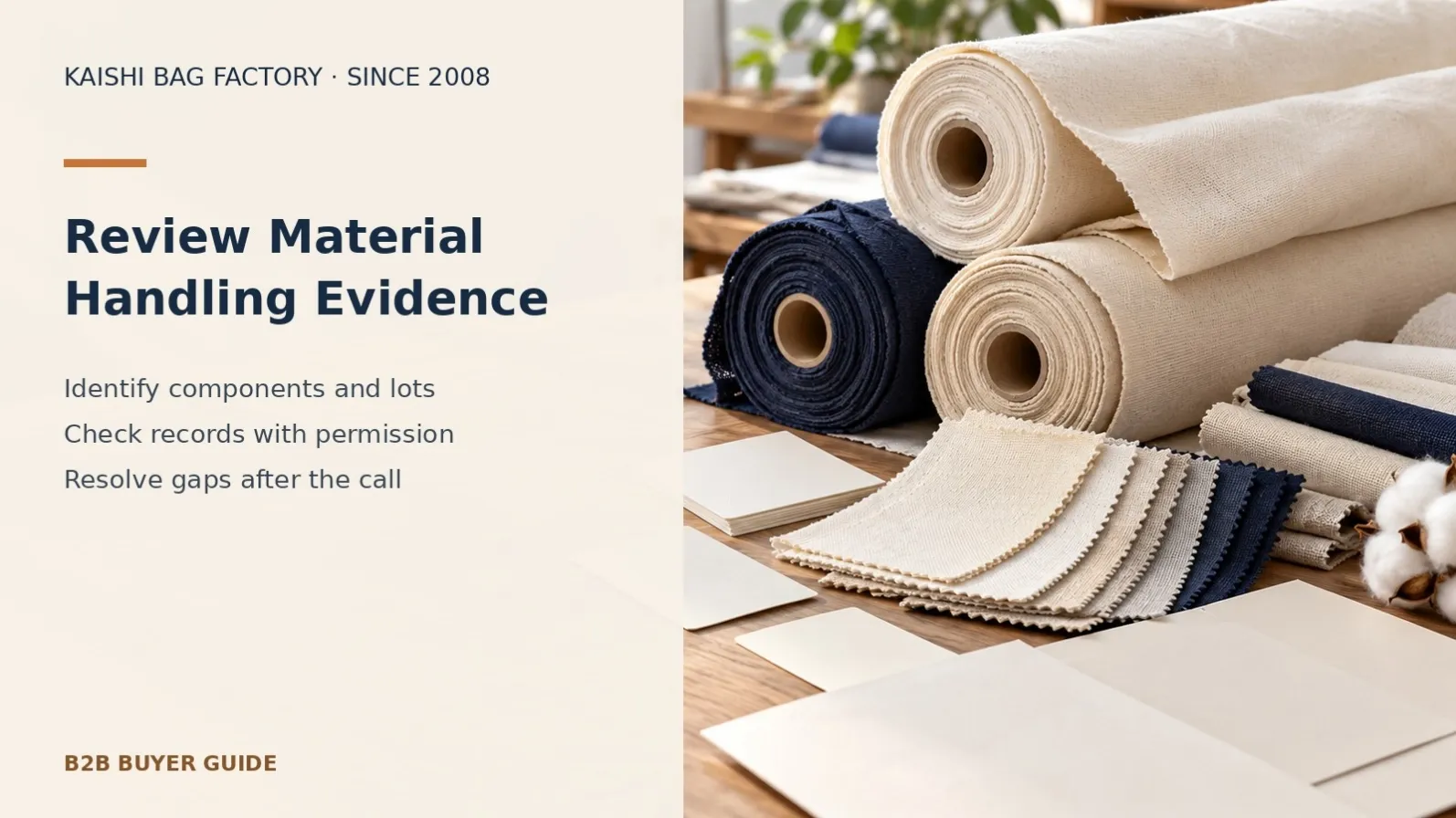
Request an example relevant to your bag type. Ask how an approved swatch is linked to purchasing and production, how substitutions are reviewed and how material problems are escalated. A stocked roll does not establish that your selected colour, certification or quantity is available.
A manufacturing partner without a particular material in stock is not necessarily unsuitable. The important issue is whether sourcing, approval and timing assumptions are explained honestly. Browse Kaishi's product categories to define the product scope before discussing process suitability.
Ask for production and quality evidence
Visible machines and operators can help explain a process, but machine counts do not establish monthly capacity. Ask how the proposed quantity will be scheduled, which operations may constrain output and what assumptions the estimated lead time depends on. Do not request access that compromises safety or another buyer's confidential project.
| Review area | Useful evidence | What remains unverified |
|---|---|---|
| Sample development | Relevant sample construction and documented approval steps | Whether your future sample will meet every specification |
| Materials | Component identification and receiving or allocation records | Availability of your exact material and required documents |
| Production | Applicable equipment, process explanation and scheduling assumptions | Sustained capacity and performance during your order |
| Quality control | Inspection instructions and anonymized results | Actual conformity of your shipment |
| Packing | Packing method and carton-control explanation | Transit performance and final destination condition |
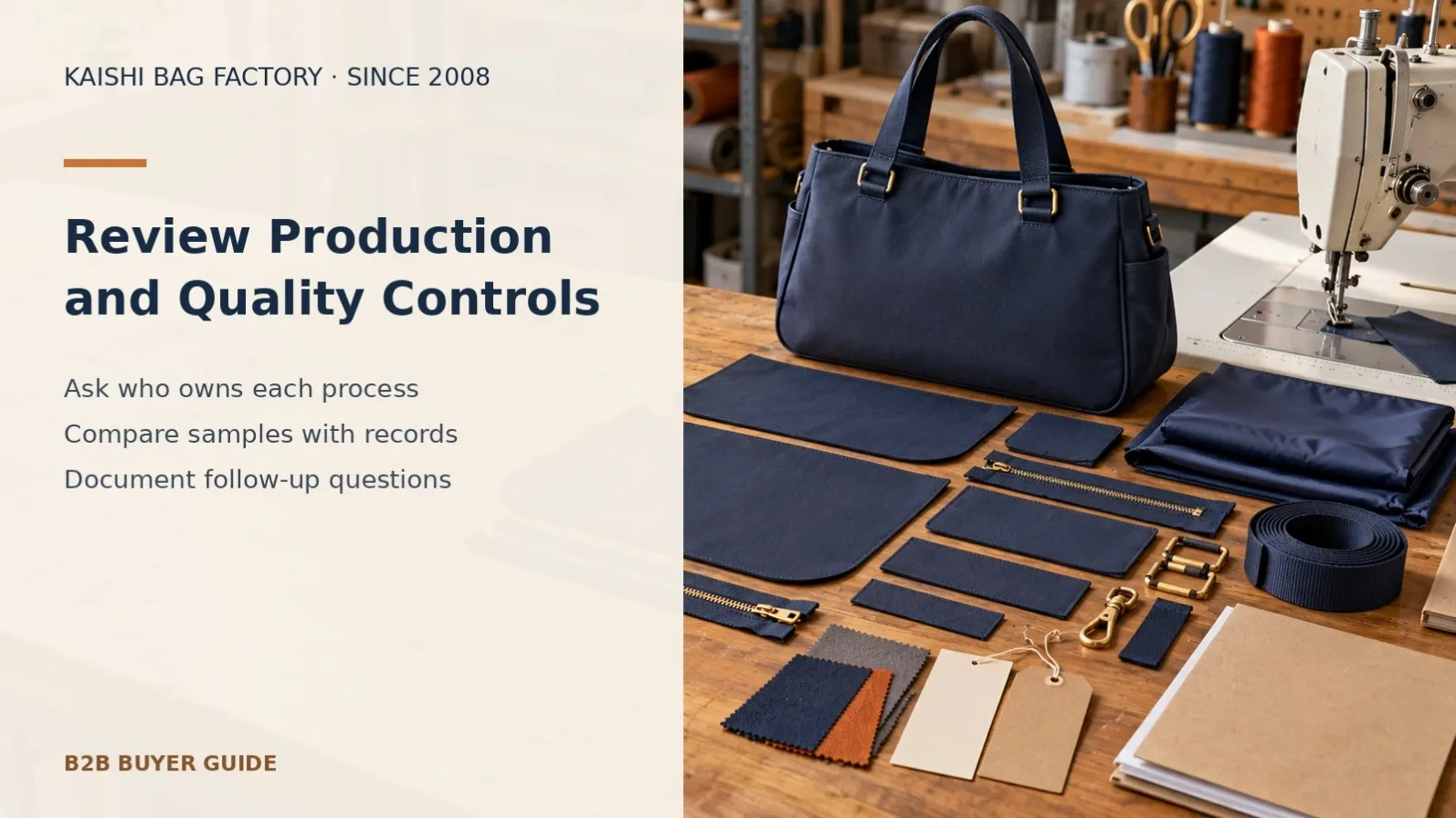
Ask who approves production against the reference sample, how defects are classified and what happens when a check fails. A quality table or a clean floor is not a substitute for measurable acceptance criteria. Agree a separate shipment inspection plan suited to the product and order risk.
Handle documents, privacy and recording carefully
Discuss file access and recording consent before collecting evidence. Request only what is relevant; anonymized records may be sufficient for an initial review. Do not demand other customers' artwork, order prices or personal worker information as a test of transparency.
The archived IAF announcement about MD 4 Issue 3 describes ICT uses including interviews, remote document review and visual or audio access. Its scope concerns conformity assessment. Use it as background for understanding remote methods, not as evidence that an ordinary sales call is an accredited audit.
If certification is claimed, check the entity, site, scope, issuing body and validity through relevant channels. A certificate visible on camera is not enough. Confidentiality arrangements and possible NDA terms should be discussed for the particular project, without assuming unlimited access or absolute secrecy guarantees.
Record gaps and decide the next step
Keep notes that separate observed evidence, supplier explanations and unresolved items. “The host showed a sewing operation” is more accurate than “capacity verified.” Where the view was incomplete, say what was missing and why further evidence is needed.
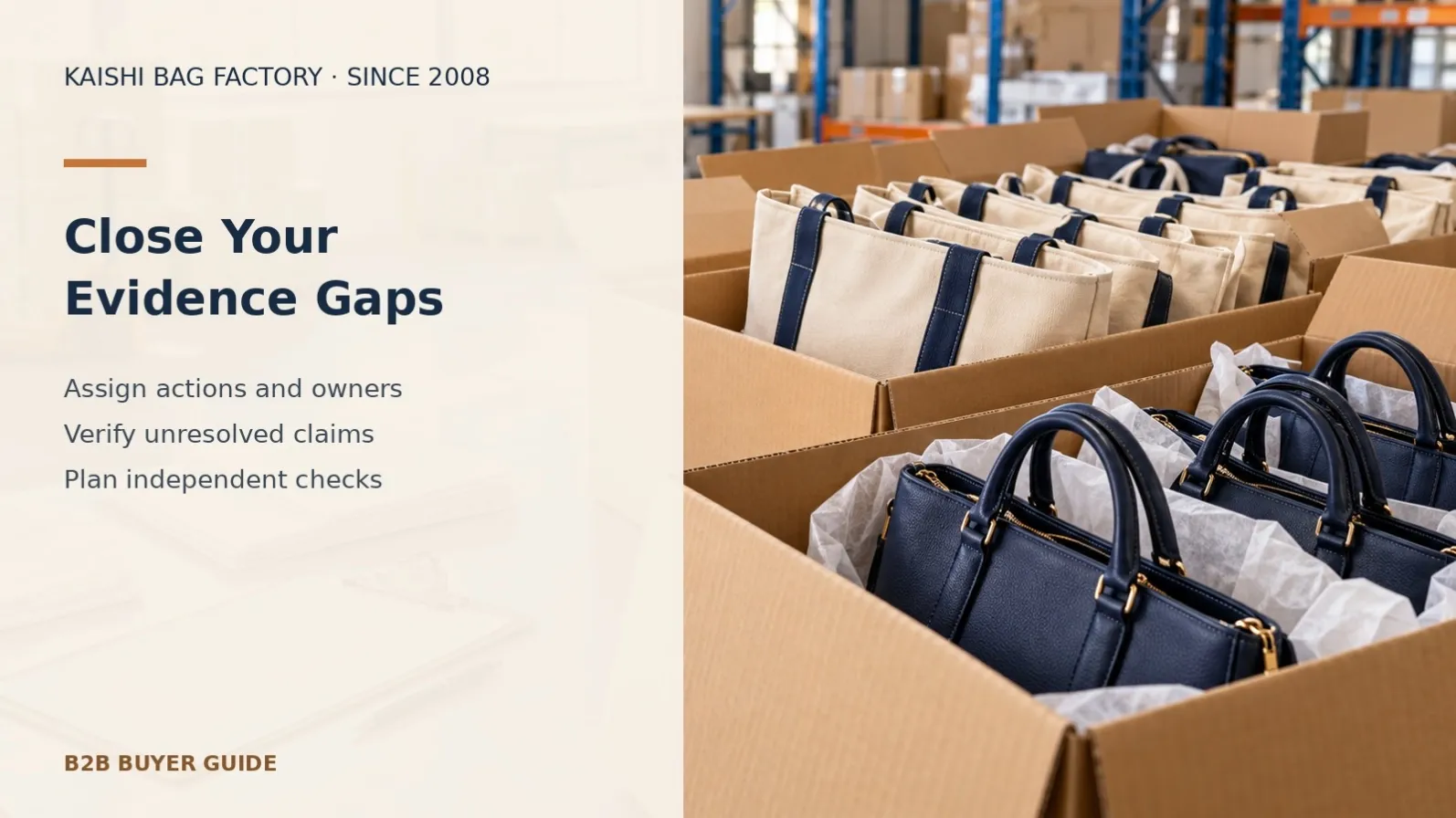
For each open item, assign a responsible person and an agreed follow-up date. Material discrepancies, unexplained entity differences or contradictory production answers merit clarification. Refusal to disclose customer information may be reasonable; refusal to explain your own manufacturing arrangement needs a different response.
Choose additional checks according to risk: a physical sample, document verification, an independent site review or a pre-shipment inspection. No single method establishes every aspect of supplier reliability. Repeat targeted checks when the product, site or manufacturing arrangement changes.
Discuss the commercial terms separately
Kaishi Bag Factory is based in Baigou, China and has worked in OEM/ODM since 2008. Our standard MOQ is usually 300 pieces per style. A 200-piece first order can be assessed individually and is not guaranteed; 100 pieces are generally not feasible. Mixed-style arrangements and repeat-order quantities require separate confirmation.
Payment is by T/T only, usually 50% deposit and 50% before shipment. Samples require upfront payment and fees are non-refundable; free samples or automatic credits should not be assumed. Lead times depend on design, materials, sample approval and quantity. See our payment planning guide. A successful video call does not replace a written specification and order agreement.
Frequently asked questions
Can a video tour prove a supplier owns the factory?
No. It provides observations that need to be connected with documents and appropriate verification of the manufacturing arrangement.
Can a remote audit replace a shipment inspection?
No. Supplier screening and checking your actual shipment answer different questions. Agree suitable shipment checks separately.
Must every factory have a separate sample room?
No. Facilities differ. Ask how development and approval are controlled rather than requiring an identical room layout.
How long should the call take?
Agree a duration based on the scope, available records and connection quality. Do not use a rushed or interrupted call as a final verdict.
What if the supplier refuses recording?
Discuss the reason and alternative evidence arrangements. Record only with permission and respect confidentiality and safety restrictions.
Does showing a certificate confirm compliance?
No. Verify its entity, site, scope, issuer and validity. Product or market requirements may require separate evidence.
What should I do after the call?
Write a factual evidence summary, assign follow-up actions and decide which independent checks are needed before advancing the order.
References and next step
- ISO/IEC TS 17012:2024 public overview.
- Archived IAF announcement: MD 4 Issue 3 (4 February 2025; reviewed 3 October 2026).
Planning a custom bag project? Send your product brief and supplier-review questions to Kaishi. Ask Donna about available review arrangements for your project. Email donna@Kaishibagfactory.com or contact Donna on WhatsApp.