
Wholesale Bag Carton Labels: SKU, Quantity and Receiving Traceability
Connect bag carton labels to SKU, quantity, packing records and receiving checks. Use customer-approved identifiers rather than inventing barcode numbers.

Connect bag carton labels to SKU, quantity, packing records and receiving checks. Use customer-approved identifiers rather than inventing barcode numbers.
This guide is for OEM/ODM brand teams, importers and wholesale buyers developing an original bag specification. It addresses wholesale bag carton labelling through decisions that can be documented, sampled and reviewed. A photograph or generic material name is not an approval standard. Define the intended use, compare the actual proposed construction and keep a controlled physical reference before authorizing production.
1. Separate the product variant from the shipping unit
Define how the buyer identifies a style, colour and other relevant variant. Then identify how cartons and shipments are recorded. A product SKU and a logistics-unit identifier answer different questions. Keep the relationship clear so a receiver can connect the external label to the contents and the packing record.
GS1 distinguishes logistics-unit identification through the SSCC. Its framework does not mean every ordinary wholesale bag carton must use the same label system. Ask the customer and logistics provider which requirements apply. Do not invent a GS1 identifier or copy a barcode from an unrelated product to make a carton look professional.
2. Obtain the customer’s receiving requirements
Request the warehouse’s label fields, accepted format, placement and any barcode instructions before approving artwork. Identify whether the shipment goes to a wholesaler, distributor, fulfilment centre or retailer. Those destinations may have different receiving workflows. Confirm the responsible contact rather than assume a generic export label meets every customer’s needs.
For Nigeria and India wholesale buyers, use the actual consignee’s requirements rather than generalize one national practice. The same applies to US and European importers. This guide addresses operational labels and records, not a complete customs-labelling or product-compliance assessment. Route legal marking questions to the appropriate qualified reviewer.

3. Define a readable human-facing label
Choose clear fields such as order reference, carton identity, style or SKU, colour, quantity and relevant handling information. Use the agreed terminology consistently with the packing list. Do not include unrelated customer details or marketing claims. A receiving label needs to communicate the supplied unit accurately.
Review the printed sample at its intended size and on the actual carton surface. Check contrast, clipping and whether the label remains visible when cartons are stacked or handled as planned. Avoid placing decorative elements where they interfere with reading. The buyer should approve the actual label version, not only a screenshot enlarged on a laptop.
4. Treat barcode data and print quality separately
Confirm who assigns the identifiers and which data structure or symbology the receiving system requires. A barcode image that looks clear to a person may still encode incorrect data. Check the actual printed label with the intended workflow and appropriate verification where required. Do not claim universal compatibility with every scanner.
GS1’s logistics-label guidance connects standardized identifiers with human-readable and machine-readable information. Apply the applicable customer and standard requirements rather than reproduce a decorative barcode. Keep the approved data example and printing instructions. Do not reuse a unique logistics-unit identifier across unrelated units when the selected system requires uniqueness.

5. Link labels to the packing record
For each carton, record the contents, quantity, external identifier and shipment reference. If a carton contains a permitted combination of variants, make the record explicit. This is a documentation workflow, not a promise that mixed-style orders are accepted or qualify for lower minimums.
The worksheet below is a buyer proposal. Agree how packing adjustments are recorded and who authorizes a changed label. A last-minute quantity correction must update the relevant records as well as the sticker. Otherwise a neatly printed label can still create receiving confusion by pointing to an outdated packing list.
| Record | Purpose | Check |
|---|---|---|
| Style or SKU | Identify the product variant | Matches buyer terminology |
| Carton identifier | Identify the supplied unit | Correct assignment and uniqueness |
| Quantity | Describe actual contents | Matches packing record |
| Barcode | Support required receiving workflow | Data and printed performance |
| Template revision | Control destination requirements | Approved printed example |
6. Validate the handover and receipt
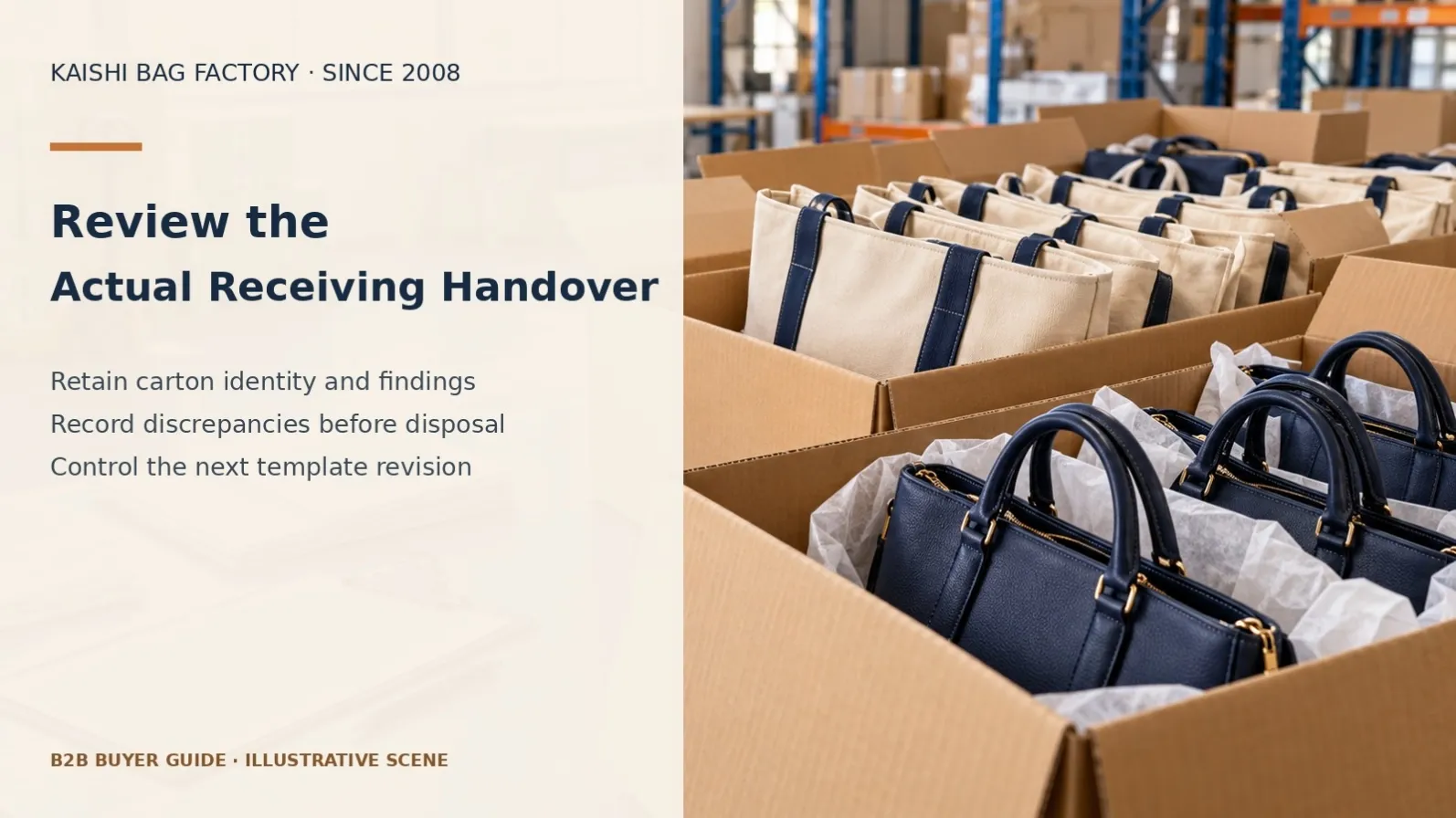
Before dispatch, compare representative cartons with the final packing records and label version. Check that the goods identity, quantity and external data agree. At receipt, record damaged labels, unclear identifiers or discrepancies before discarding packaging. Keep the carton reference with the observation so the issue can be investigated.
GS1’s traceability framework connects identifiers with records and relevant supply-chain events. For a bag order, retain the agreed product and shipment information so the receiver can connect an observed discrepancy to the supplied carton. Use traceable records to connect the received variant to the approved product. Do not infer full material traceability or regulatory compliance from a readable carton label alone.
7. Maintain a controlled label template
Keep the customer-approved format, field definitions and final print example with the order. Record the version used for each shipment and which destination it serves. A repeat order should confirm the current receiving requirements instead of automatically recycling an old carton layout.
If a customer changes warehouse or fulfilment provider, review the workflow again. Avoid promising fewer receiving errors or faster clearance as a guaranteed outcome. The purpose is accurate identification and evidence. Keep the actual receipt findings so the next packing instruction can address observed problems rather than assumptions about the buyer’s market.
Prepare a project-specific enquiry
Send the current drawing or tech pack, measured dimensions, intended carry contents, material references, component list, colour breakdown and proposed order quantities. Identify the sales destination and any buyer-required testing or packaging documentation. Separate mandatory requirements from design preferences, and explain which decisions remain open. This lets the factory review a real development scope rather than make assumptions from a reference photograph.
Ask the quotation to identify the selected construction, sample scope, material exceptions, packaging, delivery basis and validity conditions. Confirm who approves the physical sample and which revision becomes the production baseline. If a component changes, request an impact review before accepting the replacement. Keep commercial approval separate from technical approval: an attractive unit price does not establish that the revised bag meets the agreed use or inspection requirements.
Related buyer guides
Continue with shipping document guide, inspection guide.
Frequently asked questions
Is an SKU the same as an SSCC?
No. An SKU is a buyer’s product identifier; the GS1 SSCC identifies a logistics unit. Confirm which identifiers the receiving workflow requires.
Can the factory invent barcode numbers?
Use identifiers assigned through the agreed customer or standards process. Do not copy unrelated codes or create unsupported GS1 identifiers.
Does every bag carton require a GS1 label?
This article makes no universal requirement. Confirm the customer, carrier and applicable standards for the actual shipment.
Can one carton contain several variants?
Document any agreed arrangement accurately. This does not guarantee that mixed-style purchasing is accepted or changes the MOQ.
Is a successful scan enough?
Check encoded data, the required workflow and appropriate print verification. A scan alone does not prove the entire packing record is correct.
Should we reuse last order’s label?
Reconfirm the destination, identifiers, quantities and current template. Retain the exact approved version for the shipment.
What are Kaishi’s order, sample and payment terms?
Kaishi Bag Factory is based in Baigou, China and has worked in OEM/ODM since 2008. Standard MOQ is usually 300 pieces per style. A 200-piece first order may be evaluated individually without a guarantee; 100 pieces is usually not feasible. Mixed styles and reorders do not automatically qualify for lower minimums. Samples are prepaid and non-refundable, without automatic bulk-order credit. Payment is T/T only, usually 50% deposit and 50% before shipment. Timing depends on design, materials, sample approval and quantity. Any NDA and project-specific conditions require agreement.
Sources and next step
Sources checked on 7 October 2026: GS1 logistics-label guideline and GS1 SSCC overview. Supplier examples explain general principles, not Kaishi equipment ownership, certification or guaranteed availability. The purchasing worksheets are suggested buyer practices rather than quoted standard requirements.
Contact Kaishi Bag Factory with your specification and quantities for a project review. Email donna@Kaishibagfactory.com or message Donna on WhatsApp.