
Wholesale Bag Reorders: Using Sales and Quality Feedback to Plan the Next Order
Plan a wholesale bag reorder from variant-level sales, available stock, quality issues and confirmed factory conditions. A previous order is evidence to review, not an automatic repeat specification.

Plan a wholesale bag reorder from variant-level sales, available stock, quality issues and confirmed factory conditions. A previous order is evidence to review, not an automatic repeat specification.
This guide is for OEM/ODM brand teams, importers and wholesale buyers developing an original bag specification. It addresses wholesale bag reorder planning through decisions that can be documented, sampled and reviewed. A photograph or generic material name is not an approval standard. Define the intended use, compare the actual proposed construction and keep a controlled physical reference before authorizing production.
1. Identify the exact product and review period
Start with the style, colour, material reference and received batch. Record the dates of receipt, availability for sale and the sales review period. If the buyer combines several deliveries into one SKU, note the batch boundaries. Otherwise, a performance issue from one delivery can be mistaken for the history of the whole style.
This guide focuses on replenishment decisions after stock and feedback exist. It is different from planning a first collection assortment. Separate sold units, units on hand, units committed to customers, damaged stock and returns. A headline saying the style sold well does not establish which colour needs replenishment or whether the remaining stock is actually sellable.
2. Read sales together with stock availability
Review sales by variant and channel. A low sales count can reflect weak demand, limited visibility or insufficient available stock. A colour that was out of stock for part of the period cannot be compared casually with one that was continuously available. Note promotions, price changes and large one-off orders.
Shopify’s inventory reporting explains sell-through and stock-related metrics, but their definitions depend on the report and period. Record the definition used in your own system rather than mixing numbers from incompatible reports. Do not invent a universal reorder threshold or claim that one metric predicts future sales. Use the data to identify a question, then review its context.

3. Separate commercial returns from quality feedback
Classify why units came back or were discounted. Customer preference, unsuitable size, damage in transit, a specification mismatch and a functional failure are different issues. Preserve the relevant batch, photographs and reported conditions. A return count without reasons cannot explain whether the design, packaging or selling information should change.
ISO 10002’s complaints-handling scope supports analyzing feedback for improvement. It does not establish a bag-specific acceptance rate or prove that every complaint is a manufacturing defect. Review the evidence with the supplier and the buyer team. If information is incomplete, record the missing evidence instead of attaching an unsupported root-cause label to the next order.
4. Choose repeat, revise or defer by variant
A repeat decision retains the approved specification, subject to availability and commercial reconfirmation. A revise decision changes an identified feature and needs a controlled development review. A defer decision pauses buying while stock, demand or a quality question is unresolved. These are management choices, not guaranteed outcomes of a spreadsheet formula.
Use different decisions for different variants where warranted. A strong-performing colour may justify a review for replenishment while another needs a slower-stock plan. Avoid automatically reproducing the previous colour ratio. Also avoid treating a desired smaller reorder as already accepted by the factory. Confirm style and colour minimums and material purchasing constraints before allocating units.

5. Build a reorder decision worksheet
Bring sales, stock and issue evidence into one review sheet with an assigned action. Keep raw counts and interpretive comments separate. Note which period and channels the figures represent, so someone reading the sheet later can understand what was actually observed. Do not use a national-market assumption in place of buyer-specific records.
The suggested worksheet below is intended for OEM brands and wholesalers, including buyers serving Nigeria and India. It does not guarantee that one market will buy the same variants as another. Add purchase budget, target receipt window and approval responsibilities. Where demand information is weak, make that limitation visible instead of dressing a guess as a forecast.
| Input | Record by variant | Decision use |
|---|---|---|
| Sales | Units, period, channel and price context | Identify demand signals |
| Stock | Available, committed, damaged and returned | Avoid false replenishment urgency |
| Quality feedback | Reason, batch and supporting evidence | Repeat or revise construction |
| Supply confirmation | MOQ, components, quote and timing | Allocate feasible quantities |
| Release reference | Sample, specification and approved changes | Inspect the correct version |
6. Reconfirm the approved product and current supply conditions
Send the factory the previous approved sample and specification references, not merely an old invoice number. Ask whether the material, finish, hardware and packaging can be supplied on the same basis. A visually similar replacement can change colour, hand or function, and should go through an appropriate review.
Request an updated quotation and timing assessment for the planned quantities. A reorder does not automatically mean lower MOQ, unchanged pricing or a fixed shorter lead time. Material purchasing, component availability, production scheduling and any requested revision remain relevant. Keep the commercial confirmation aligned with the technical version so the purchase order does not describe one product while the factory prepares another.
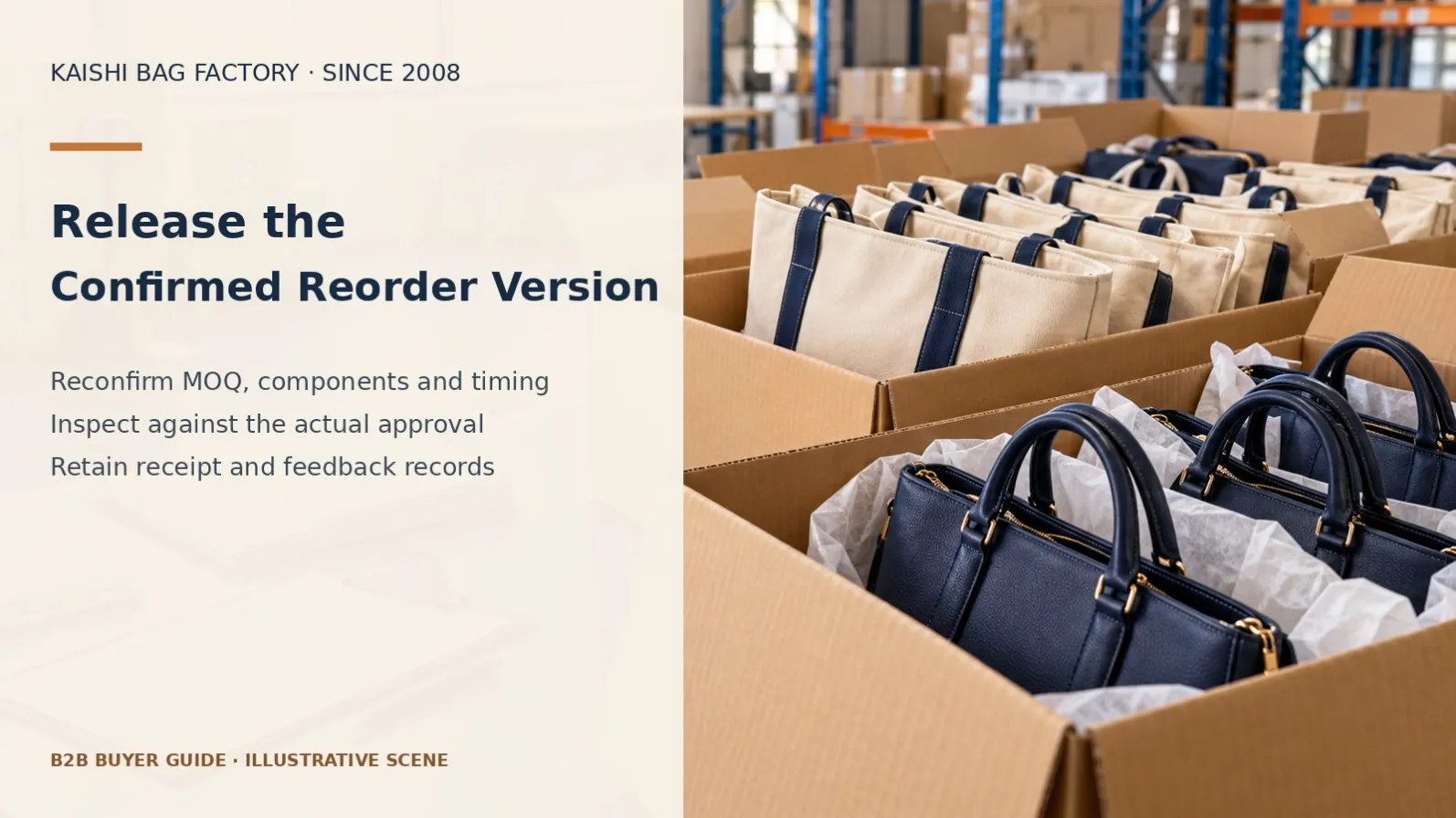
7. Validate the reorder and retain the learning
Identify the sample or reference used for release and any newly approved changes. If an earlier issue prompted a correction, specify how the next sample or inspection will check it. Review connected effects: a new handle can alter packing, and a lining change can affect appearance or pocket behaviour. Do not close the issue only because the supplier acknowledges it.
After receipt, compare the actual delivered version with the approved reorder scope and keep variant-level records for the next buying cycle. Protect customer information when sharing feedback, and obtain authorization before turning records into a published case study. The goal is a traceable purchasing decision, not a promise that every reorder will improve margins or sell through faster.
Prepare a project-specific enquiry
Send the current drawing or tech pack, measured dimensions, intended carry contents, material references, component list, colour breakdown and proposed order quantities. Identify the sales destination and any buyer-required testing or packaging documentation. Separate mandatory requirements from design preferences, and explain which decisions remain open. This lets the factory review a real development scope rather than make assumptions from a reference photograph.
Ask the quotation to identify the selected construction, sample scope, material exceptions, packaging, delivery basis and validity conditions. Confirm who approves the physical sample and which revision becomes the production baseline. If a component changes, request an impact review before accepting the replacement. Keep commercial approval separate from technical approval: an attractive unit price does not establish that the revised bag meets the agreed use or inspection requirements.
Related buyer guides
Use the tech pack revision guide for specification changes and the MOQ and timing guide for current order conditions.
Frequently asked questions
Should I reorder the previous colour ratio?
Review variant-level sales, stock availability and current channel needs first. The previous ratio is a starting record, not an automatic recommendation.
Does low sales mean low demand?
Not always. Stockouts, exposure, pricing and the review period can affect the count. Interpret the data in context.
Are all returns factory defects?
No. Classify reasons and collect evidence before assigning a cause or choosing a product revision.
Will a reorder have a lower MOQ?
Do not assume that. Confirm style and colour quantities with the factory for the current material and production scope.
Can I accept similar replacement hardware?
Review the actual replacement for fit, function and appearance, and document whether further sample or testing evidence is needed.
Can sales records become a public customer case?
Only with authorized evidence and appropriate permission. Do not invent results or expose identifying customer information to make a marketing example.
What are Kaishi’s order, sample and payment terms?
Kaishi Bag Factory is based in Baigou, China and has worked in OEM/ODM since 2008. Standard MOQ is usually 300 pieces per style. A 200-piece first order may be evaluated individually without a guarantee; 100 pieces is usually not feasible. Mixed styles and reorders do not automatically qualify for lower minimums. Samples are prepaid and non-refundable, without automatic bulk-order credit. Payment is T/T only, usually 50% deposit and 50% before shipment. Timing depends on design, materials, sample approval and quantity. Any NDA and project-specific conditions require agreement.
Sources and next step
Sources checked on 7 October 2026: Shopify inventory report definitions and ISO 10002 feedback-handling scope. Supplier examples explain general principles, not Kaishi equipment ownership, certification or guaranteed availability. The purchasing worksheets are suggested buyer practices rather than quoted standard requirements.
Contact Kaishi Bag Factory with your specification and quantities for a project review. Email donna@Kaishibagfactory.com or message Donna on WhatsApp.