
Planning a Wholesale Handbag Assortment by Style and Colour
Plan a wholesale handbag assortment with clear style roles, colour depth, budget limits and receiving records. A practical buyer worksheet without sales guarantees.
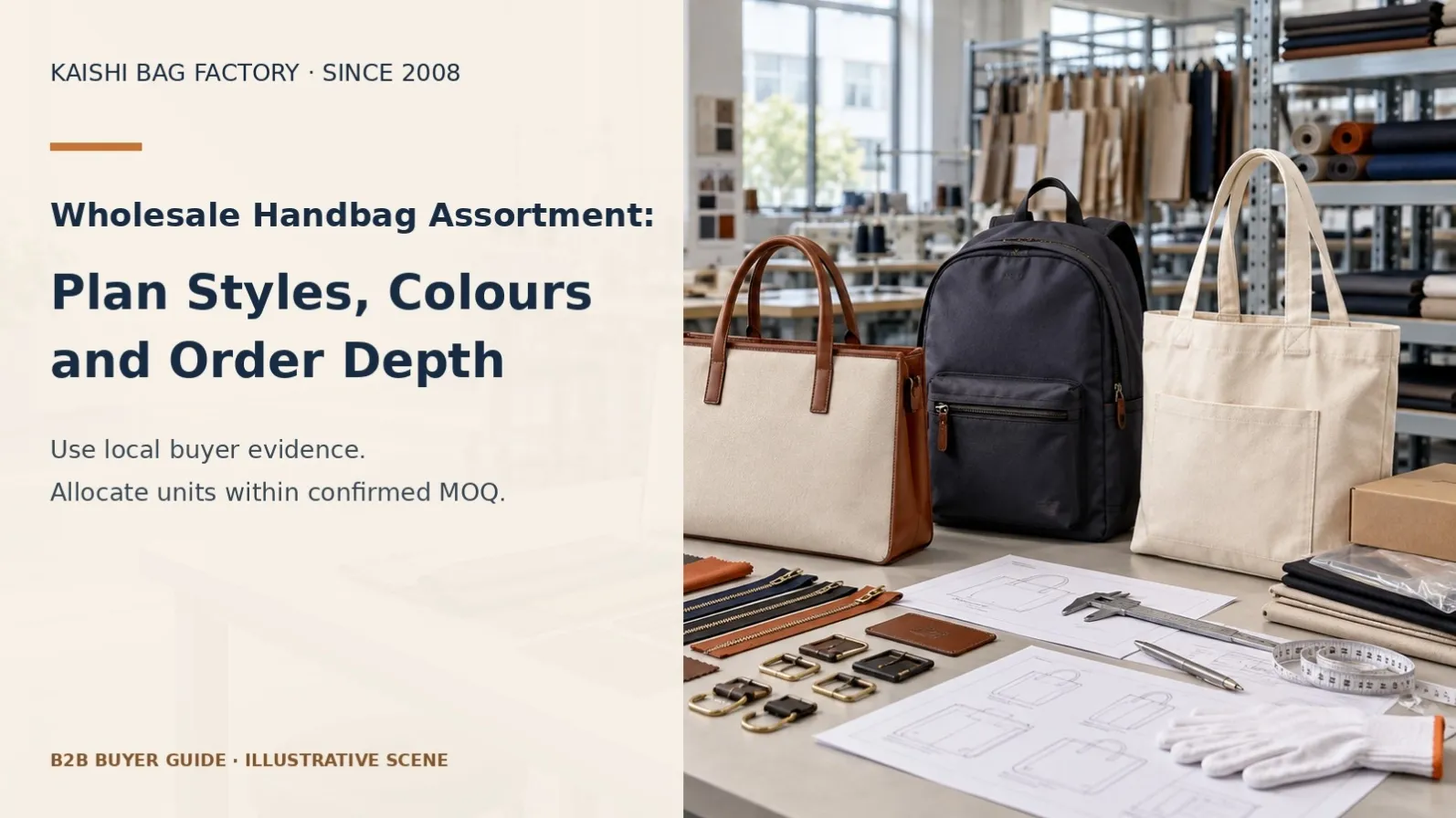
Plan a wholesale handbag assortment by assigning each style a buying role, selecting justified colour variants and allocating units within confirmed order minimums and cash constraints. Use evidence from your own customers, channel, price band and inventory. A larger range is not automatically a stronger range, and no style-colour mix guarantees sales in Nigeria, India or any other market.
This guide supports wholesalers, importers and retail buyers preparing an OEM bag order. It focuses on assortment breadth, variant depth and the receiving-to-reorder loop. It does not prescribe national colour preferences, universal percentages or guaranteed turnover. Separate a sourcing decision from a forecast, and label assumptions that still need local validation.
1. Define the customer and selling channel
Start with the channel in which the bags will sell: wholesale distribution, independent stores, an online shop or a brand programme. Define the end-customer use, price band and the buyer’s required margin. A range intended for occasional dressing is a different brief from a daily commuting range, even when both contain a tote.
Use your own order history, retailer feedback and enquiries. If the business is new, record interviews or small-market observations as hypotheses, not proof of demand. Nigeria and India contain diverse customers and channels; country names alone are insufficient to justify a design, colour or price. Document the actual city, channel and customer group you are targeting.
2. Separate breadth from depth
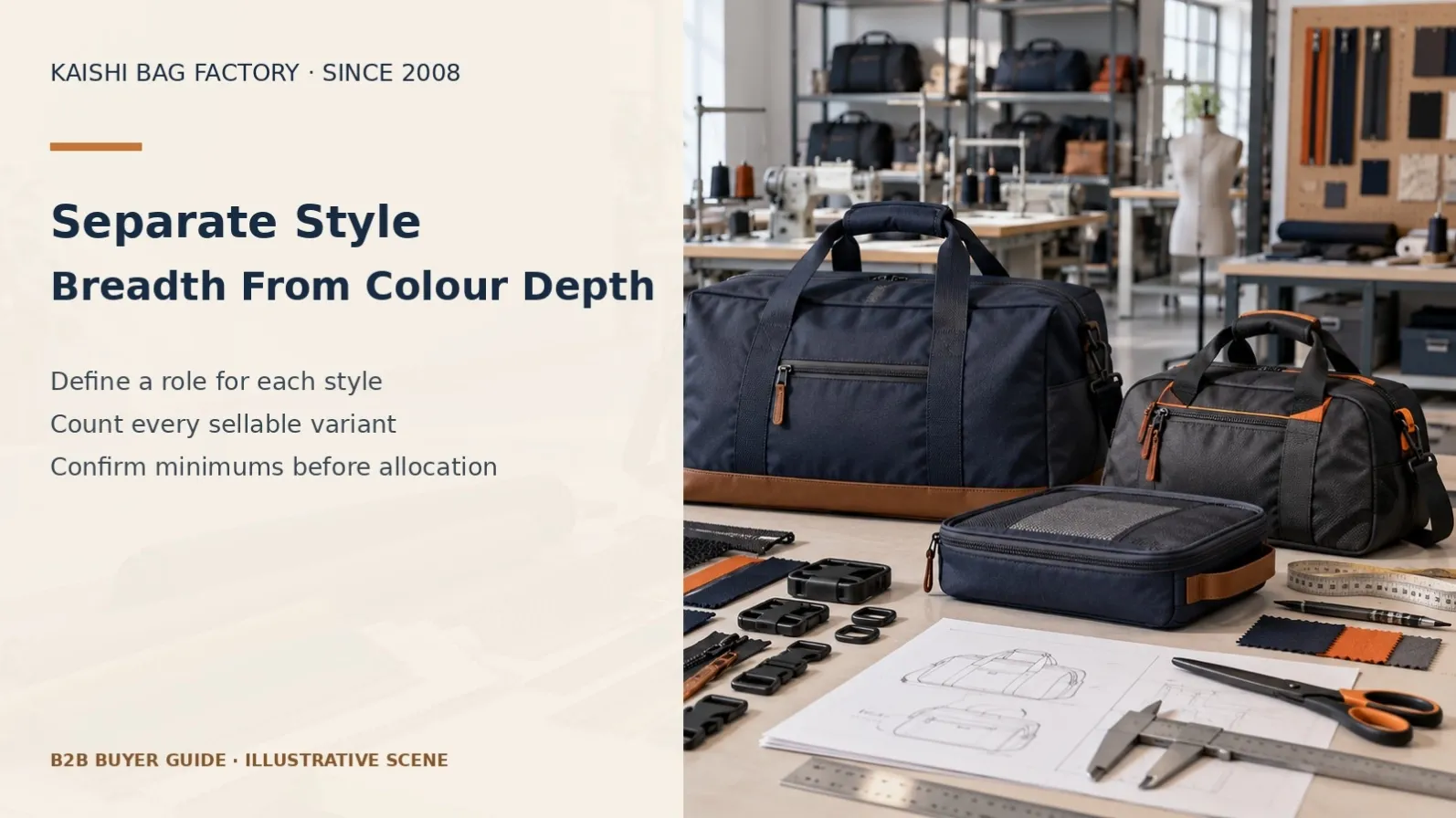
Breadth is the number of different styles or product roles. Depth is the quantity held within a style or variant. Shopify’s assortment-planning guidance distinguishes these planning dimensions. For handbags, a style with several colour choices creates multiple sellable variants that need separate identification and stock tracking.
Choose the role of each style before adding colours. Possible roles include a core everyday bag, a larger work tote or a smaller occasion format. These are planning examples, not a recommended demand split. Remove choices that serve the same role without a clear buyer reason. A tight range can be easier to explain and manage than a catalogue of overlapping shapes.
3. Select colours using evidence and material feasibility
Record why each colour is included: repeat orders, customer requests, a coordinated collection or a clearly labelled test. Consider whether the colour works across the actual outer material, lining, thread and hardware. A colour seen on a screen does not establish that a particular material is available or approved.
Avoid applying the same colour count to every style. A new or uncertain design may need a different buying decision from an established seller. Ask the factory to confirm how material purchase, colour quantities and style minimums affect feasibility. Do not assume multiple styles or small colour runs can automatically combine to meet one minimum.
4. Build an order matrix before requesting a quotation
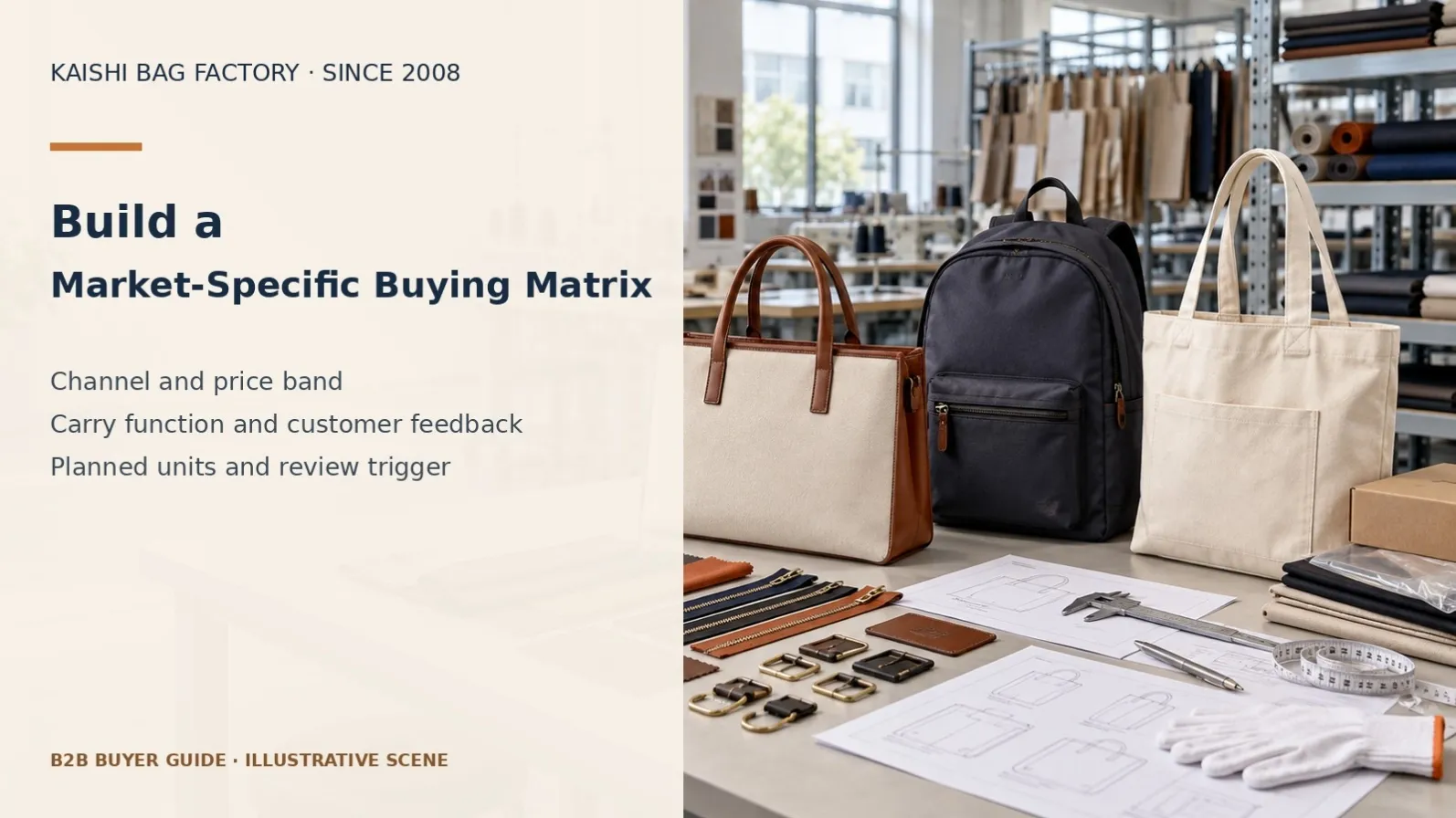
List style reference, function, material, colour reference, planned units, target price, selling channel and the reason for the allocation. Include the proposed receiving date and which assumptions are still open. This lets the quotation discussion address a real assortment rather than a collection of unrelated photographs.
Confirm the unit counts after the supplier reviews the specification and order conditions. Standard Kaishi MOQ is usually 300 pieces per style; colour allocation still needs project confirmation. Do not turn that minimum into a rule that every colour can be ordered in any quantity. A 200-piece first order is an individual assessment, not a routine assortment policy.
5. Check cash exposure and landed-cost assumptions
Calculate the order commitment using the confirmed quotation and shipment assumptions. Include packaging, freight, insurance where applicable, import charges and local distribution costs that apply to your transaction. A low factory price does not describe the entire cost of receiving and selling the range.
Keep currency, delivery terms and calculation dates visible. If a charge is uncertain, use a scenario and obtain a current quotation or professional confirmation. Do not publish a fixed tariff or landed-cost percentage for all handbags. Compare feasible assortment options against available capital and the inventory risk you are willing to carry.
| Matrix field | Buyer input | Purpose |
|---|---|---|
| Style role | Function and target channel | Explain why the style belongs |
| Colour evidence | Orders, feedback or test hypothesis | Avoid unsupported preference claims |
| Units | Confirmed style and colour allocation | Align feasibility and cash exposure |
| Cost assumptions | Quote, freight and import scope | Compare landed scenarios |
| Review trigger | Stock and sales evidence | Support the next buying decision |
6. Make the assortment easy to receive and sell
Assign clear style and colour identifiers and align them with the purchase order, carton marks and receiving records. Confirm whether cartons contain one variant or a documented assortment. A buyer needs to reconcile received units before stock can be evaluated reliably.
Prepare consistent product information for retailers or your own channel: dimensions, material description, carry function and only substantiated performance claims. Product photos should represent the actual approved variant. Do not use a sample image to imply stock of every colour, and do not invent customer endorsements to help sell an untested range.

7. Set a review and reorder rule using actual results
Track units received, sold, available, returned and committed to customers by variant. Review sales alongside stock availability and promotion timing. A colour that sold few units because it was out of stock is not directly comparable with one available throughout the period. Shopify’s inventory guidance emphasizes maintaining reliable stock information.
Decide in advance what evidence will trigger a reorder, a revised allocation or a pause. Use your business’s review intervals and lead-time requirements; no universal trigger is appropriate for every wholesaler. Reconfirm the factory’s materials, minimums, price and timing for each reorder. Previous production does not guarantee a lower MOQ or unchanged component availability.
Related buyer guides
Review the MOQ guide, the import planning guide and the payment terms guide when testing the order matrix against sourcing conditions.
Frequently asked questions
How many handbag styles should I start with?
There is no universal number. Select enough distinct roles to serve your channel within capital and supplier constraints. Each style should have a clear reason and a feasible unit allocation.
Which colours sell best in Nigeria or India?
Use evidence from your own customer group and channel. A national market label cannot reliably predict a colour’s sales, and this guide makes no such guarantee.
Can I split the MOQ across different designs?
Do not assume this is accepted. Kaishi’s standard minimum is usually per style. Discuss the actual order matrix with Donna before making a buying commitment.
Should I buy equal units of every colour?
Equal quantities are a planning choice, not a rule. Use buyer evidence, uncertainty and confirmed colour minimums to decide, and record the rationale.
Does a runway trend justify a large wholesale order?
A runway observation is a design signal rather than proof of demand in your channel. Validate relevance, price and function before committing inventory.
What information makes a reorder decision stronger?
Variant-level stock, actual sales, customer commitments, returns and availability history help. Reconfirm the sourcing conditions and distinguish evidence from forecasts.
What are Kaishi’s MOQ and project terms?
Kaishi Bag Factory is based in Baigou, China and has worked in OEM/ODM since 2008. Standard MOQ is usually 300 pieces per style. A 200-piece first order may be reviewed individually, without a guarantee; 100 pieces is usually not feasible. Mixed styles do not automatically share one minimum, and a reorder does not automatically qualify for a lower MOQ. Samples are prepaid and non-refundable, without an automatic credit against bulk orders. Payment is T/T only, usually 50% deposit and 50% before shipment. Development and production timing depends on design, materials, sample approval and quantity. Confirm project terms before committing to a launch date.
Sources and project enquiry
References checked on 6 October 2026: Shopify assortment-planning guidance and Shopify inventory-management fundamentals. These sources support general guidance; they are not evidence of a Kaishi certification, supplier relationship or guaranteed project capability.
Contact Kaishi Bag Factory with your style-colour matrix, intended channel, material references and planned quantities to review feasibility and quotation scope. Email donna@Kaishibagfactory.com or message Donna on WhatsApp.