
From Buyer Feedback to a Revised Bag Sample: A Practical Review
Turn bag sample feedback into a clear diagnosis, measured change request and verified revised sample. Separate preference, specification mismatch and functional failure before choosing a correction.

Turn bag sample feedback into a clear diagnosis, measured change request and verified revised sample. Separate preference, specification mismatch and functional failure before choosing a correction.
This guide is for OEM/ODM brand teams, importers and wholesale buyers developing an original bag specification. It addresses bag sample feedback diagnosis through decisions that can be documented, sampled and reviewed. A photograph or generic material name is not an approval standard. Define the intended use, compare the actual proposed construction and keep a controlled physical reference before authorizing production.
1. Capture the observation before suggesting a solution
A comment such as “the bag does not feel right” needs context before a factory can act. Record the sample identity, intended use, contents, carry mode and what happened. Add photographs that show both the whole bag and the relevant detail. Explain whether the issue is constant or appears only under a specific condition.
Keep the buyer’s observation separate from the proposed cause. A handle that feels awkward might involve dimensions, stiffness, attachment position or bag balance; changing the strap length immediately can miss the real issue. This article uses a teaching scenario, not an actual Kaishi customer case or testimonial. No client outcome, defect rate or sales result is claimed.
2. Sort preference, mismatch and failure
A preference is a design choice the buyer wants changed, such as a softer hand or different pocket opening. A mismatch means the sample differs from an agreed drawing or reference. A functional failure means the product does not perform an agreed task under the relevant conditions. These categories can overlap, but they need different evidence.
For a mismatch, identify the approved reference and measurement method. For a preference, explain the new target and what trade-offs are acceptable. For a functional issue, preserve the condition under which it occurred. ISO 10002 describes analyzing feedback as part of product and service improvement; it does not supply a bag-specific repair rule or demonstrate that Kaishi holds any certification.

3. A teaching scenario: the opening feels difficult
Imagine a buyer reviewing a prototype shoulder bag and finding access awkward while it is worn. The initial suggestion is to lengthen the zipper. Before revising the pattern, the review team checks which hand opens it, what contents are inside, where the strap sits and whether the mouth is supported or collapsing.
The investigation could reveal different causes: opening geometry, handle interference, a stiff facing or a component interaction. These are possible diagnostic questions, not findings from a real order. The useful lesson is to observe the completed sample before choosing a correction. Keep the old version available so the revised sample can be compared under the same conditions.
4. Write a change request that answers one question
Describe the proposed change, its reason, affected component and expected observable result. Attach marked drawings with measurement points rather than arrows alone. If the change is exploratory, state that it is a trial and list the alternatives being compared. Do not call an experiment a final production instruction.
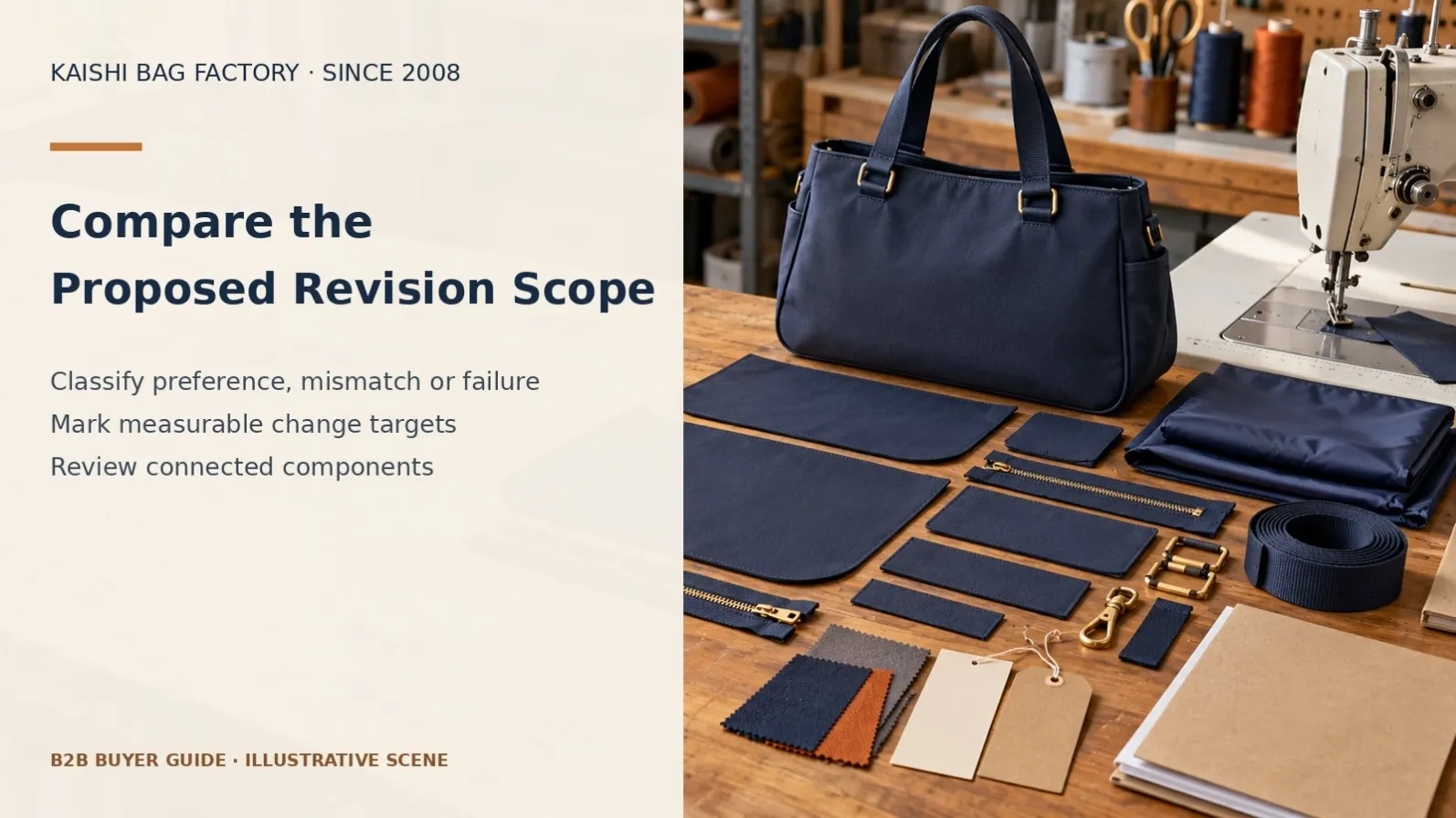
Changing several variables simultaneously can make the result difficult to interpret. Where practical, isolate the question or explain the combined revision. Review connected features such as lining, reinforcement, hardware and packaging. A wider opening can affect a zipper length, panel shape or carry appearance. The factory should review cost and feasibility before the buyer treats the revision as already agreed.
5. Use a feedback-to-evidence worksheet
Connect the issue to the evidence, classification, proposed response and validation condition. Assign one person to consolidate buyer feedback so different team members do not send conflicting instructions. Keep unresolved questions open rather than allowing the factory to guess which comment overrides the approved drawing.
The worksheet below is a suggested diagnostic tool. It differs from a general revision log: its purpose is to establish what needs solving before a change is chosen. Do not add a fabricated root cause just to complete a column. When the evidence is insufficient, identify the additional photograph, measurement, demonstration or test required to make a useful decision.
| Step | Record | Next decision |
|---|---|---|
| Observation | Sample ID, use and visible issue | Is more evidence needed? |
| Classification | Preference, mismatch or failure | Which target applies? |
| Trial request | Measured change and affected parts | Is scope feasible? |
| Comparison | Same review conditions and side effects | Does the revision meet the target? |
| Closure | Approval, exception or new action | Which version is authorized? |
6. Compare the revised sample under the same conditions
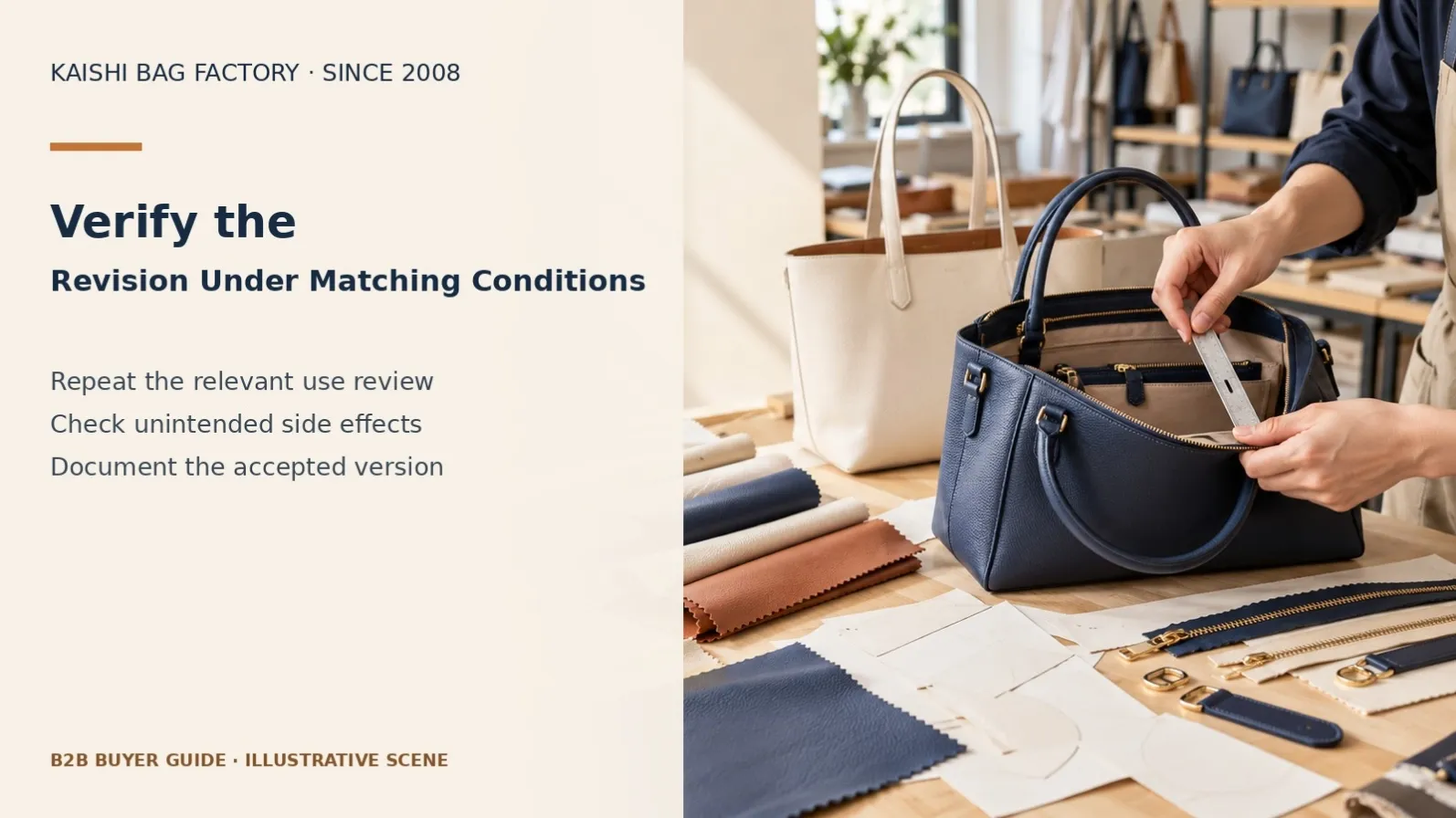
Use the same representative contents, carry mode and observation method where appropriate. Check the target issue first, then inspect connected features for unintended consequences. A correction that improves opening access may alter the silhouette or expose a lining edge. Review the complete sample, not only the changed part.
Distinguish a subjective improvement from a measured result and from a formal performance test. If the change concerns seam or attachment behaviour, obtain appropriate technical review. AMANN’s bag guidance explains why material, seam construction, thread and needle work together. A new stitch appearance alone cannot demonstrate that a functional problem has been solved.
7. Close feedback with a decision, not a compliment
Record whether the revised sample is approved, approved with an explicit exception or needs another review. Identify the sample and drawing revisions covered by that decision. A message saying “much better” is useful feedback, but does not identify whether the remaining details are accepted for production.
For publication of a real case later, obtain Donna’s authorization and the underlying evidence. Remove identifying customer information unless its use is approved. Do not infer client satisfaction from the absence of a complaint. Keep this teaching article separate from marketing testimonials and avoid promises about the number of sample rounds or guaranteed time saved.
Prepare a project-specific enquiry
Send the current drawing or tech pack, measured dimensions, intended carry contents, material references, component list, colour breakdown and proposed order quantities. Identify the sales destination and any buyer-required testing or packaging documentation. Separate mandatory requirements from design preferences, and explain which decisions remain open. This lets the factory review a real development scope rather than make assumptions from a reference photograph.
Ask the quotation to identify the selected construction, sample scope, material exceptions, packaging, delivery basis and validity conditions. Confirm who approves the physical sample and which revision becomes the production baseline. If a component changes, request an impact review before accepting the replacement. Keep commercial approval separate from technical approval: an attractive unit price does not establish that the revised bag meets the agreed use or inspection requirements.
Related buyer guides
For controlled records after a change is chosen, read the tech pack revision guide. Use the bag sampling guide for the wider approval process.
Frequently asked questions
Is this a real customer case?
No. The access scenario is explicitly a teaching example. A real Kaishi case would need authorized evidence before publication.
Should I tell the factory how to fix every issue?
Describe the problem and target clearly, then review proposed solutions with the factory. An early assumption about the cause can lead to an ineffective change.
What should a feedback photograph include?
Show the whole sample, the relevant detail and the conditions of use. Add measured points where needed and identify the sample version.
Can I change several features at once?
You can propose a combined revision, but identify the connected effects and how the result will be interpreted. Isolated trials can make diagnosis clearer.
Is a better-looking seam proof of strength?
No. Appearance and functional performance are separate questions. Request appropriate construction review or testing for the intended requirement.
When is feedback closed?
When a documented decision identifies the accepted version and any exceptions or remaining actions. General praise alone is not production approval.
What are Kaishi’s order, sample and payment terms?
Kaishi Bag Factory is based in Baigou, China and has worked in OEM/ODM since 2008. Standard MOQ is usually 300 pieces per style. A 200-piece first order may be evaluated individually without a guarantee; 100 pieces is usually not feasible. Mixed styles and reorders do not automatically qualify for lower minimums. Samples are prepaid and non-refundable, without automatic bulk-order credit. Payment is T/T only, usually 50% deposit and 50% before shipment. Timing depends on design, materials, sample approval and quantity. Any NDA and project-specific conditions require agreement.
Sources and next step
Sources checked on 7 October 2026: ISO 10002 complaints-handling scope and AMANN bag seam guidance. Supplier examples explain general principles, not Kaishi equipment ownership, certification or guaranteed availability. The purchasing worksheets are suggested buyer practices rather than quoted standard requirements.
Contact Kaishi Bag Factory with your specification and quantities for a project review. Email donna@Kaishibagfactory.com or message Donna on WhatsApp.