
Handbag Colour Transfer onto Clothing: What Buyers Should Check
Review colour transfer from handbag surfaces, straps and trim onto clothing. Match rubbing evidence to the actual material and approve finished-bag contact conditions.
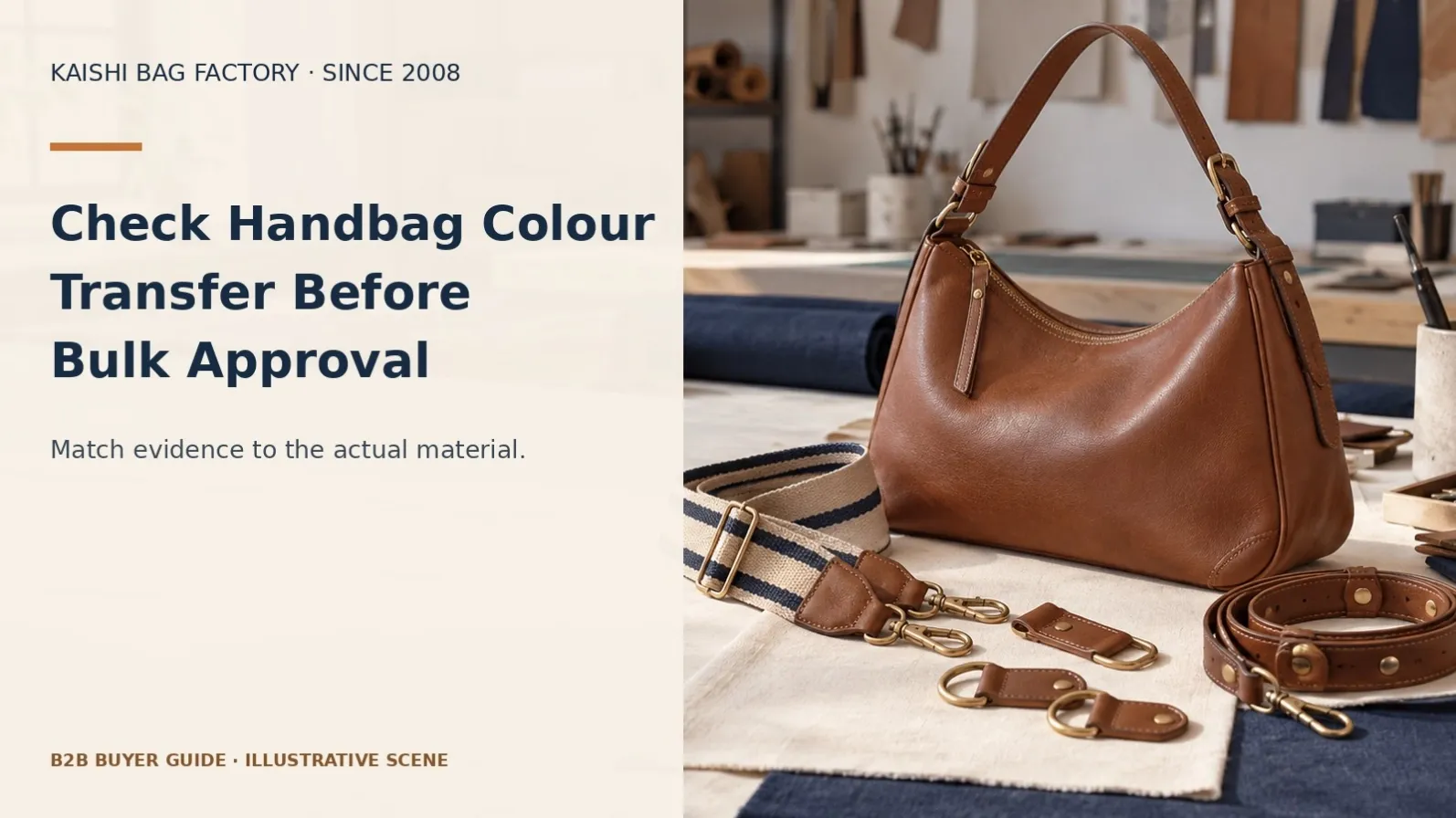
Check handbag colour-transfer risk on the actual outer material, straps, trim and lining, then review how those parts contact clothing and contents. Select material-appropriate rubbing evidence with a laboratory and agree acceptance criteria. A dark colour, a protective coating or a single informal wipe does not by itself establish performance.
For brands and wholesalers, a bag that looks attractive in a catalogue can still generate complaints if colour marks a light garment. The purchasing task is to connect the actual contact areas with relevant evidence and physical approval. This article focuses on transfer and staining, rather than colour matching, abrasion resistance or a guarantee against every possible use condition.
1. Map contact with clothing and contents
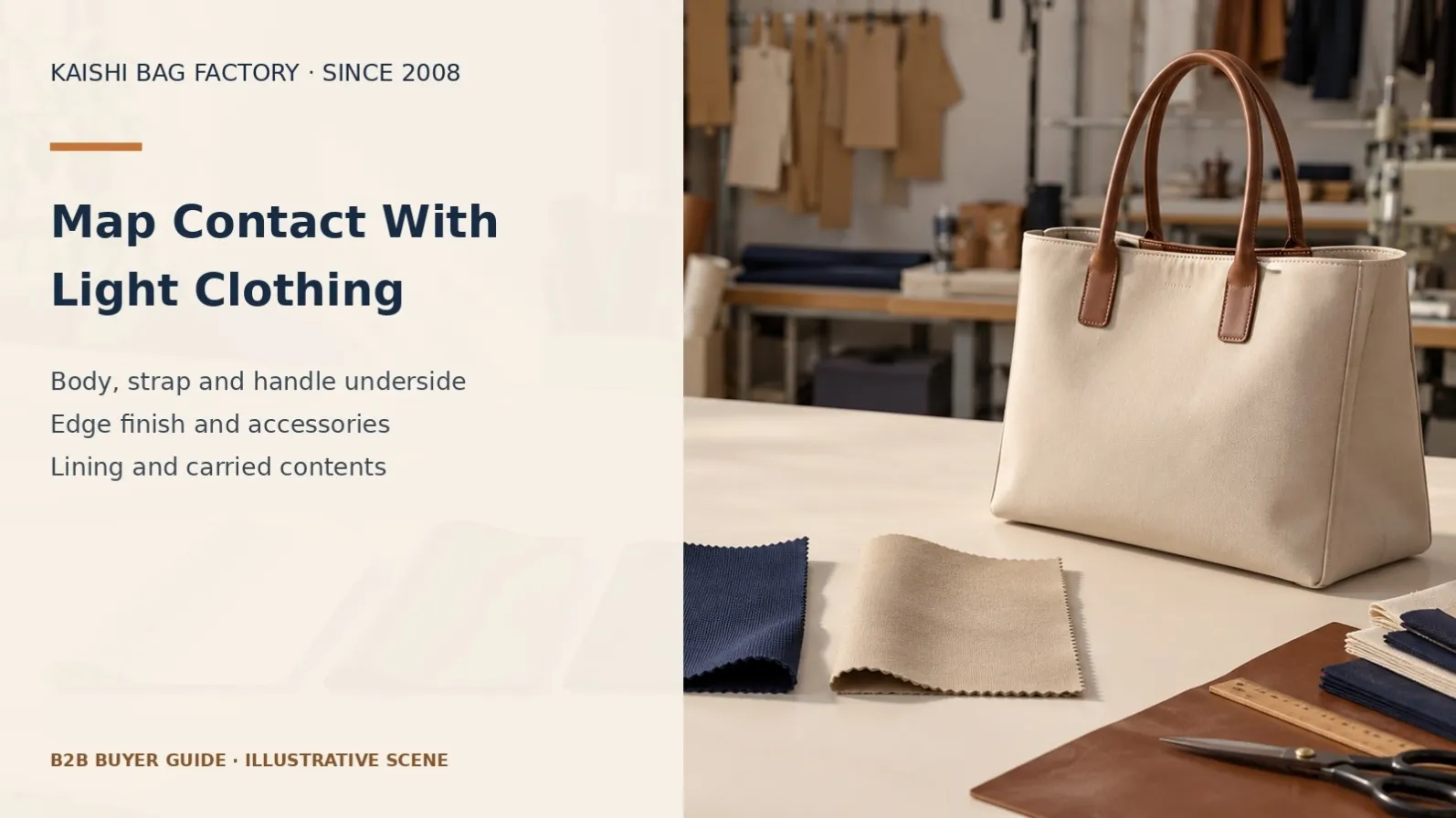
Identify which bag surfaces can touch a wearer during ordinary use. Review the body panel, shoulder strap, handle underside, edge finish, decorative trim and detachable accessories. A crossbody may contact a garment differently from a hand-carried bag. Do not assess only the attractive front panel while overlooking a darker strap lining or folded edge.
Also consider contact inside the bag: light wallets, a fabric pouch or paper items may touch the lining. Record these as separate questions because the material and exposure can differ. Ask the buyer what carrying configuration is intended and document it in the sample brief. Avoid making national or customer-group assumptions about how every bag will be used.
2. Identify the actual colour-bearing construction
Record the substrate, dye or finish reference where known, colourway and supplier material code. A general description such as vegan leather or cotton is not enough to identify the tested construction. The backing, coating, print and edge treatment may need separate consideration. Approve the actual proposed materials rather than borrowing evidence from a visually similar sample.
Keep representative physical references with the approved revision. If the supplier changes the surface finish or source, ask whether the previous evidence still applies. A product name does not establish unchanged composition or processing. The aim is traceability between the purchase specification, laboratory sample and finished bag, without claiming that every factory must use one particular material system.
3. Choose evidence for the material and question
ISO 105-X12 describes textile colourfastness to rubbing, while ISO 11640 addresses leather colourfastness under repeated rubbing. They concern different material scopes. A laboratory should confirm which current method and edition are appropriate to the actual substrate, coating and assessment objective. Do not treat a method number as a universal pass requirement or a finished-handbag certification.
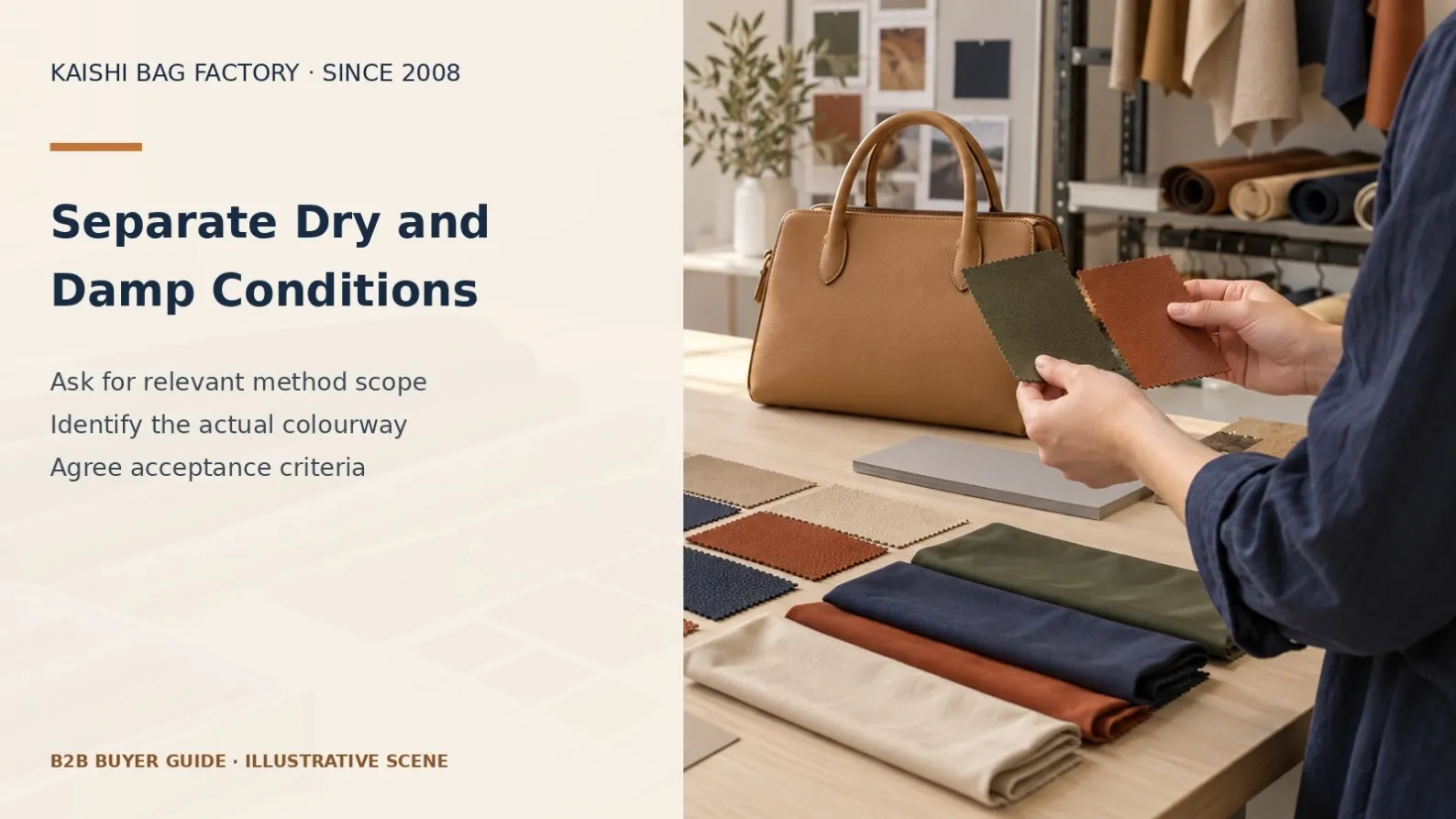
Ask the report to identify the submitted material, colour, conditions and result. Discuss relevant dry and damp contact conditions instead of accepting an unexplained pass screenshot. This guide does not prescribe grades, cycles or a moisture level; those require a suitable method and agreed buyer specification. An informal check can help identify an issue, but should not be relabelled as a standard test.
4. Review complete-bag contact separately
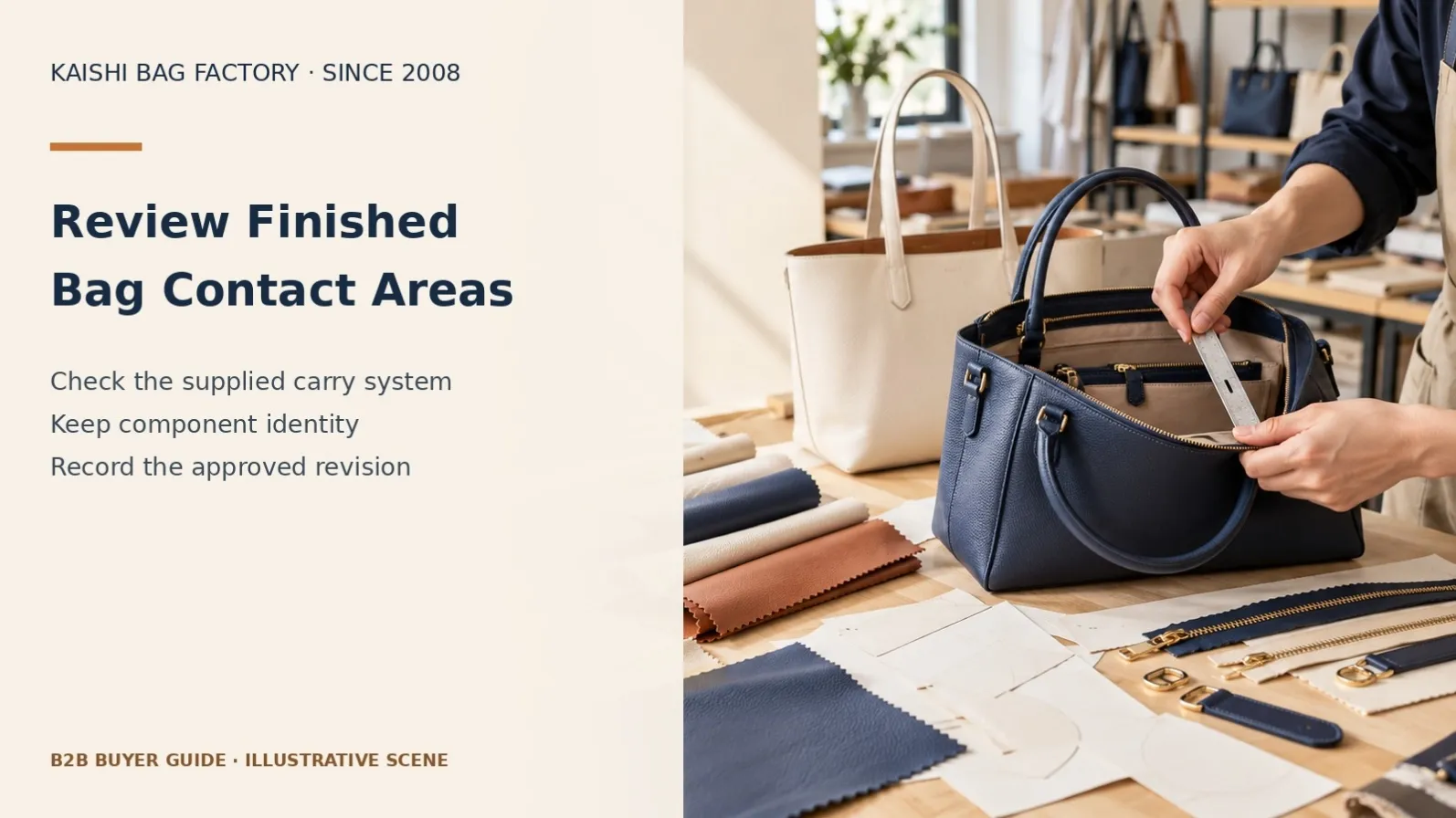
Material evidence answers a defined laboratory question. The completed bag adds seam placement, folded edges, accessory movement and the actual carry configuration. Inspect how the bag contacts a representative light surface during a controlled review appropriate to its intended use. Agree the procedure and references in advance rather than improvising a dramatic demonstration for a sales video.
Avoid using valuable clothing as an unplanned test surface. Keep any practical trial clearly labelled as a buyer review and preserve the relevant material identity. Do not claim that it replaces laboratory evidence or predicts every garment interaction. If a problem appears, identify the exact contact point before proposing an unrelated outer-material change.
5. Write acceptance criteria that inspectors can use
A statement such as never stains anything is difficult to evaluate and may promise more than the evidence supports. Define the critical components, relevant conditions, accepted physical references and any required test evidence. Record who decides whether an observed mark is acceptable and how a disputed result is reviewed. Include the approved revision and material references on the inspection instruction.
Keep colour transfer distinct from surface abrasion, colour matching and general appearance. A bag can match a colour target yet have insufficient evidence for rubbing performance. Conversely, an appearance difference does not necessarily indicate transfer. The worksheet below helps sourcing teams keep these decisions separate so an inspector is not expected to invent criteria at the end of production.
| Review item | Evidence to retain | Approval question |
|---|---|---|
| Contact map | Body, strap, trim and lining locations | What can touch clothing or contents? |
| Material identity | Code, finish, colour and revision | Does the evidence match this component? |
| Method scope | Applicable method and conditions | What has actually been assessed? |
| Finished bag | Representative carry configuration | Are contact areas covered by the review? |
| Change control | Substitution and renewed approval | Does the original evidence still apply? |
6. Control colourways and proposed substitutions
Do not assume one tested colour covers every shade, finish or component. Ask the laboratory or supplier what range the evidence actually represents. Dark and light variants may require separate review depending on the construction and buyer requirements. Record the coverage rather than turning a single sample result into a blanket statement for an entire future collection.
If a component is revised, review the effect on appearance, touch, attachment and contact behaviour. Approve the changed sample and update the bill of materials. A substitute strap lining or edge finish should not silently inherit the original evidence. Keep the revision with the order so future reorders can be assessed against a clear baseline rather than a remembered showroom sample.
7. Handle a complaint with traceable evidence
Request the style, colourway, batch identity, photographs and a description of how the bag was used and stored. Preserve the bag and affected material when appropriate for investigation. Distinguish the reported observation from a conclusion about its cause. A photograph alone may show a mark without establishing which surface produced it or under what conditions.
For a hypothetical handbag launch, a mark associated with the shoulder strap calls for reviewing that complete strap construction and contact location. It does not automatically prove that the body panel must be replaced. This is an investigation example, not a customer case. Agree the next evidence-gathering step and any stock decision through the buyer's quality process, without inventing a remedy or guarantee.
Frequently asked questions
Will every dark handbag stain light clothing?
No universal conclusion follows from colour alone. Review the actual material, finish, components and relevant contact conditions. Avoid claiming either inevitable staining or guaranteed immunity based on appearance.
Is a white-cloth wipe enough?
It can be an informal screening observation, but it is not automatically a standardised test. Agree the sample, procedure and acceptance conditions, and use appropriate laboratory evidence where the purchasing requirement calls for it.
Does a textile rubbing result cover leather trim?
Not automatically. Textile and leather methods have different scopes. Identify every relevant material and ask the laboratory how to assess the construction rather than extending one result without justification.
Should I check the shoulder strap separately?
Yes, identify its actual contact surfaces and construction. The underside, edge treatment and attachment components may differ from the body panel. Include them in the specification and sample review.
Can one colourway cover the collection?
Only if the evidence and justified scope support that conclusion. Do not assume that different dyes, finishes or suppliers behave identically. Ask what material and variants were actually submitted and assessed.
What should I send with a transfer complaint?
Provide product and batch identity, clear photographs, the contact location and use conditions. Preserve relevant items for investigation and distinguish the observed mark from any unverified conclusion about its cause.
What are Kaishi’s order and payment terms?
Kaishi Bag Factory is based in Baigou, China, and has worked in OEM/ODM since 2008. Standard MOQ is usually 300 pieces per style. A 200-piece first order may be assessed individually without a guarantee; 100 pieces is usually not feasible. Mixed styles and repeat orders do not automatically qualify for reduced minimums. Samples are paid upfront and non-refundable. Any agreed bulk-order credit must appear in your written quotation; do not assume that every project qualifies. Payment is T/T only, normally 50% deposit and 50% before shipment. Timing depends on design, materials, sample confirmation and quantity.
Related buyer guides
Coordinate the physical colour approval, lining specification and inspection plan while keeping their separate purposes clear.
Sources and project enquiry
References checked on 20 October 2026: ISO 105-X12 textile rubbing scope and ISO 11640 leather rubbing scope. These public scope descriptions do not reproduce full test procedures; confirm the applicable published edition before commissioning work. These limited references support general principles; the buyer checklists are suggested procurement practices. No named supplier, equipment, certification or guaranteed performance is implied for Kaishi. Recheck relevant sources before February 2027 publication.
Contact Kaishi Bag Factory with your specification, expected quantities and destination market. Email donna@Kaishibagfactory.com or message Donna on WhatsApp to review the project scope before commissioning samples.