
How to Reduce Bag Packaging Volume Without Losing Shape
Reduce bag shipping volume through tested folding, targeted support, carton trials and unpacking checks. A practical OEM packing specification guide.
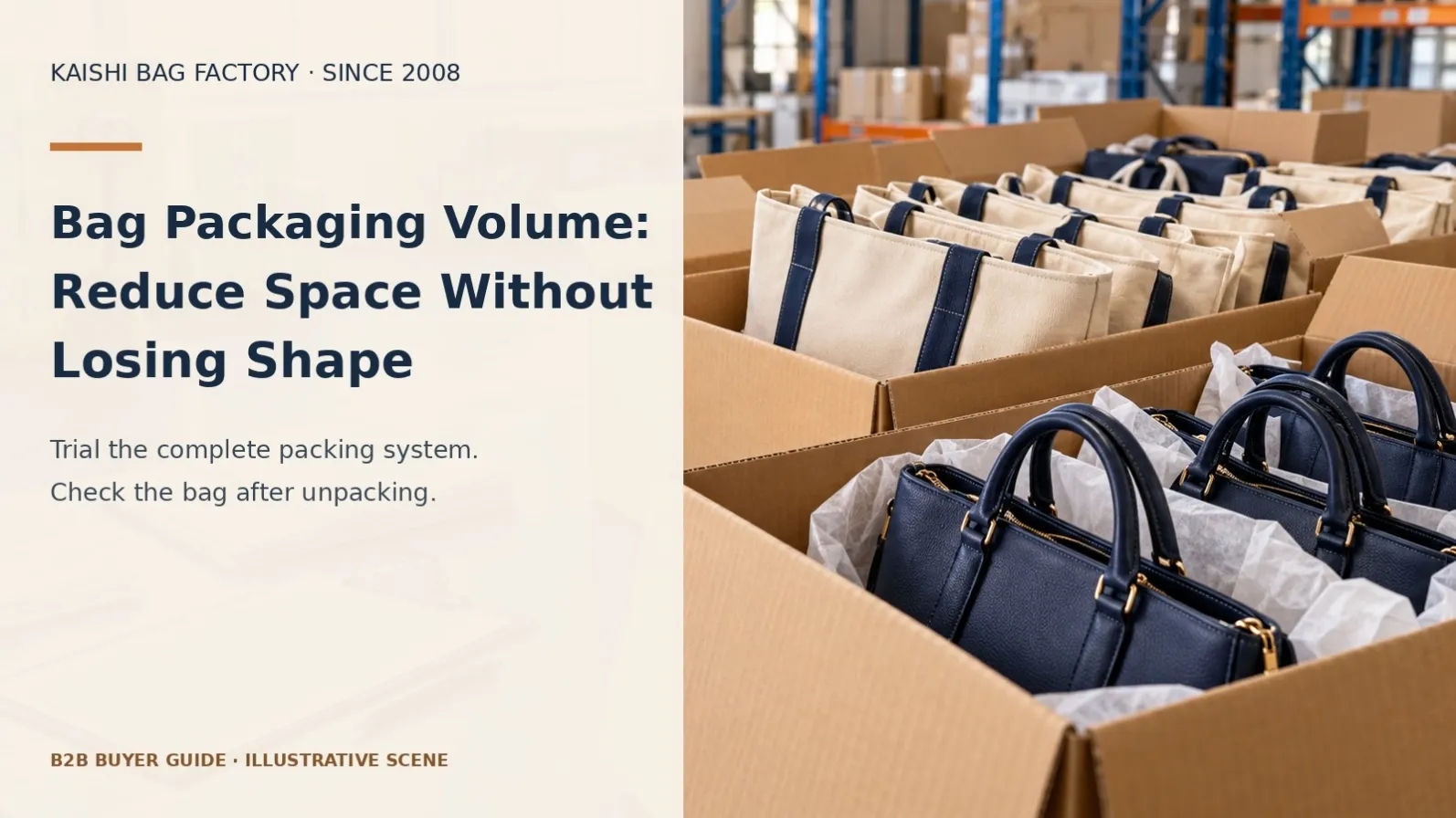
Reduce bag packaging volume by removing unnecessary space while preserving the approved shape, finish and carry components. Measure the packed carton, trial the proposed fold or support arrangement with finished samples, then inspect the bags after unpacking. A smaller carton is useful only if the arrival condition remains acceptable and the carrier’s chargeable-weight calculation supports the saving.
This guide is for OEM buyers, importers and wholesalers comparing bag packing proposals. It addresses physical packing and approval decisions rather than promising a fixed freight reduction. Soft totes and structured handbags need different trials. The shipping route, service, carton strength and product construction must be considered together.
1. Establish the current packing baseline
Record the finished bag dimensions, unit net weight, protective packaging, internal support, units per carton, external carton dimensions and gross weight. Photograph the layout before the carton is closed. Without this baseline, “more compact packaging” is difficult to compare or repeat during bulk packing.
Use the real carton’s outside dimensions after it is filled and closed, including bulges. A proposed empty box size may not describe the shipped package. Record the measurement units and the service used in the freight quotation. If variants require different packing, keep separate records rather than assuming one carton configuration fits the entire assortment.
2. Understand chargeable weight without using a universal divisor
Carriers can use actual weight and dimensional or volumetric weight to determine the chargeable shipment weight. DHL and FedEx publish explanations of these methods. Their applicable rules depend on service and terms; different service pages can use different calculation factors. Confirm the rule used in your actual quotation.
Do not apply one online formula to every courier, airfreight and sea shipment. Ask the forwarder which dimensions, rounding rules, minimums and charges apply. A physical volume reduction may not reduce the final invoice if another weight or minimum controls the charge. Keep product protection separate from an unverified freight-savings percentage.
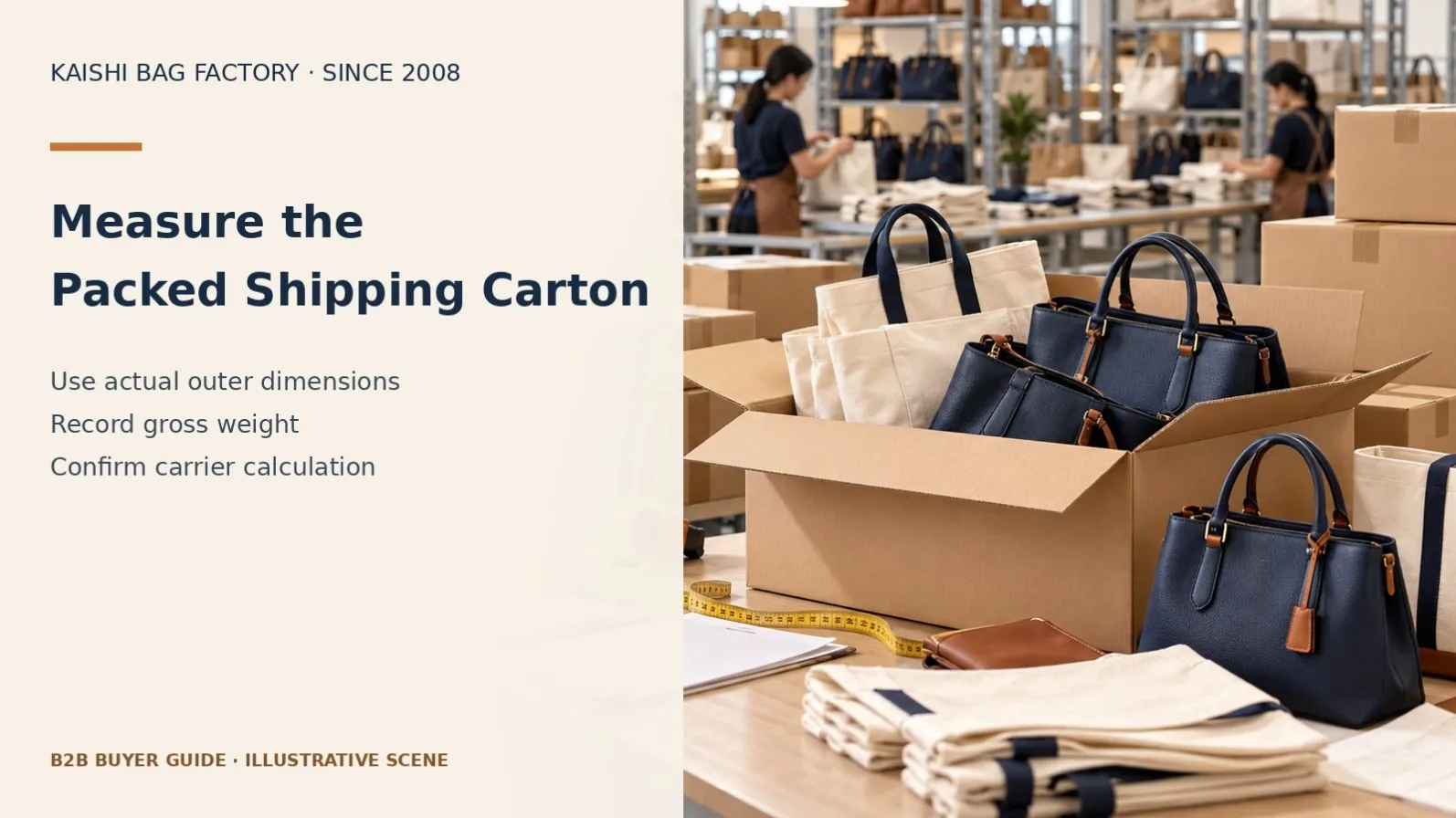
3. Classify the bag before deciding whether to fold it
A soft unreinforced tote may permit an agreed fold, while a structured handbag can have stiff panels, coated surfaces, edge finishing or handle attachments that should not be compressed in the same way. Define prohibited fold lines and components that need protection. Avoid folding over decorative hardware or forcing a zipper mouth into a sharp bend.
Check the actual sample rather than relying on a material category. A coated fabric’s finish or a laminated construction can change its response to pressure. The appropriate fold direction, support and recovery expectations need approval. Do not claim that every leather or PU bag will recover automatically after shipping.
4. Use support where the construction needs it
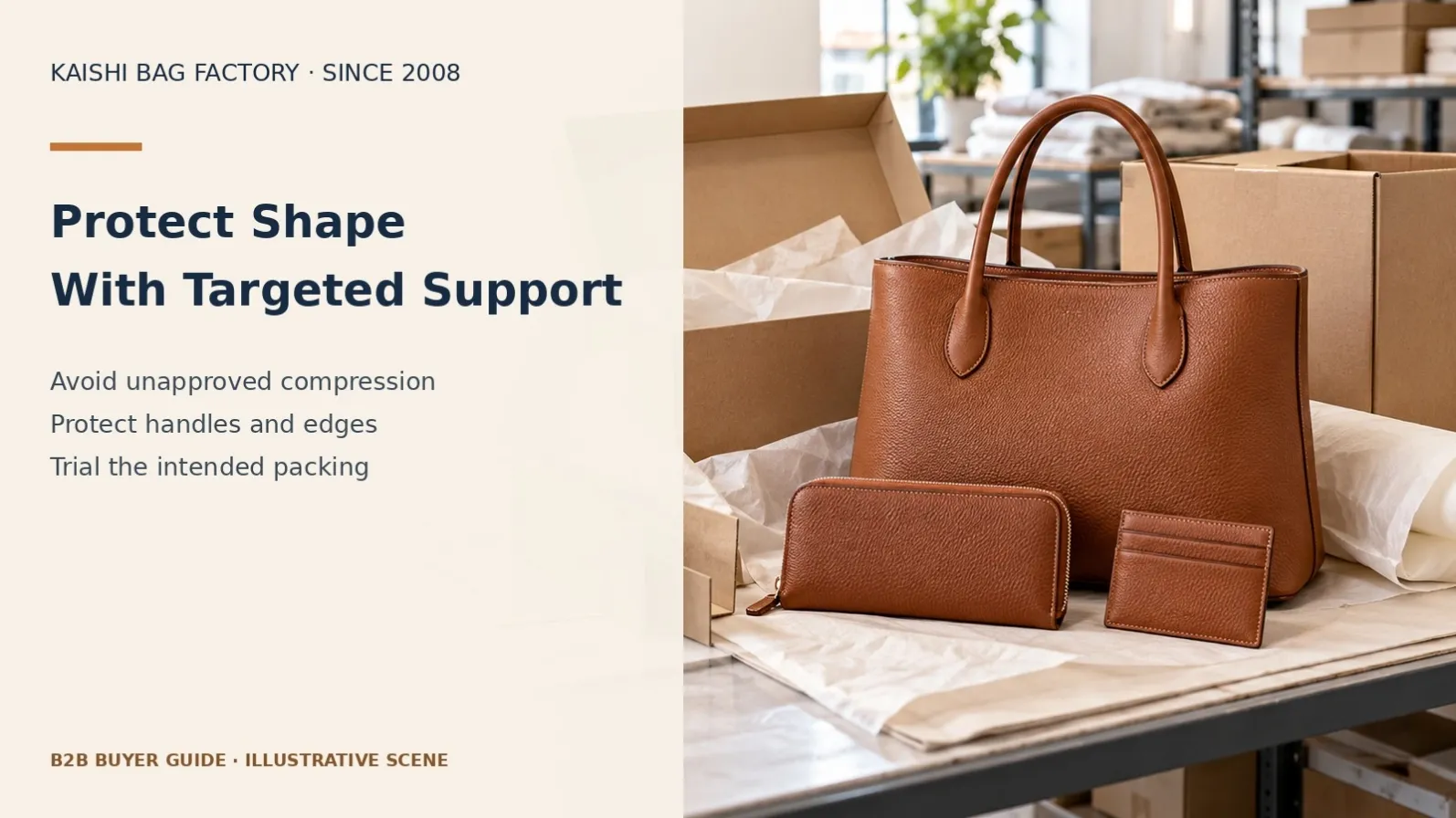
Review internal support, handle positioning, edge protection and separation between units. The purpose is to prevent unwanted movement and distortion, not to fill every cavity by default. Compare options on a packed sample and inspect whether support leaves marks, changes the silhouette or makes unpacking unnecessarily difficult.
Consider how accessories sit against the bag during transport. A buckle, strap clip or removable handle can press into a panel. Protect or reposition such components in the packing trial. Material choices for protective packaging should meet the buyer’s specifications; do not label an option recyclable, biodegradable or environmentally superior without relevant evidence and context.
5. Compare packing configurations using the same evidence
Prepare two or more feasible layouts, with the same finished bag construction and consistent measurements. Record whether the proposed arrangement changes units per carton, gross weight, empty space or unpacking work. More units per box is not automatically better if the box becomes difficult to handle or the product is compressed beyond the approved condition.
A simple packing comparison sheet should include the carton dimensions, unit count, protective materials, fold restrictions and arrival review. Ask for a revised freight quotation using that information. Keep the approved packing revision linked to the purchase order, particularly if the original product quotation assumed a different presentation.
| Record | Why it matters | Review action |
|---|---|---|
| Outer carton dimensions | Input for applicable volume calculation | Measure the filled closed carton |
| Bag orientation and folds | Can affect shape and finish | Approve on the finished construction |
| Internal support | Controls deformation and movement | Inspect for marks after unpacking |
| Units and variant breakdown | Affects handling and receiving | Align with purchase order |
| Arrival condition | Tests the purpose of protection | Record appearance and functional checks |
6. Inspect the bag after a representative packing trial
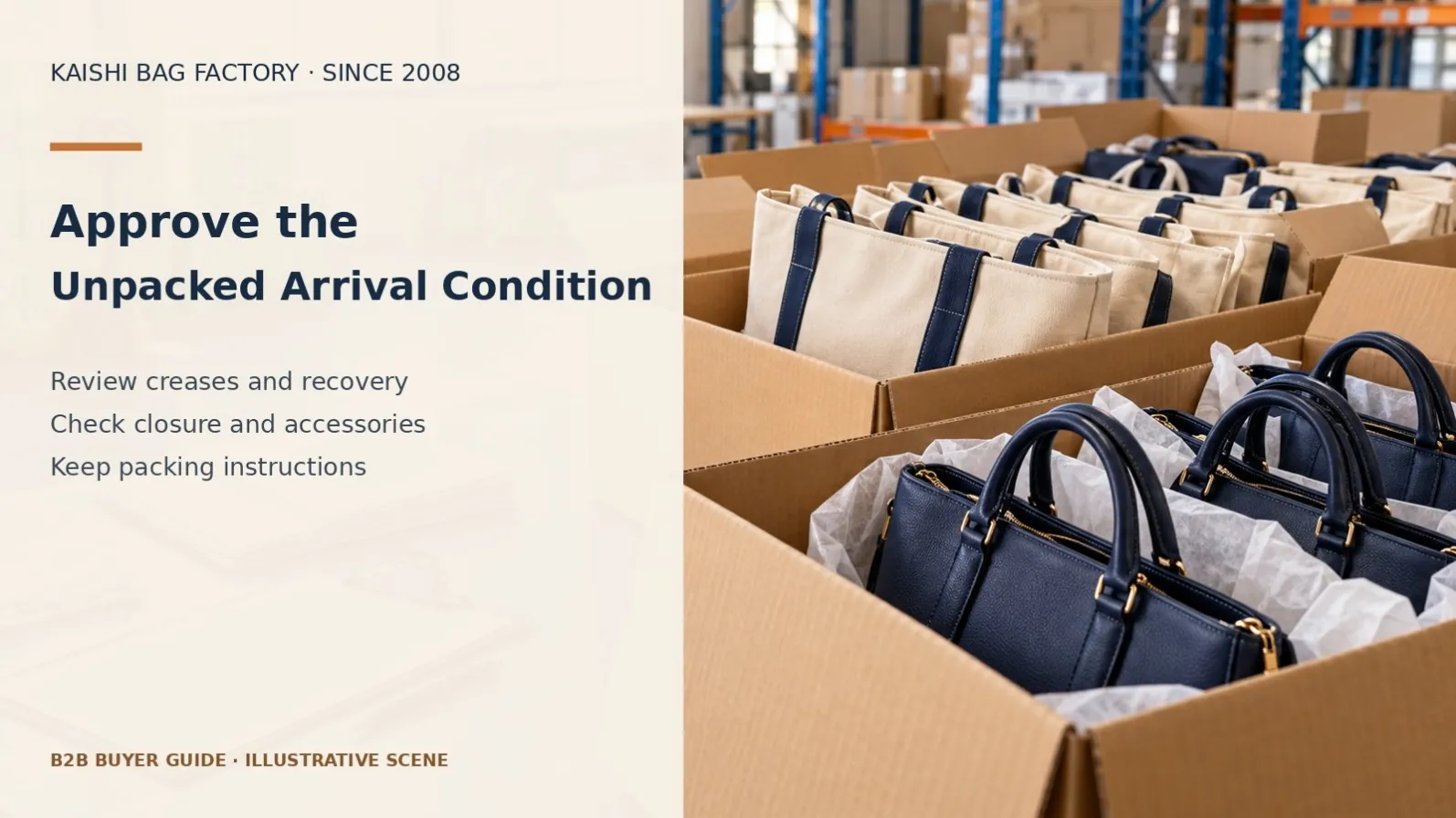
Pack and unpack finished samples using the proposed materials and arrangement. Inspect creases, panel shape, colour transfer, surface marks, closures, handles and hardware. Record the period and conditions of any recovery observation. There is no universal recovery time that can be copied across all constructions.
A bench packing trial does not reproduce every transport hazard. If the risk or buyer programme requires transport testing, consult a suitable packaging laboratory and define a relevant procedure. Use the findings to change the packing design and retest as needed. Do not turn an illustrative packing photograph into a claim that a shipping test was passed.
7. Make the approved packing repeatable in bulk
Issue a packing instruction with photographs, material references, unit orientation, support locations, quantity per carton and carton marks. Specify which bags or variants it covers. Include inspection checks so that the packing team can identify deviations before a shipment is closed.
For importers selling through warehouses or retail channels, check receiving requirements as well: barcode location, style and colour identification, carton segregation and any required assortment breakdown. A packing change can affect handling and inventory accuracy. Obtain confirmation from your own logistics team, and update the packing instruction when the shipment route or bag construction changes.
Related buyer guides
Review the bag importing guide for shipment planning, the quality-control guide for inspection records, and the tech pack checklist for packing inputs.
Frequently asked questions
Can I flatten structured handbags to save freight?
Only evaluate compression with the actual construction and agreed arrival criteria. Do not authorize bulk flattening from a photograph. Trial the proposed packing and review the unpacked bag first.
Does a smaller carton always reduce shipping cost?
No. Chargeable weight, service rules, rounding and minimum charges can affect the result. Request a revised quotation using the actual packed dimensions and gross weight.
Can soft canvas totes be folded?
A fold may be feasible, but decoration, backing and trims still require review. Define the fold locations and inspect the finished sample after packing.
Should all bags use the same amount of stuffing?
No universal quantity is suitable. Support should reflect construction and agreed arrival condition. Extra filling can add space without improving protection.
What should I include in a packing request?
Provide bag dimensions, shape requirements, variants, receiving needs, intended route and any existing packing baseline. Ask for a documented trial rather than an unsupported savings claim.
Can I claim the new packaging is sustainable?
Only use a specific environmental claim with appropriate evidence and market context. A volume reduction alone does not prove that the whole packing system is sustainable.
What are Kaishi’s MOQ and project terms?
Kaishi Bag Factory is based in Baigou, China and has worked in OEM/ODM since 2008. Standard MOQ is usually 300 pieces per style. A 200-piece first order may be reviewed individually, without a guarantee; 100 pieces is usually not feasible. Mixed styles do not automatically share one minimum, and a reorder does not automatically qualify for a lower MOQ. Samples are prepaid and non-refundable, without an automatic credit against bulk orders. Payment is T/T only, usually 50% deposit and 50% before shipment. Development and production timing depends on design, materials, sample approval and quantity. Confirm project terms before committing to a launch date.
Sources and project enquiry
References checked on 6 October 2026: DHL Express weight and dimensions guidance and FedEx dimensional-weight explanation. These sources support general guidance; they are not evidence of a Kaishi certification, supplier relationship or guaranteed project capability.
Contact Kaishi Bag Factory with your bag specification, current carton information, arrival-condition requirements and intended shipping route to discuss a packing trial. Email donna@Kaishibagfactory.com or message Donna on WhatsApp.