
From Runway References to a Manufacturable Handbag Collection
Turn official runway design signals into an original handbag brief with material, colour, construction and sample decisions. Separate facts from development proposals.
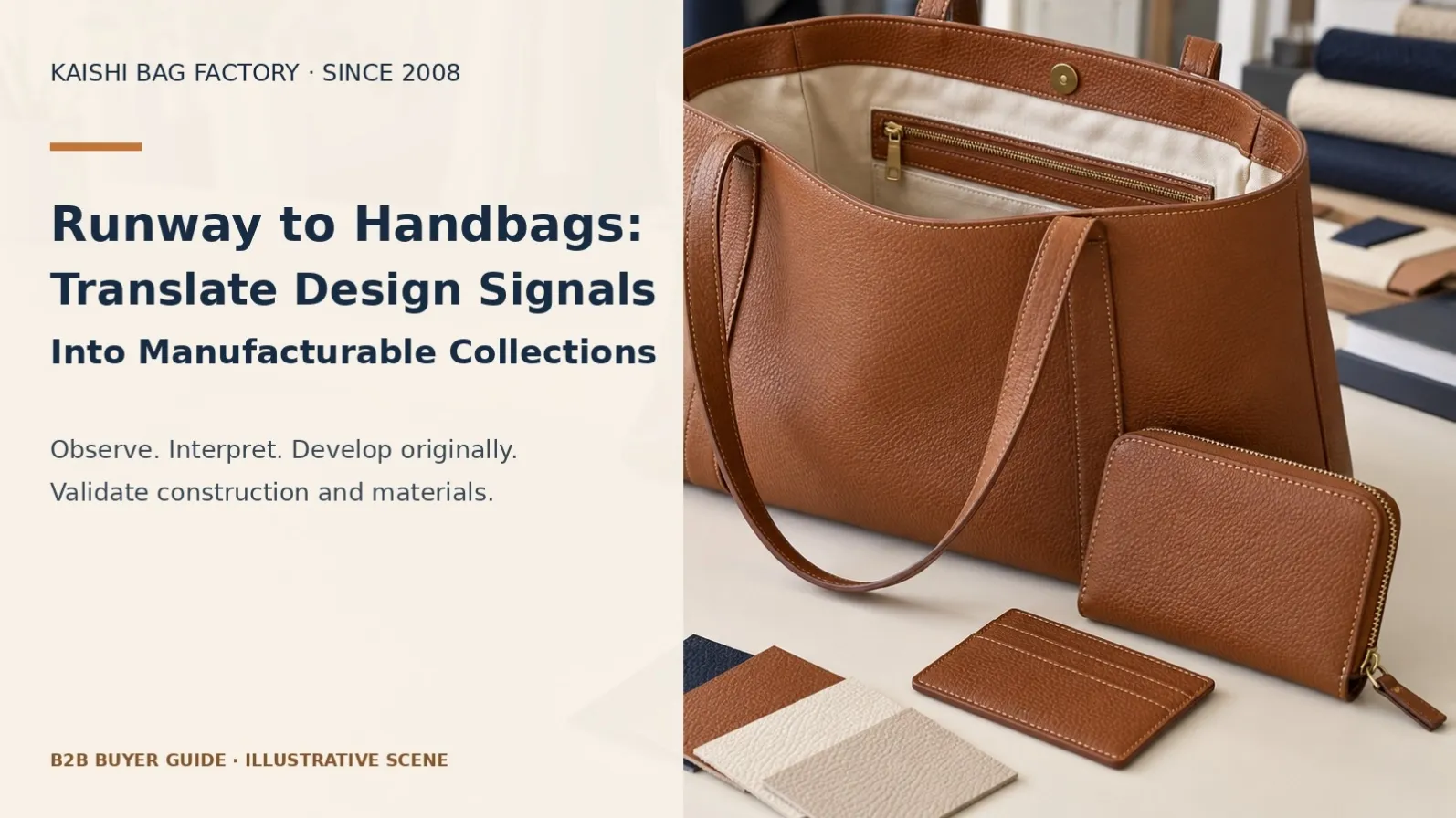
Turn runway references into an original bag collection by separating verified design signals from interpretation, then translating selected ideas into measurable product specifications. Start with the customer’s use case, price position and development constraints. A fashion show can inform proportions, colour relationships or material direction; it does not prove demand for a particular handbag or authorize copying a protected design.
This guide is prepared on 7 October 2026 for an October content plan. Its examples use official Spring/Summer 2027 descriptions available at that date. Recheck new references before publication. The aim is a practical design-to-sampling workflow for OEM brands, importers and wholesale buyers, rather than a claim to predict the whole season.
1. Build an evidence-led reference sheet
Keep each reference’s brand, season, source link and review date. Add a short factual description before writing your own interpretation. Prada’s official Spring/Summer 2027 account examines variation within one garment form and describes functional fastenings used in decorative ways. This is evidence about its collection narrative, not a published forecast for the handbag market.
Miu Miu’s official announcement, dated 4 October 2026, discusses contrasts between everyday dressing and more formal elements, including changes in texture and fastening. Its discussion of colour includes footwear. Do not present that as a verified palette for every bag category. Keep source facts brief and use a separate column for your proposed product application.
2. Translate a signal rather than reproduce a product
A functional closure used as a visible design feature might prompt an original brief for accessible opening, restrained hardware or a contrast puller. It should not become a request to reproduce the same closure layout, silhouette, ornament or brand identifier. Define the problem your own design solves and develop several alternatives before selecting one.
WIPO explains industrial designs as protection relating to a product’s ornamental appearance. Rights and availability vary by jurisdiction and circumstance; removing a logo does not establish permission to copy. Ask for suitable professional advice when a reference is close to an existing design. Keep sketches and development decisions that show your original process without claiming those records guarantee freedom to operate.
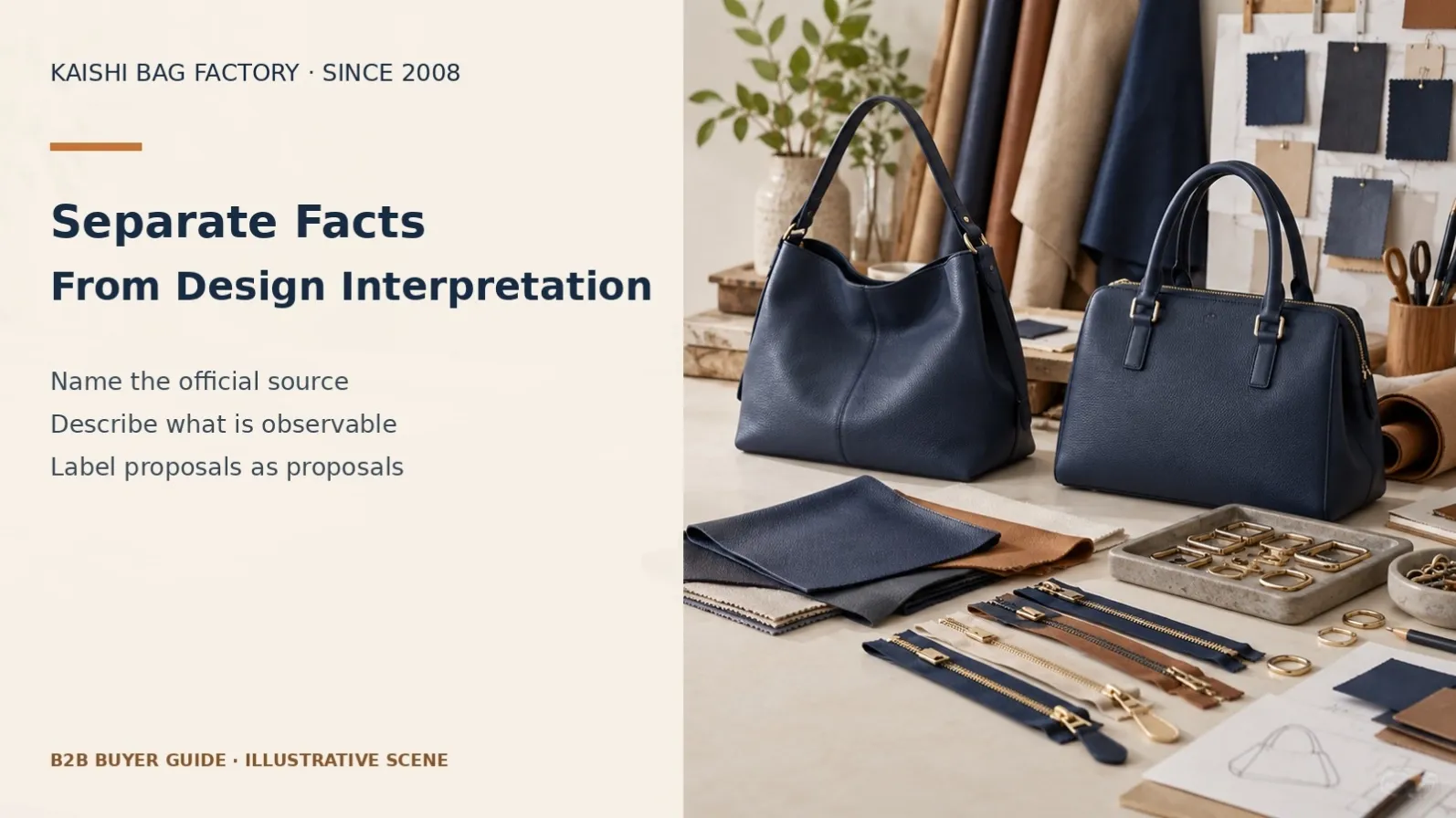
3. Define the buyer scenario before the silhouette
Choose a specific use case: an everyday shoulder bag, compact occasion bag or practical tote, for example. Record essential items, carrying method, access and intended retail context. Explain whether the empty bag should retain its shape or have a relaxed profile. Those decisions influence dimensions, panel construction, reinforcement and opening, regardless of the source mood board.
For wholesale planning, discuss the buyer’s actual store network, customer preferences and previous selling evidence. Do not assume one country has one colour preference or that a runway style will sell well in Nigeria, India, Europe or the United States. Treat market fit as a hypothesis to review with the buyer, supported where available by their own records.
4. Develop colour and texture as physical decisions
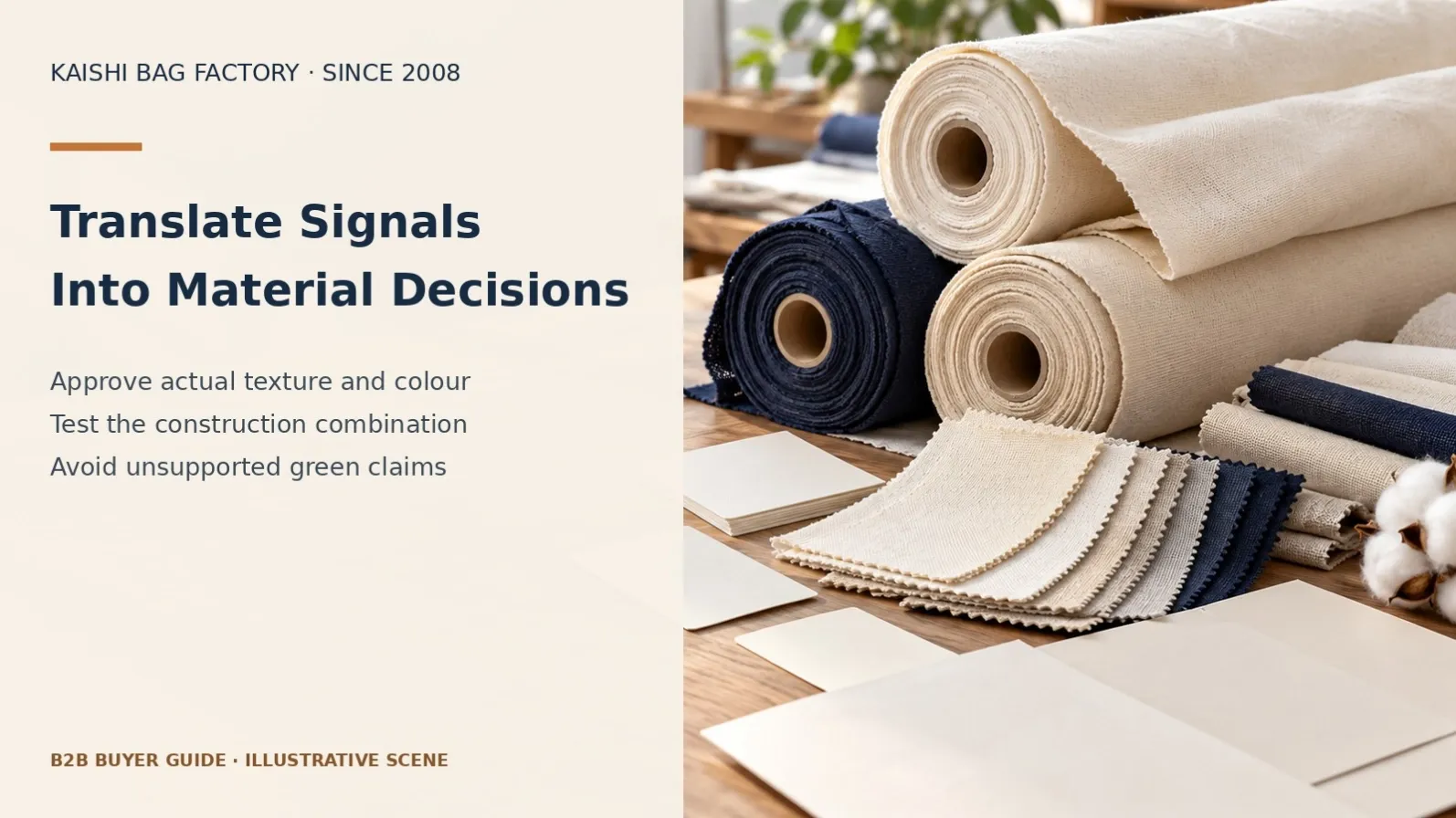
A palette can express a relationship between neutral body colours and a restrained accent without copying a show look. Select an initial direction, then approve actual swatches on the proposed materials. Texture, gloss and finish change how colour appears. A reference photograph can communicate mood but should not become the sole production acceptance standard.
If a runway account discusses distressed or altered surfaces, evaluate whether that direction fits the intended product and care expectations. Ask what the proposed material actually is and what evidence supports relevant performance claims. Do not assume Kaishi stocks a particular experimental finish or branded material. Keep an alternative material route available until availability, cost and sample behaviour are confirmed.
5. Convert the concept into a sampling brief
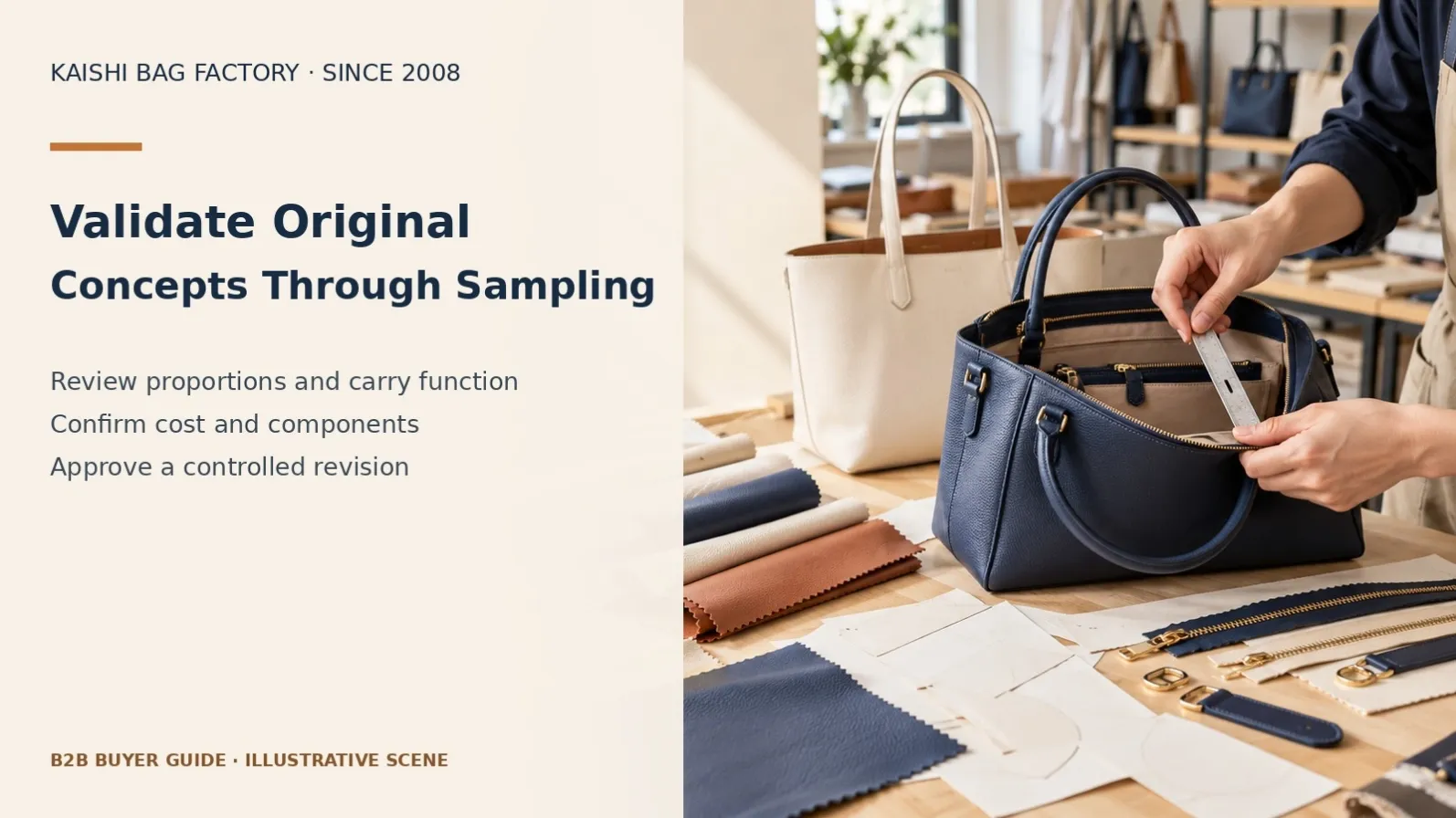
Write dimensions and measurement points, body material, lining, handle drop, strap adjustment, opening, pockets and hardware references. Add the desired empty and loaded appearance. Identify decisions still open and ask the development team to review them. A brief can allow controlled alternatives, but it should specify which features define the design and which can change.
Use a simple decision matrix to connect each inspiration to a development requirement and approval method. Review the bag as a complete assembly: an attractive panel can behave differently after it is lined, reinforced and fitted with a closure. Choose a sample scope that can resolve the most important questions before treating the design as production-ready.
| Reference level | Proposed bag decision | Evidence before approval |
|---|---|---|
| Official collection narrative | Select a design principle, not a replica | Source and dated factual note |
| Buyer interpretation | Original silhouette and functional concept | Independent sketches and use brief |
| Material direction | Specific substrate and finish options | Physical swatch and availability review |
| Colour relationship | Body, trim and hardware coordination | Approved material references |
| Production proposal | Construction and packing specification | Sample, cost review and version sign-off |
6. Review manufacturability and cost trade-offs
Ask how each feature affects pattern work, cutting, seams, reinforcement, finishing and packing. Complex surface treatments, additional pieces or unusual hardware may introduce development work. Obtain project-specific confirmation instead of assigning a fixed surcharge or assuming a minimal-looking bag is simple to produce. Compare alternatives against the same required function and appearance.
If the price position cannot support every proposed feature, reduce complexity deliberately. Preserve the defining proportion or colour relationship while simplifying a secondary element. Recheck the sample after any substitution that affects hand feel, shape or use. Record the decision and revised specification, including any unresolved assumption that still prevents a firm production quotation.
7. Approve the collection before expanding variants
Confirm a representative style and material route before adding a wide colour range. Decide how the styles relate through handles, hardware finishes or lining while retaining a clear purpose for each. A collection should not accumulate near-identical variants merely because the mood board contains many attractive images. Review order feasibility separately for each style and colour allocation.
Finalize the approved sample, technical file and version record. Distinguish visual approval from any required performance or compliance verification. Confirm packaging, quantity and payment conditions before making launch commitments. A forecast remains a forecast even after a sample is approved; the buyer still needs a commercial plan and a way to review actual customer response.
Related buyer guides
Use the bag tech pack quotation checklist to structure your original development brief. Review bag lining choices and the hardware specification guide as separate construction decisions.
Frequently asked questions
Does a runway reference prove a bag will sell?
No. It is a design input, not sales evidence. Evaluate the proposal against the buyer’s channel, use case, budget and actual customer information. Avoid guarantees about demand or season-wide adoption.
Can a factory copy a bag if its logo is removed?
Logo removal does not resolve all possible design or other rights. Develop an original product and seek appropriate advice where a reference is close to an existing protected design. Do not promise unrestricted copying.
How should I describe a trend in an OEM brief?
Identify the source and date, state the observed principle, then write your own proposed application separately. Convert it into dimensions, materials, function and sample acceptance criteria.
Can I use a runway photograph as a colour standard?
Use it for direction, with appropriate rights, rather than as the sole production target. Approve a physical reference on the proposed material and agree how colour will be reviewed.
What if the suggested material is unavailable?
Request a confirmed alternative and review its effect on appearance, construction, care and cost. Do not assume the substitute preserves the original sample result or that every experimental material is commercially available.
Should I develop all styles and colours together?
Start with the most important design decisions and representative samples. Plan breadth and colour depth from your buying brief and production feasibility; more variants do not automatically create a stronger collection.
What are Kaishi’s MOQ and project terms?
Kaishi Bag Factory is based in Baigou, China and has worked in OEM/ODM since 2008. Standard MOQ is usually 300 pieces per style. A 200-piece first order may be reviewed individually, without a guarantee; 100 pieces is usually not feasible. Mixed styles do not automatically share one minimum, and a reorder does not automatically qualify for a lower MOQ. Samples are prepaid and non-refundable, without an automatic credit against bulk orders. Payment is T/T only, usually 50% deposit and 50% before shipment. Development and production timing depends on design, materials, sample approval and quantity. Confirm project terms before committing to a launch date.
Sources and project enquiry
References checked on 7 October 2026: Prada official SS2027 collection; Miu Miu official SS2027 announcement, 4 October 2026; WIPO industrial designs overview. These sources support general guidance; they are not evidence of a Kaishi certification, supplier relationship or guaranteed project capability.
Contact Kaishi Bag Factory with your original sketches, selected reference principles, proposed materials, target quantities and buying context for a project review. Email donna@Kaishibagfactory.com or message Donna on WhatsApp.