
How to Specify a Structured Handbag That Holds Its Shape
Specify a structured handbag with clear shape targets, reinforcement, base support and sample checks. A practical OEM buyer guide with approval criteria.
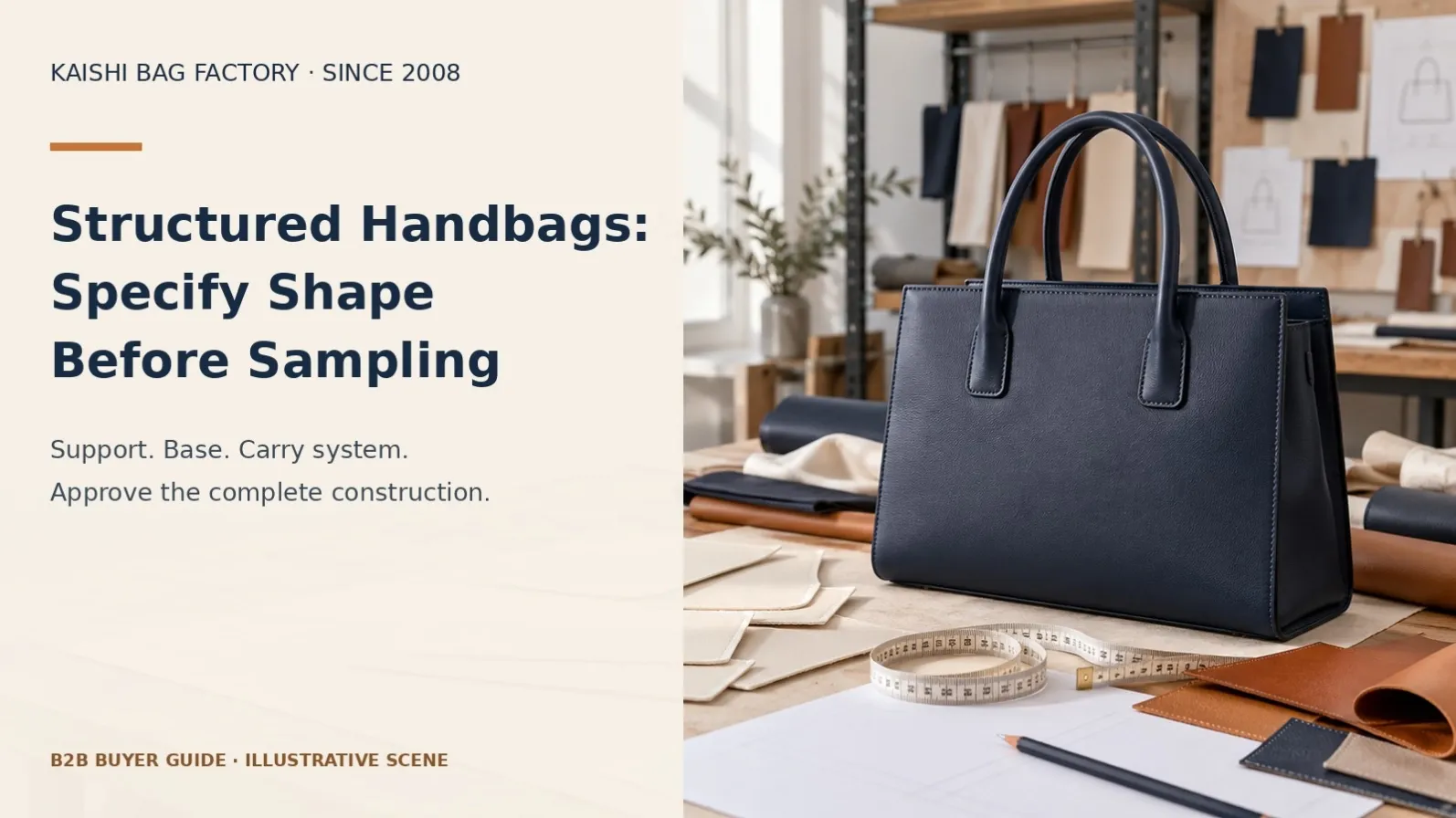
A structured handbag holds its shape through the complete construction, not the outer material alone. Specify the empty silhouette, intended load, reinforcement zones, base support, handle attachments and packing method, then approve a production-intent sample against those requirements. A request for “thicker leather” or “premium PU” does not define the result.
This guide is for OEM brand teams and wholesale buyers developing a boxy everyday handbag, a structured tote or a compact top-handle bag. Its purpose is to turn a visual shape preference into decisions that a factory can review, price and verify. It does not prescribe a universal thickness or guarantee that a photograph can be reproduced with any material.
Quick specification checklist
- Describe how the bag should look empty, loaded and after unpacking.
- Define measurements, intended contents and acceptable flexibility.
- Identify support separately for body panels, base, opening and handle anchors.
- Approve the actual outer material, lining and reinforcement combination.
- Record sample checks and packing instructions in one controlled revision.
1. Define what “holds its shape” means
Start with a functional description. Does the bag need to stand on a flat surface when empty? Should the top opening stay straight with the zipper open? Is a slight inward curve acceptable, or must the side panels remain upright? These are different development targets. Mark the relevant views on an original drawing rather than relying on a styled product photograph.
State the contents you expect the bag to carry, including their approximate total mass and arrangement. A laptop, water bottle and small accessories create a different load from light personal essentials. Agree a review procedure with the factory. The intended load is a development input, not a published capacity claim until appropriate evidence supports it.
2. Review outer material and support as a system
Leather, coated fabric and woven fabric can each be used in structured constructions, but their behaviour depends on the actual specification. Record the material reference, finish, backing, thickness where relevant and physical swatch. A material that looks stiff in a small swatch may behave differently across a large panel. More thickness can also change seam handling, weight and edge appearance.
Freudenberg describes woven, nonwoven and weft reinforcement solutions for leather goods, including support for panels and smaller components. This establishes that internal support is a separate design variable; it does not establish that one branded reinforcement is included in a Kaishi quotation. Ask the factory to explain its proposed support arrangement and validate the combination through a sample.
3. Locate reinforcement instead of stiffening everything
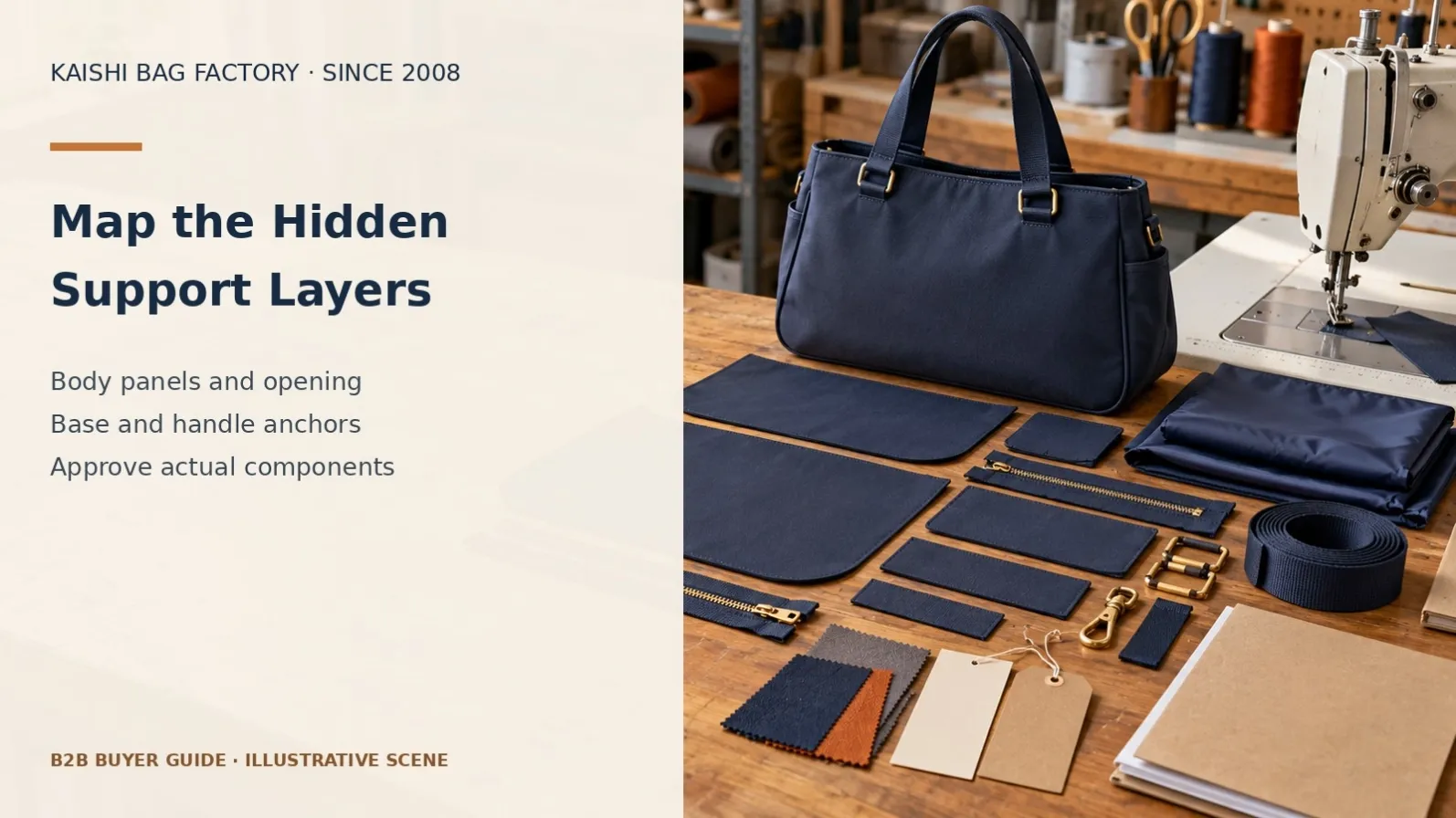
Map the areas that need support: front and back panels, gussets, pocket openings, zipper mouth, handles and strap anchors. A uniformly rigid bag may feel heavy or resist normal opening. Conversely, unsupported high-stress zones can distort even when the body looks firm. The objective is appropriate support in the right location.
Request a component list or annotated construction drawing showing which layers sit behind each area. Discuss how their edges finish and how they join neighbouring seams. An abrupt change in stiffness can become visible through a thin outer layer. Review the finished appearance under normal lighting and handling rather than approving an unseen reinforcement name alone.
4. Specify the base and how it connects to the body
The base influences standing stability and loaded shape. Define whether its support is permanent or removable, how it is enclosed and whether the interior should remain easy to clean. A removable insert needs an agreed fit and edge treatment; a fixed base needs a construction that does not create uncomfortable hard edges.
Inspect the junction between the base and gussets. Check for rocking on a level surface, unwanted bulging and concentrated marks after loading. Metal feet, if requested, are an additional component rather than a substitute for base design. Specify their position, attachment and backing. Do not assume a bag with feet will stay upright in every loading arrangement.
5. Check handles, straps and the top opening
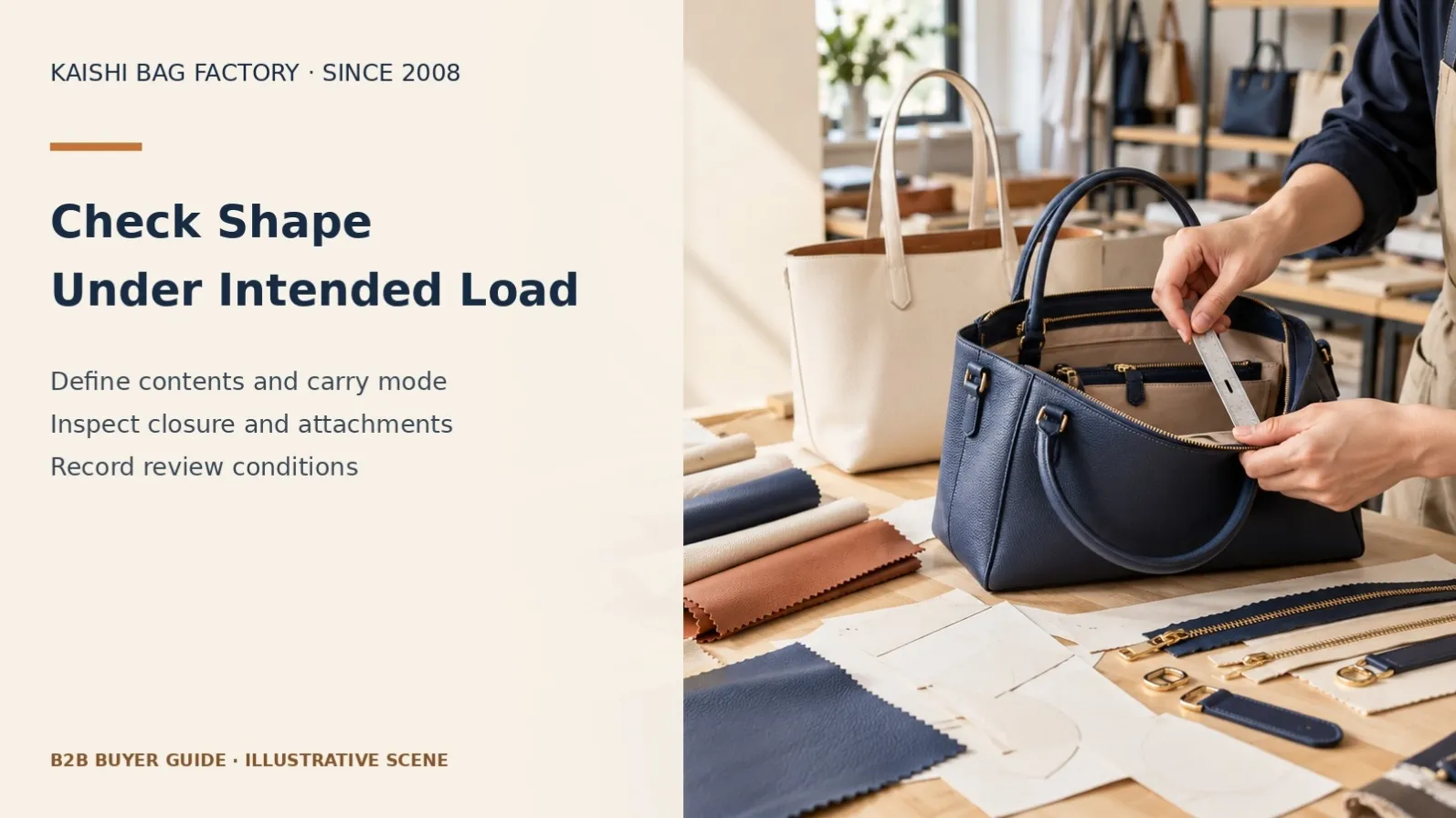
Handles transfer load into the body. Their attachment needs review alongside panel support, seam construction and hardware. Describe the carry mode: hand-held, elbow carry or shoulder use. Verify clearance with the finished sample and check whether the handle pulls the mouth out of alignment when loaded.
SATRA TM241 is a published method for evaluating luggage handles and attachments under static loading. It illustrates the value of a defined procedure rather than an informal tug. Ask a suitable laboratory which method and conditions are appropriate for your handbag. Do not copy a laboratory maximum into a product rating or claim that an untested sample passes a named standard.
Buyer approval matrix
| Area | Define before sampling | Record at approval |
|---|---|---|
| Empty silhouette | Standing, mouth line and acceptable flexibility | Front, side and base views without stuffing |
| Loaded shape | Contents, arrangement and agreed review conditions | Deformation and recovery observations |
| Support layers | Zones, references and assembly approach | Approved construction and exceptions |
| Carry system | Handle clearance and attachment requirements | Functional checks and any test report scope |
| Arrival condition | Support, fold restrictions and carton arrangement | Unpacking review using proposed packing |
6. Approve shape after realistic handling and packing
Review the sample empty before adding tissue for photography. Then load it according to the agreed procedure, operate the closure and inspect the base, mouth and handle anchors. Document the conditions and the result. Avoid vague feedback such as “make it better”; identify the affected zone and the behaviour you want changed.
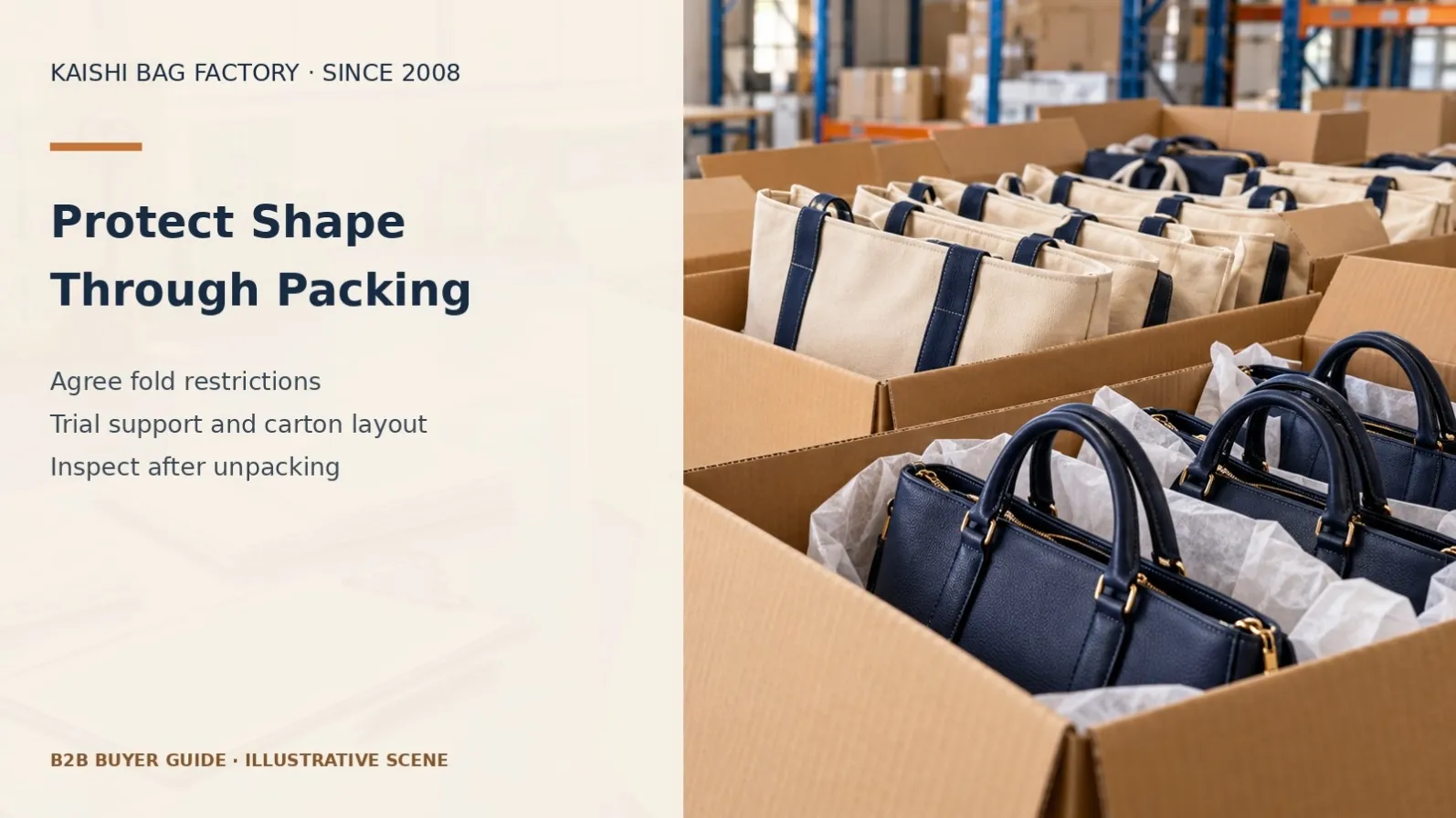
Shape must also survive the proposed packing arrangement. Do not approve a display sample and separately authorize a compressed shipment without checking their relationship. Trial the intended stuffing, protective bag and carton layout. Inspect the bag after unpacking and record any recovery period used in the review. There is no universal recovery time that applies to every construction.
7. Keep the approved version linked to the quote
A change in reinforcement, base construction or handle attachment can affect material use, labour, weight and packing volume. Request a revised quotation when the specification changes. The quote should state what sample and component references it covers. Keep photographs as supporting evidence, with the written construction requirements as the controlling record.
For your enquiry, use our bag tech pack checklist. Review the bag lining guide and hardware specification guide when defining interior layers and carry components. These connected guides address component decisions rather than replacing shape validation.
Frequently asked questions
Can a PU handbag stand upright when empty?
It can be designed for that goal, but the actual outer material, support layers, base and proportions must be assessed together. Approve the empty sample rather than assuming that a PU description guarantees a structured result.
Is thicker material always better for structure?
No. Thickness alone does not establish stiffness, recovery or a suitable construction. It can also increase weight and change finishing. Ask for a proposed material and reinforcement combination that meets the intended use.
Should every panel use the same reinforcement?
Not necessarily. Body panels, openings and handle anchors have different functions. The appropriate support arrangement should be explained in the construction specification and confirmed through sampling.
Can packaging flatten a structured bag?
Compression or inappropriate folding can affect shape. Review the proposed packing with a finished sample and define any fold restrictions, internal support and acceptable unpacked appearance before bulk shipment.
What measurements should my drawing include?
Include width, height, depth, opening dimensions, handle clearance and relevant pocket positions, with measurement points. Add empty and loaded shape requirements so dimensions do not become the only approval criteria.
What are Kaishi’s ordering conditions?
Kaishi is based in Baigou, China and has worked in OEM/ODM since 2008. Standard MOQ is usually 300 pieces per style; a 200-piece first order is assessed individually and not guaranteed. A 100-piece order is usually not feasible. Mixed styles do not automatically share one minimum.
Are samples free and delivery times fixed?
No. Samples are prepaid and non-refundable, without an automatic fee credit. Bulk payment is T/T only, usually 50% deposit and 50% before shipment. Timing depends on design, materials, sample confirmation and quantity; project conditions must be confirmed.
Sources and next step
Technical references checked on 6 October 2026: Freudenberg reinforcement materials for leather goods and SATRA TM241 handle strength method. These support general construction and verification principles, not a claim that Kaishi uses a specific supplier or holds a named certification.
Contact Kaishi Bag Factory with your original drawing, dimensions, intended contents, shape targets and proposed quantities. Email donna@Kaishibagfactory.com or message Donna on WhatsApp for a project review.